How to Prevent Polishing Defects in Stainless Steel Cutlery Manufacturing

How to Prevent Polishing Defects in Stainless Steel Cutlery Manufacturing
Polishing plays an important role in the final appearance of stainless steel cutlery. A well-finished spoon, fork, or knife should meet the agreed surface requirements and feel appropriate for its intended use. However, polishing defects can reduce visual consistency, create additional rework, and delay bulk orders if they are discovered only during final inspection.
For importers, wholesalers, retailers, and private-label brands, understanding how polishing quality is controlled helps make supplier discussions more productive. The objective is not simply to achieve a bright surface, but to establish a repeatable process that produces cutlery matching the approved specification.
1. Identify the Defects That Matter Most
Polishing defects can appear in different forms depending on the product shape, surface finish, and production method. Common examples include visible scratches, uneven brightness, cloudy areas, excessive material removal, and inconsistent polishing marks.
Some defects are mainly cosmetic, while others may affect dimensions, edges, or the usability of the product. For example, a rough area near a handle transition may require a different response from a minor visual variation on a less prominent surface.
Buyers and manufacturers should agree on defect descriptions and acceptance criteria before production begins. General requests such as “mirror finish” or “smooth polishing” should be supported by an approved sample and clear visual standards.
The required finish may also differ across product categories. A premium gift collection may require stricter appearance controls than a value-focused wholesale range, so acceptance criteria should reflect the intended market.
2. Consider Product Geometry Before Choosing a Polishing Process
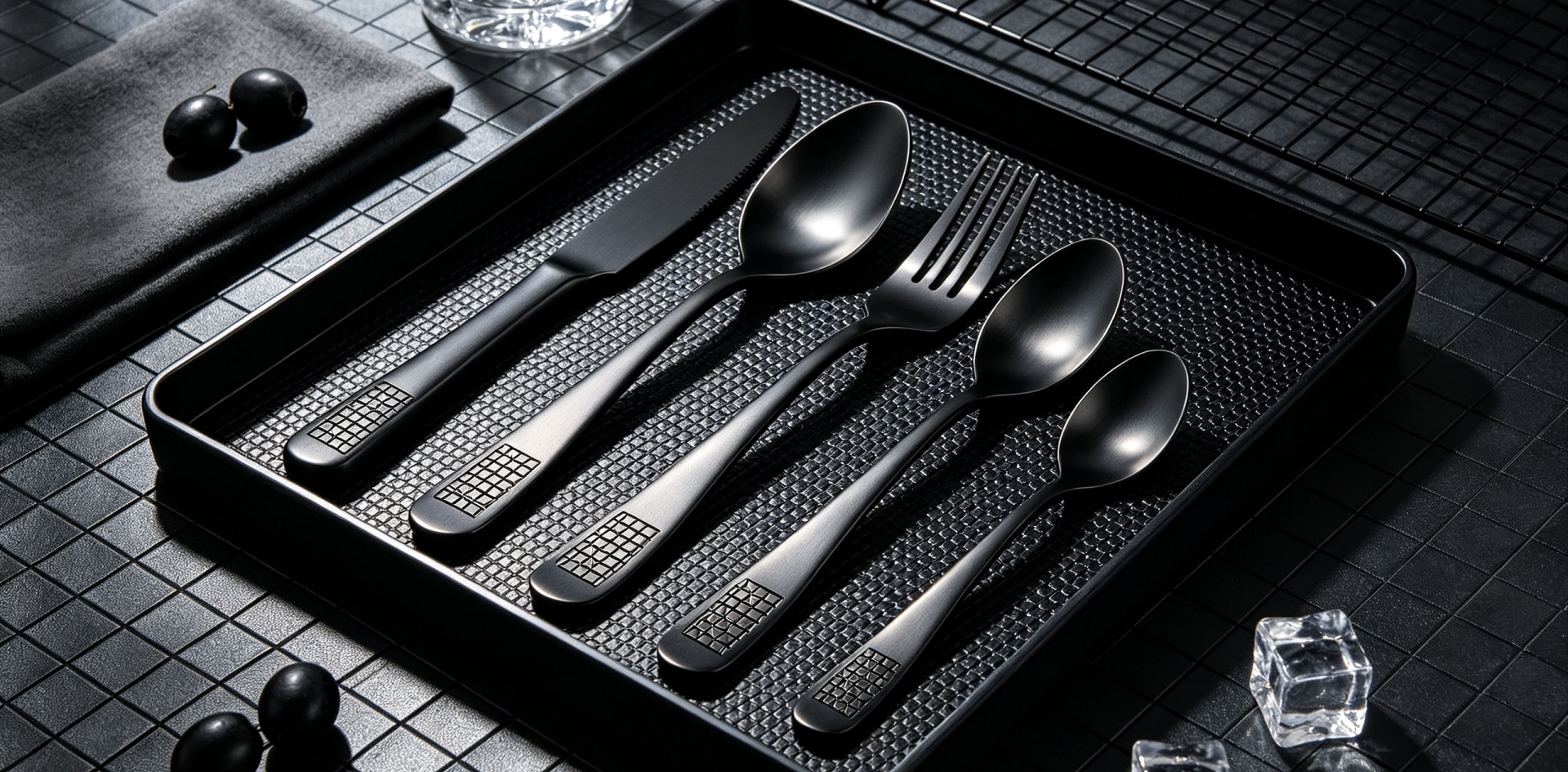
Spoons, forks, and knives have different shapes, and these shapes influence how easily their surfaces can be polished consistently. A spoon bowl has a curved surface, while fork tines contain narrow spaces and the handle may include grooves or decorative patterns.
Areas that are difficult to access can retain uneven polishing marks or show differences in surface appearance. If the process is designed only around broad, flat areas, detailed sections may receive insufficient attention.
During product development, the factory should assess whether the proposed design can be finished consistently using the intended production process. Deep grooves, sharp transitions, and complex decorative details may require additional process planning.
For customized stainless steel cutlery, evaluating manufacturability before mass production can help prevent avoidable surface defects and reduce the need for repeated finishing adjustments.
3. Maintain Polishing Equipment and Process Settings
Polishing consistency depends partly on the condition of the tools and the stability of the process. Worn polishing materials, inconsistent pressure, unsuitable settings, or poor equipment maintenance may contribute to uneven results.
Factories should establish appropriate operating procedures for each product family. Settings suitable for a broad spoon bowl may not be appropriate for a narrow fork neck or a knife handle with a different profile.
Equipment checks and routine maintenance help identify changes before they affect large quantities. Operators should also follow documented procedures when replacing polishing materials or adjusting settings.
When a defect appears repeatedly in the same location, the investigation should examine the process rather than relying only on final sorting. Identifying the cause early can reduce rework and improve consistency across the production batch.
4. Control Surface Preparation Before Final Polishing
The final polishing stage cannot always compensate for problems introduced earlier in manufacturing. Surface marks, forming irregularities, or handling damage may remain visible if they are not addressed appropriately before the finishing stage.
A controlled process should include checks at relevant stages so that unsuitable pieces are identified before additional work is invested in them. This is particularly useful for products with demanding visual requirements or complex surface shapes.
The factory should distinguish between defects that can be corrected through an approved finishing operation and defects that require another disposition. Excessive polishing to remove a deep mark may alter the product's dimensions or shape.
A consistent process helps avoid the situation in which operators continue removing material from a piece simply to improve its appearance, potentially creating a different quality problem.
5. Prevent Scratches During Handling and Transfer
A polished surface can be damaged after finishing if cutlery pieces rub against one another or contact unsuitable work surfaces. Scratches may occur during transfer between production stages, temporary storage, inspection, or packing.
Handling procedures should therefore consider how finished pieces are placed, separated, and moved. Suitable trays, organized workstations, and appropriate protective materials can reduce unnecessary contact.
Staff should also understand that polished surfaces may show marks more readily than some other finishes. Careful handling is especially important when products are grouped together before being placed into retail packaging.
If scratches are repeatedly found at the same stage, the factory should investigate that transfer point. Correcting the handling method is generally more effective than relying on additional polishing after the damage occurs.
6. Establish a Practical Inspection Method
Polishing quality should be checked under consistent conditions. Lighting, viewing distance, inspection angle, and surface cleanliness can all influence what an inspector sees.
Before assessment, products should be clean and dry so that residue or water spots are not mistaken for permanent defects. Inspectors should compare the products with the approved sample and the agreed defect criteria.
For coordinated cutlery sets, representative spoons, forks, and knives should be reviewed together. This helps reveal differences in brightness or texture that may be less noticeable when each item is examined separately.
The inspection plan should also define how many pieces are checked, how samples are selected, and how nonconforming products are handled. Where a formal sampling plan is used, the parties should agree on the applicable criteria before the order is produced.
7. Investigate Defects and Verify Corrective Actions
When polishing defects are discovered, the factory should record the product model, production batch, defect type, and location. Photographs can help communicate findings between the buyer and supplier, especially when the parties are working in different countries.
The investigation should consider possible causes such as tool condition, process settings, surface preparation, handling, and storage. Corrective action should address the source of the defect rather than only removing visibly affected pieces.
After a process adjustment, the factory should verify the result using representative samples. If the change affects the finish or dimensions, those characteristics should also be checked before production continues.
A documented corrective-action process helps prevent the same problem from recurring in later batches or repeat orders.
8. What B2B Buyers Should Confirm Before Production
Before approving a bulk stainless steel cutlery order, buyers should confirm the finish description, approved reference sample, defect classification, inspection conditions, and acceptance criteria. They should also clarify how polishing defects will be documented and what happens if the production lot does not meet the agreed standard.
For OEM and private-label projects, these requirements should be communicated before manufacturing starts. Clear specifications make it easier for the factory to plan the finishing process and for the buyer to evaluate the result consistently.
Homefelt supports stainless steel cutlery customization, OEM/ODM projects, wholesale production, and coordination of product design, packaging, and transportation. Buyers can share their preferred finish, reference samples, product drawings, and order quantities for review.
For more information or a quotation for stainless steel spoons, forks, knives, and flatware sets, contact ingrid@homefelt.net or visit //www.huabao-homecollection.com/.
You May Be Interested In
How to Select Test Samples for Stainless Steel Cutlery Food Contact Testing
How to Ensure Component Compatibility in Stainless Steel Cutlery Sets
Related Article