
Stainless Steel Cutlery Burr Height Control for OEM and Bulk Manufacturing
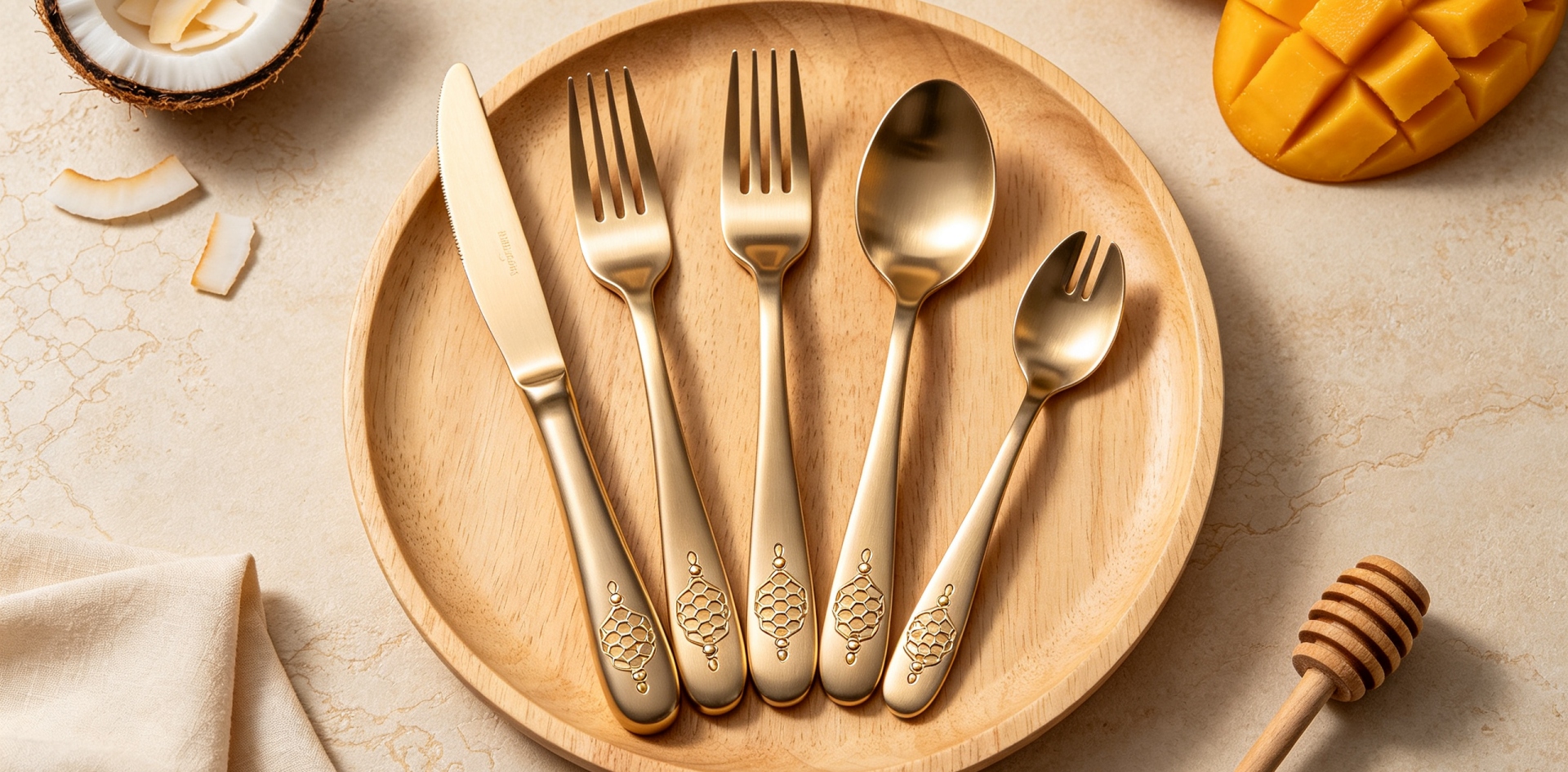
Stainless Steel Cutlery Burr Height Control for OEM and Bulk Manufacturing
When stainless steel cutlery is stamped, cut, formed and finished, the edges need to be carefully controlled before the products are ready for commercial use. One small manufacturing detail that can affect the final result is burr height.
A burr is a small raised or sharp material remnant that can occur around a cut, stamped or processed edge. Although it may be very small, uncontrolled burrs can affect handling, finishing quality and the overall perception of a stainless steel knife, fork or spoon.
For OEM, ODM and private-label projects, burr height can therefore be treated as a specific production-control point rather than simply relying on a general visual inspection.
Homefelt factory manufactures stainless steel cutlery for wholesale and bulk buyers, including custom knives, forks, spoons and flatware sets. Product development, manufacturing, packaging and transportation can be coordinated through a one-stop service according to each customer's requirements.
What Is Burr Height in Stainless Steel Cutlery?
Burr height refers to the height of a raised material edge remaining after a cutting, stamping or machining operation.
The location and size of a burr depend on the manufacturing process and the product geometry. On stainless steel cutlery, potential areas can include:
-
Blank cut edges
-
Stamped contours
-
Fork tine edges
-
Openings or cut details
-
Handle components
-
Component connection areas
-
Other processed edges
Burr height is different from overall edge smoothness or surface roughness. A product can have a generally smooth surface while still requiring specific control of a localized raised edge.
For B2B production, defining the relevant inspection area makes the requirement clearer.
Why Burr Control Matters for Cutlery
Knives, forks and spoons are handled directly by consumers and commercial users. Their edges therefore need to be processed appropriately for the intended application.
Uncontrolled burrs can create several potential problems:
-
Uncomfortable handling
-
Inconsistent edge appearance
-
Difficulty during polishing
-
Reduced finishing consistency
-
Increased variation between production batches
For commercial buyers, these details matter because a small defect repeated across thousands of pieces can become a significant quality issue.
A clear burr-control requirement gives the factory a practical reference for production and inspection.
Where Burrs Can Occur
Different cutlery products create different opportunities for burr formation.
A fork, for example, contains multiple tine edges and narrow spaces that require careful processing. A spoon may have a perimeter created through blanking before forming. A knife can contain several processed contours around the blade and handle.
The production team therefore needs to consider the geometry of each individual SKU.
Typical control points may include:
-
Edge location
-
Burr height
-
Burr direction
-
Process condition
-
Finishing method
-
Accessibility for polishing
-
Final appearance
The inspection standard can be adjusted according to the actual product design.
How Material and Thickness Affect Burr Formation
Stainless steel grade and material thickness influence how sheet material behaves during cutting and forming.
A production process that works well for one material specification may require different settings for another. Tool condition, cutting clearance and processing parameters can also influence the quality of the resulting edge.
For this reason, burr control should be considered together with the actual material specification.
A technical product file may include:
-
Stainless steel grade
-
Material thickness
-
Blank dimensions
-
Cutting method
-
Edge-processing requirements
-
Finishing method
-
Inspection standard
This creates a more complete manufacturing reference.
Burr Height and Tooling Condition
Tool condition is another important factor in edge quality.
As production tools are used repeatedly, their cutting performance can change. If the tooling condition is not properly monitored, edge quality may gradually become less consistent.
For high-volume stainless steel cutlery production, maintaining appropriate tooling and process conditions helps reduce unnecessary variation.
Homefelt factory can evaluate the product design and production process during OEM development to determine which areas require closer monitoring.
The objective is not simply to remove every visible irregularity through additional processing. It is to establish a stable manufacturing process that produces the required edge condition efficiently.
Finishing After Cutting and Forming
After the initial blanking or forming stage, cutlery may go through additional grinding, polishing or other finishing operations.
These processes can reduce or remove unwanted material remnants, but the finishing method needs to be compatible with the product geometry.
For example, narrow fork areas can be more difficult to process consistently than a broad, accessible surface. Decorative handles or complex contours may also require additional attention.
Therefore, burr control can influence how the entire finishing process is planned.
Maintaining Consistency in Bulk Production
For a single sample, a buyer can inspect the product manually. For a large order, however, consistent production controls become essential.
A bulk inspection program can define representative points and acceptance requirements for the relevant edges.
Depending on the product, checks may include:
-
Burr height
-
Edge condition
-
Visible material remnants
-
Surface finish
-
Process consistency
-
Appearance after polishing
-
Comparison with the approved sample
The exact acceptance limits should be established according to the product design, application and customer's quality requirements.
This approach helps turn an otherwise subjective edge-quality issue into a clearer production specification.
OEM Sample Development
Burr requirements are particularly useful during custom product development.
When a customer provides a new drawing or reference sample, Homefelt can review the product geometry and identify areas where cutting, stamping and finishing may require additional control.
During sample development, the factory can assess:
-
Material specification
-
Product thickness
-
Blank geometry
-
Edge processing
-
Forming sequence
-
Finishing requirements
-
Final appearance
This gives the buyer an opportunity to confirm the finished product before approving bulk production.
Experience in Large-Volume Cutlery Production
In large B2B projects, product quality is often determined by many small manufacturing details rather than one single specification.
A buyer may require a particular stainless steel grade, product thickness, surface finish and packaging configuration. At the same time, localized edge conditions need to remain consistent across the order.
Homefelt's experience in stainless steel cutlery manufacturing supports this type of detailed production management.
The factory can work from customer drawings, samples or product concepts and translate them into practical manufacturing requirements for knives, forks, spoons and complete flatware collections.
Quality, Certification and Testing Information
For commercial buyers, manufacturing capability should be supported by appropriate quality documentation.
Homefelt has passed BSCI, SEDEX 4P, BRC and ISO9001 audits or certifications, as well as Disney audit requirements. FAMA and FSC certificates are also available for applicable projects.
Depending on the customer's product and market, relevant inspection records, specifications, material information and testing documentation can be incorporated into the project documentation.
The exact requirements can be discussed according to the customer's purchasing and quality-control system.
OEM, ODM and Private Label Production
Burr control is relevant whether the customer is ordering a standard product with private labeling or developing a completely new cutlery design.
Homefelt supports:
-
OEM stainless steel cutlery
-
ODM product development
-
Private label flatware
-
Wholesale cutlery
-
Bulk knife, fork and spoon production
-
Customized product specifications
-
Customized packaging
For new designs, production requirements can be reviewed before sampling. For repeat orders, the approved specification can serve as a reference for maintaining consistent manufacturing.
One-Stop Service for B2B Cutlery Projects
A reliable cutlery project requires coordination between product design, manufacturing, finishing, inspection, packaging and delivery.
Homefelt can provide one-stop support covering:
-
Product design review
-
Material and specification confirmation
-
Sample development
-
Manufacturing
-
Edge and surface processing
-
Quality inspection
-
OEM and ODM production
-
Private label packaging
-
Bulk order coordination
-
Transportation
This allows buyers to manage their stainless steel cutlery project through one experienced factory partner.
Related Article



