
Stainless Steel Cutlery End Termination: A Detail for Custom B2B Designs
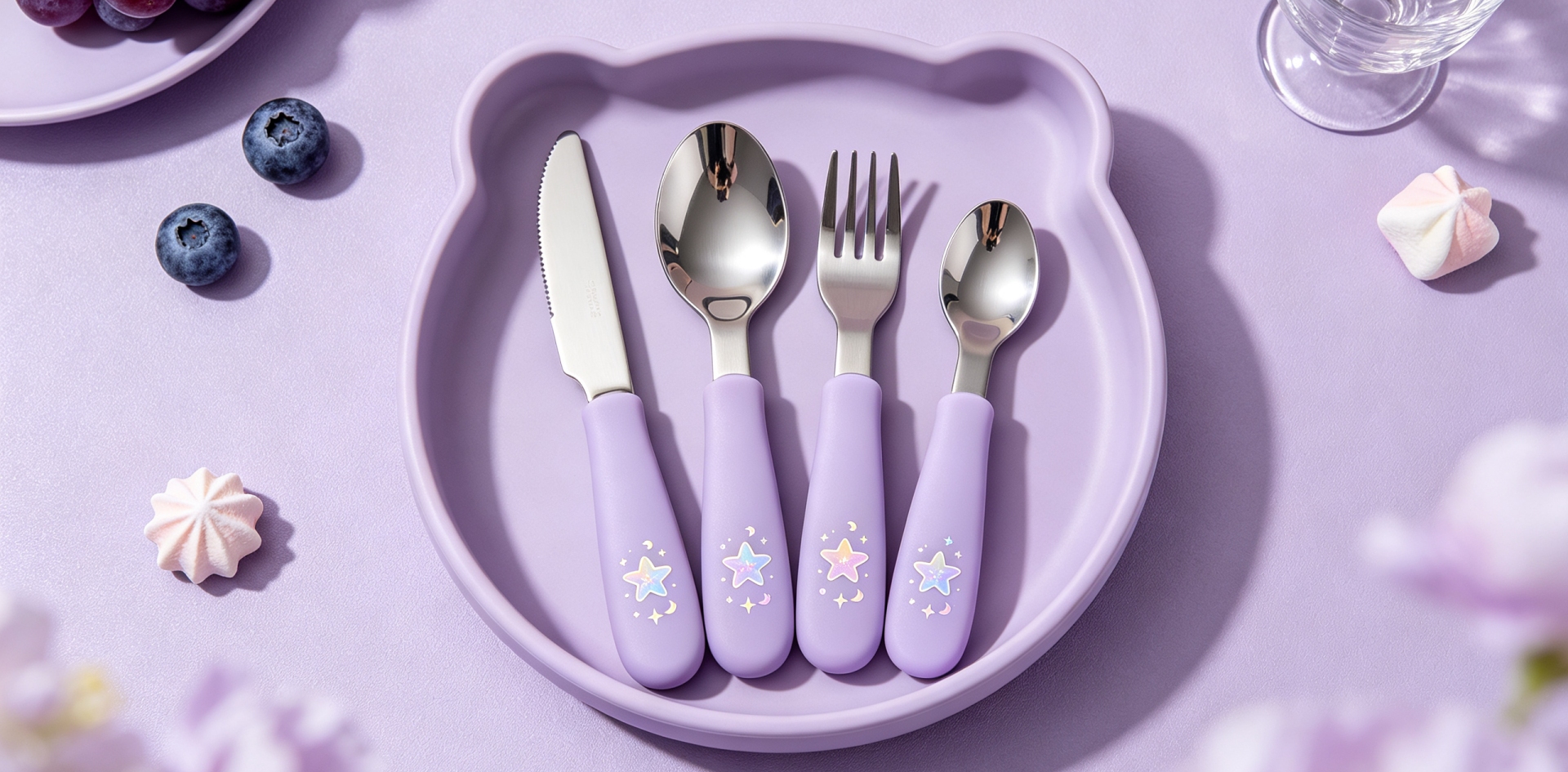
Stainless Steel Cutlery End Termination: A Detail for Custom B2B Designs
When developing stainless steel cutlery for a B2B project, buyers usually begin with the major specifications: material, dimensions, finish, weight, handle shape, and the overall style of the collection. These decisions are essential, but the final appearance of a cutlery piece is also influenced by smaller design details.
One of these details is the end termination of the cutlery.
The end of a knife, fork, or spoon handle may look like a simple finishing point. In reality, it forms an important part of the overall silhouette. The way the handle closes, narrows, rounds, or meets its final edge can influence how the product looks in the hand, on a table, inside packaging, and beside other pieces in the same collection.
For OEM, ODM, and private label projects, this detail is worth defining clearly because it becomes part of the product identity.
What Is the End Termination of Cutlery?
The end termination is the final section of the handle where the cutlery piece reaches its endpoint.
Depending on the design, this area may be rounded, straight, slightly angled, tapered, or shaped with a more distinctive contour. Some designs use a simple and clean ending, while others use the final section as a visual feature.
Although the end is located at the very back of the product, it can have a strong effect on the silhouette.
This is particularly noticeable when cutlery is displayed in a retail package or arranged together as a collection. The eye naturally follows the outer contour of the pieces, and the handle ending becomes part of that visual line.
For a standard product, the manufacturer already has this design established. For a custom B2B project, however, the buyer may need to specify exactly how this area should look.
Why the Handle Ending Matters in a B2B Collection
A custom cutlery project is often developed around a particular brand style.
A brand may prefer clean geometric lines, soft rounded forms, classic proportions, or a more contemporary appearance. The handle ending should support that overall direction rather than look like an unrelated detail.
For example, a collection built around soft curves may benefit from a smooth rounded termination. A more architectural design may use a straighter or more defined ending.
The choice does not need to be complicated. What matters is consistency.
When several pieces are placed next to each other, their handle endings should look as though they were developed as part of the same product family.
This can be important for:
-
retail cutlery sets
-
private label flatware collections
-
hospitality projects
-
wholesale product ranges
-
branded tableware programs
-
OEM product development
The End Shape and the Overall Handle Silhouette
The handle ending should not be designed independently from the rest of the handle.
Its appearance depends on what happens immediately before it.
A handle may become gradually wider, remain relatively consistent, or change direction toward the final section. The ending then completes this visual movement.
If the transition is abrupt, the product may have a stronger visual character. If it is gradual, the result may appear softer and more continuous.
For custom stainless steel flatware, these relationships are often more important than one isolated dimension.
A buyer may therefore provide an overall handle drawing rather than simply saying that the handle should be “rounded” or “straight.”
A technical drawing can show the intended contour and make the design easier for a manufacturer to reproduce.
Different Cutlery Pieces Need a Consistent Approach
Knives, forks, and spoons are different products, but a collection normally benefits when their handle endings share a common design language.
The exact dimensions do not have to be identical because each piece has different proportions.
A knife may have a slightly different handle length from a spoon. A fork may require another proportion because of the head design. What should remain consistent is the visual principle.
For example, the same basic ending concept can be adapted to different handle lengths while maintaining a recognizable family resemblance.
This is particularly useful for B2B buyers developing a complete range rather than purchasing individual SKUs.
When the pieces are placed together, the customer should be able to recognize the common design language without every product being exactly the same.
How the End Termination Affects Visual Weight
The final section of a handle can also influence the perceived visual weight of a cutlery piece.
A fuller ending can make the handle appear visually heavier. A narrower or more gradual ending may create a lighter impression.
This does not necessarily mean that the actual product weight changes significantly. It is primarily a question of shape and visual proportion.
For a designer developing a private label collection, this can be useful when trying to create a particular product character.
A premium-looking range, a modern retail collection, and a practical foodservice product may all use stainless steel, but their handle proportions and ending details can be completely different.
The manufacturer therefore needs to understand the design objective, not only the basic measurements.
Manufacturing Considerations
A custom handle ending must also be suitable for manufacturing.
The final shape is influenced by the material, forming method, tooling, and finishing process. A very sharp or complicated contour may require a different production approach from a simple rounded ending.
For B2B projects, manufacturability should be considered early.
A design that looks attractive in a drawing still needs to be translated into a stable production process. The manufacturer may review the proposed contour and determine how it can be formed consistently across a large quantity of pieces.
This is one reason why early communication between the buyer and factory can save time later in the project.
Instead of waiting until bulk production to discover that a detail needs adjustment, the design can be reviewed during the development stage.
Why Samples Are Important
For a custom stainless steel cutlery project, a sample provides an opportunity to evaluate the end termination together with the complete handle.
Looking only at a drawing can make a design appear different from the finished metal product.
The sample allows the buyer to check:
-
the overall silhouette
-
the transition toward the end
-
the visual proportion of the handle
-
the relationship between the handle and functional section
-
the appearance when several pieces are placed together
-
whether the design matches the intended brand style
This is especially useful for new OEM projects where the product does not yet have an established production history.
A buyer can request adjustments to the sample before the design moves into larger-scale production.
Turning a Design Detail Into a Production Standard
Once a custom cutlery design has been approved, the goal is to make the specification clear enough for future production.
This is particularly important for private label brands that may reorder the same model months or years later.
The end termination should therefore be represented in the technical information used for production. Dimensions, contours, reference points, drawings, or approved samples can all help establish the intended product standard.
The more clearly the design is documented, the easier it becomes to communicate the same requirements during repeat orders.
This is valuable for distributors and brands that plan to build a long-term stainless steel flatware range rather than make a single one-time purchase.
End Termination and Packaging Presentation
Cutlery handle endings can also influence how a set looks inside its packaging.
When several knives, forks, and spoons are arranged together, the ends of the handles may form one of the most visible lines in the package.
A consistent termination can create a cleaner overall presentation.
For retail brands, this can be useful when developing presentation boxes, trays, sleeves, or other packaging formats. The cutlery should fit the packaging physically, but it should also look visually organized once presented to the customer.
This is another reason why packaging and product development are often better considered together rather than as completely separate decisions.
Supporting Product Differentiation
Many stainless steel cutlery products share similar basic forms.
A knife is still a knife, and a spoon is still a spoon. For brands competing in the same category, differentiation often comes from the combination of smaller design decisions.
The handle profile, surface treatment, decorative elements, proportions, and ending can work together to create a recognizable product.
The end termination alone does not need to make the product unusual. Instead, it can contribute to a larger design system.
For an OEM manufacturer, understanding this system is important because the buyer may eventually want to extend the collection with additional SKUs.
A consistent design language makes future development easier.
What B2B Buyers Should Provide to a Manufacturer
If you are preparing a custom stainless steel cutlery project, providing a clear design reference can make the first discussion much more productive.
Useful information may include:
-
overall product dimensions
-
handle drawings
-
reference samples
-
preferred handle contour
-
desired end shape
-
stainless steel grade
-
surface finish
-
estimated order quantity
-
packaging requirements
-
target market
-
OEM or private label requirements
A simple sketch can be enough to start a discussion. The manufacturer can then review the idea and determine which details require a more precise technical drawing.
For a new product, it is not necessary for the buyer to know every manufacturing term before contacting the factory. A good B2B supplier should be able to discuss the design and identify the information needed for development.
From Design Concept to Bulk Order
The purpose of custom cutlery development is ultimately to create a product that can move from an idea into repeatable commercial production.
The end termination is only one part of this process, but it illustrates how many small decisions contribute to the final result.
A successful OEM project combines design requirements with practical manufacturing considerations. The buyer provides the intended product direction, while the manufacturer translates that direction into tooling, forming, finishing, inspection, and production.
Once the sample has been approved, the same specifications can become the basis for a larger wholesale order.
For brands, distributors, and importers, this approach can provide a clearer path from an initial concept to a finished stainless steel flatware range.
Discuss Your Custom Cutlery Design
If your business is developing a new stainless steel cutlery collection, you do not need to begin with a fully finalized product.
You may already have a sketch, an existing sample, a brand concept, or a general idea of the style you want to create.
These materials can be used as the starting point for a conversation with a manufacturer.
The factory can review the proposed design, discuss practical production considerations, and help define the specifications required for sampling and quotation.
For OEM, ODM, and private label buyers, this early discussion can make it easier to understand what is possible before committing to a bulk production program.
Small details such as the handle ending may ultimately become part of what makes a collection recognizable.
Request a Custom Stainless Steel Cutlery Quote
Discuss Your OEM Flatware Project
Get a Wholesale Stainless Steel Cutlery Solution
Ask About Private Label Cutlery Manufacturing
Send Your Cutlery Design for Review
Ligne Décorative sur les Couverts Inox : Un Détail pour les Projets B2B
Rebord du Cuilleron Inox : Un Détail Important pour les Projets B2B
Related Article



