
Stainless Steel Cutlery Handle Edge Margin for OEM Manufacturing
Stainless Steel Cutlery Handle Edge Margin for OEM Manufacturing
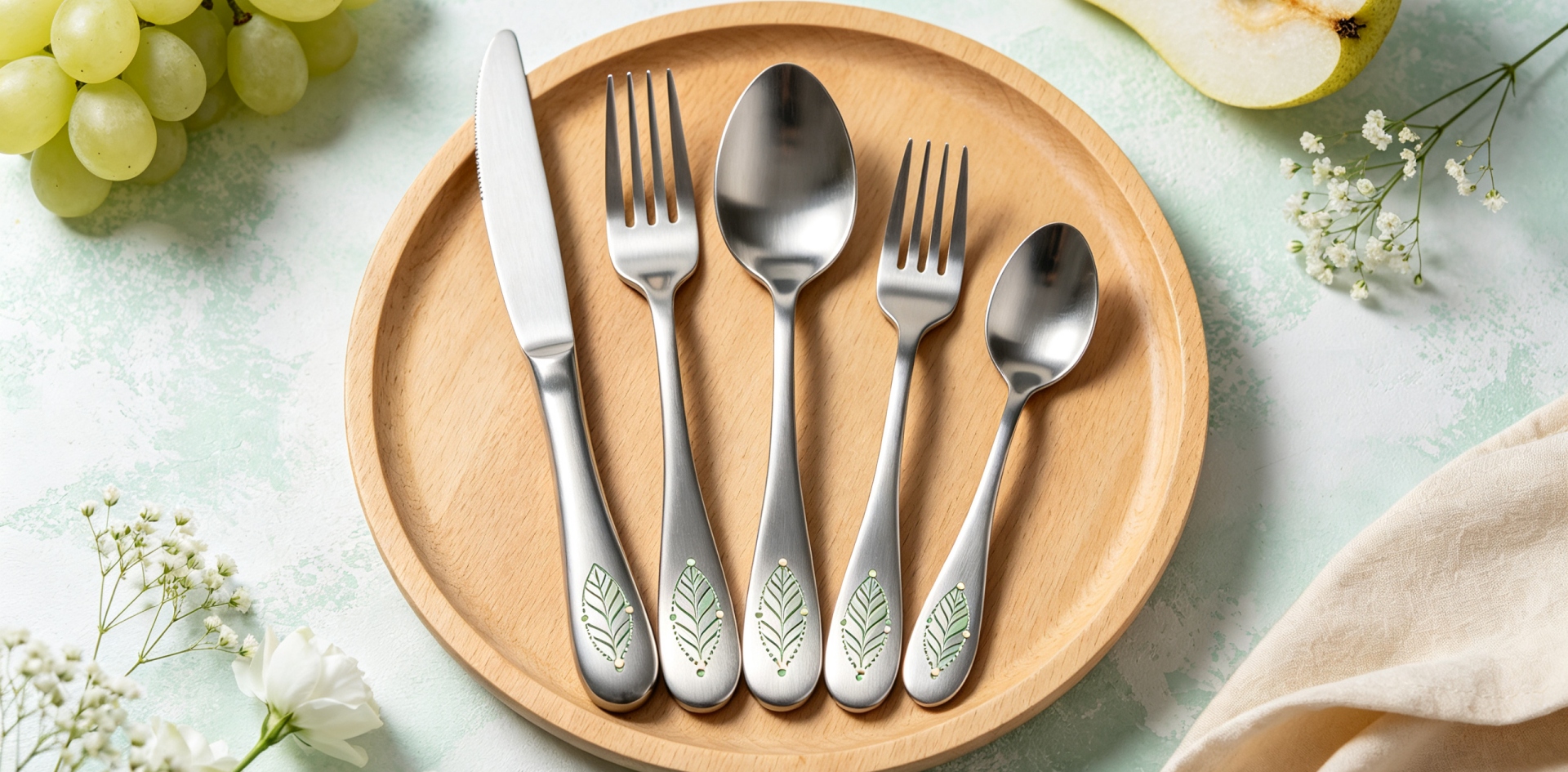
When developing custom stainless steel cutlery, handle details often determine whether a design looks refined and consistent. A decorative line, embossed motif, textured area or recessed pattern needs to sit at an appropriate distance from the handle's outer edges. This distance is known as the handle edge margin.
For OEM and private-label buyers, controlling this margin helps maintain the intended design and reduces unwanted variation across production batches. It is particularly important when a brand uses detailed handle decoration to distinguish its stainless steel spoons, forks and knives from standard products.
Homefelt factory supports OEM, ODM, private label, wholesale and bulk stainless steel cutlery production. From product design and specification review to manufacturing, customized packaging and transportation, the team can coordinate a one-stop service based on each customer's requirements.
What Is Handle Edge Margin?
Handle edge margin is the distance between a defined decorative or processed feature and the nearest specified outer edge of a cutlery handle.
The feature could be an engraved line, embossed pattern, recessed detail or textured section. The margin may be measured from the feature's boundary to the handle's side edge or another reference edge shown in the technical drawing.
It is different from overall handle width, decoration-line position or texture depth. Those dimensions describe other aspects of the product, while edge margin defines the space remaining between a feature and the handle outline.
A product specification may identify:
-
Handle width at the decoration area
-
Distance from the feature to each side edge
-
Decorative feature width
-
Pattern position
-
Distance from the feature to the handle end
-
Required dimensional tolerance
-
Reference points for inspection
Clearly defined measurements help the customer and manufacturer interpret the design in the same way.
Why Edge Margin Matters in Custom Flatware
The handle is often the most visible area of a stainless steel spoon, fork or table knife when the product is arranged on a table or displayed in retail packaging.
If a decorative feature sits too close to one side, the handle can look unbalanced. If the margin varies between pieces, the decoration may appear inconsistent even when its size remains unchanged.
A controlled edge margin supports several objectives:
-
Balanced decorative placement
-
Consistent handle appearance
-
Clear separation between decoration and outer contour
-
Repeatable manufacturing
-
Better coordination across a flatware collection
The required margin depends on the handle shape, decoration method and design intent. There is no single dimension suitable for every cutlery style.
Handle Shape and Available Margin
Handle geometry directly affects the space available for decoration.
A broad, relatively straight handle may provide a stable area for a decorative motif. A narrow handle or one with a changing outline may require more careful positioning.
For example, a pattern that appears centered on a wide handle may approach the edge when applied to a narrower section. The same issue can occur when a handle tapers or curves along its length.
During product development, the manufacturer should therefore consider the margin together with the handle's actual outline rather than using one width measurement for the entire product.
Useful reference dimensions can include handle width at several positions, the shape of the outer contour, decoration width and the distance between the feature and each side edge.
Decoration Methods and Margin Control
Different decoration methods create different manufacturing requirements.
Embossing forms a raised design, while engraving removes or marks material to create a visible feature. Textured surfaces and decorative lines may also require dedicated tooling or controlled processing.
The selected method can affect the feature's boundary and the accuracy with which its position is reproduced.
For OEM projects, the drawing should define the intended feature and its relationship to the handle edge. Where necessary, the sample can be reviewed to confirm that the chosen decoration method produces the expected appearance.
This step is particularly useful for private-label designs with fine patterns or multiple decorative elements.
Material and Forming Considerations
Stainless steel grade and material thickness influence how the handle behaves during forming and decoration.
A decorative process must suit the material and product construction. The manufacturer also needs to consider whether the handle surface is flat, curved, raised or recessed in the decoration area.
These factors can affect how the margin is measured and how the finished feature appears.
A practical specification may include:
-
Stainless steel grade
-
Material thickness
-
Handle dimensions
-
Decoration method
-
Feature dimensions
-
Edge margin
-
Surface finish
-
Inspection requirements
Reviewing these elements together helps connect the customer's design concept with actual manufacturing conditions.
How to Specify Handle Edge Margin
A drawing that only shows a decorative motif may not provide enough information for reliable production.
For commercial orders, the customer can define the margin from a clear reference edge and identify the exact point where the measurement should be taken. If the handle outline changes along its length, multiple measurement locations may be necessary.
For symmetrical designs, the drawing may specify equal margins on both sides. For intentionally asymmetrical decoration, separate left and right measurements can preserve the intended design.
The specification should also distinguish nominal dimensions from acceptable tolerances. These details give the production team a measurable standard rather than relying entirely on visual judgment.
Maintaining Consistency in Bulk Production
In large orders, minor variations in decorative positioning can become noticeable when many pieces are displayed together.
A controlled inspection process can compare finished handles against the approved drawing and sample. Depending on the design, inspection may include:
-
Distance from decoration to the handle edge
-
Feature width and length
-
Position along the handle
-
Relationship to the handle outline
-
Consistency across different cutlery pieces
-
Surface condition around the decoration
For a complete collection, the margin should be assessed according to each product's geometry. A spoon, fork and knife may share the same design language without requiring identical numerical dimensions.
This approach helps preserve visual consistency while respecting the differences between individual products.
Sample Approval for OEM and ODM Projects
The sample stage is an opportunity to evaluate how decorative positioning works on the actual cutlery.
Homefelt factory can review customer drawings, images or physical samples and discuss the handle outline, decoration method and required edge margin.
Before approving the sample, buyers can assess the feature's visual balance, the remaining space around the decoration, the surface finish and the relationship between the spoon, fork and knife.
If the design requires adjustment, the relevant dimensions can be clarified before bulk manufacturing begins.
This is especially useful for new private-label collections, where a small detail may contribute significantly to the product's identity.
Project Experience and Manufacturing Expertise
Custom cutlery projects often involve translating a visual reference into measurable production requirements. A photograph can communicate the general appearance but may not show the exact margin between a decorative element and the handle edge.
An experienced manufacturer can identify the dimensions that need to be confirmed and review whether the proposed design is suitable for the selected production method.
Homefelt works with customers developing stainless steel knives, forks, spoons and flatware sets for commercial markets. This practical approach helps align design intent, sample approval and repeat manufacturing.
Quality Documentation and Supplier Requirements
B2B buyers may require technical specifications, inspection records and supplier documentation as part of their purchasing process.
Homefelt has passed BSCI, SEDEX 4P, BRC and ISO9001 audits or certifications, as well as Disney audit requirements. FAMA and FSC certificates are also available for applicable business needs.
For a specific cutlery project, relevant specifications, inspection information and testing documentation can be discussed according to the product and customer's requirements.
The objective is to provide useful supporting information without adding unnecessary compliance explanations to the product specification.
OEM, ODM and Private Label Manufacturing
Handle edge margin is one of the many details that can be customized when developing branded stainless steel cutlery.
Homefelt factory supports OEM and ODM projects based on customer drawings, samples or new product concepts. Buyers can customize handle decoration, material, surface finish, branding and packaging to suit their target market.
For wholesalers and distributors, clearly defined specifications can also help maintain product consistency across repeat orders. For private-label brands, they provide a more reliable way to reproduce the intended design.
The factory can coordinate product development, manufacturing, packaging and transportation through one service arrangement, tailored to each customer's needs.
One-Stop Service for Custom Stainless Steel Cutlery
A successful cutlery project involves more than confirming the appearance of a handle. The final product must also meet the customer's material, quantity, packaging and delivery requirements.
Homefelt can support:
-
Product design and drawing review
-
Stainless steel material selection
-
Handle decoration development
-
OEM and ODM manufacturing
-
Private label customization
-
Sample development and approval
-
Bulk production
-
Quality inspection
-
Customized packaging
-
Transportation coordination
This one-stop approach gives B2B buyers a single manufacturing partner for their stainless steel cutlery projects.
Stainless Steel Spoon Bowl Sidewall Angle for OEM and Private Label Production
Stainless Steel Spoon Rim Profile for OEM and Private Label Manufacturing
Related Article



