
Stainless Steel Cutlery Handle Edge Radius for B2B
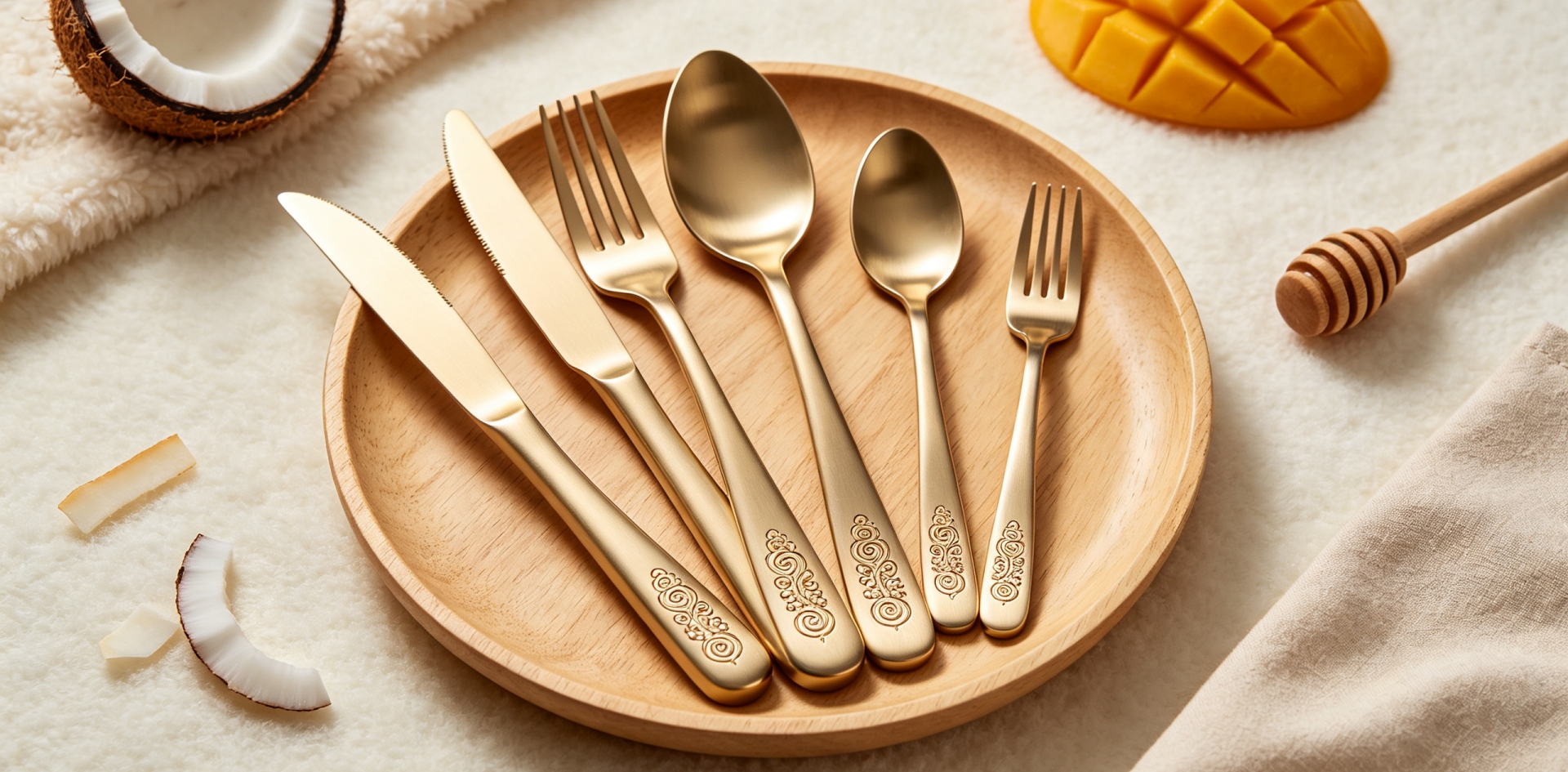
Stainless Steel Cutlery Handle Edge Radius for B2B
When a stainless steel knife, fork or spoon is developed for a B2B collection, the handle is often judged by its overall shape, width, thickness and finish. Yet there are smaller geometric details that can also influence the final product.
One of them is the radius of the handle edges.
A handle does not always have sharp transitions between its surfaces. The edges can be softened with different radii, creating a more rounded or more defined appearance. For custom stainless steel cutlery, this detail can influence how the product looks, feels and responds to finishing processes.
For OEM, ODM and private label projects, defining this characteristic can help the manufacturer reproduce the intended handle design more consistently.
What Is Handle Edge Radius?
Handle edge radius describes how sharply or gradually one surface of a cutlery handle transitions into another.
A smaller radius creates a more defined edge, while a larger radius produces a softer transition.
The difference may be subtle when looking at a single product, but it can influence the overall character of the handle.
A modern flat handle may use controlled edge rounding to maintain a clean geometric appearance. A softer handle design may use larger radii to create a smoother visual transition.
The appropriate radius depends on the product concept, handle dimensions, material thickness and manufacturing process.
Why Edge Radius Matters for B2B Cutlery
A stainless steel cutlery handle needs to perform several roles at the same time.
It should have an appropriate appearance, work with the overall product proportions and provide a practical surface for handling. It also needs to be manufacturable consistently at the required production volume.
The edge radius contributes to all three considerations.
If the edge is visually too sharp for the intended design, the product may not have the desired appearance. If it is excessively rounded, the handle may lose some of its intended geometric character.
For a private label brand, these differences can affect how a collection is perceived when several pieces are displayed together.
Handle Geometry and Visual Appearance
Light behaves differently across rounded and sharply defined surfaces.
A smaller radius can create a clearer transition between the main handle surfaces, while a larger radius can produce a softer reflection.
This becomes more noticeable on polished stainless steel because the surface reflects surrounding light.
For B2B buyers developing a specific visual style, the edge radius can therefore be considered together with the selected finish.
A highly polished handle may make subtle geometric differences more visible. A satin or softer finish may create a different visual effect.
The goal is not to select one radius as universally correct, but to make sure the handle geometry and finishing treatment support the intended product appearance.
Handle Edge Radius and Product Feel
The geometry of a handle can also influence how it feels when held.
Although the overall grip depends on the complete handle cross-section, rounded edges can create a softer transition between surfaces.
For table knives, forks and spoons used repeatedly, this can contribute to the perceived refinement of the product.
For B2B customers, the desired feel should be considered alongside the target market and product positioning.
A commercial cutlery range may prioritize a straightforward, durable construction, while a private label collection may place greater emphasis on refined handle geometry.
In either case, the edge radius should be appropriate for the complete product rather than selected independently.
Edge Radius Across Knives, Forks and Spoons
A coordinated cutlery collection does not require every piece to have identical dimensions.
A knife handle may be wider or structurally different from a spoon or fork handle. However, the products can share similar geometric principles.
For example, the same general edge-rounding approach can be used across all three pieces. This creates visual consistency while allowing each product to maintain its functional proportions.
For brands developing a complete stainless steel flatware collection, this can be a useful way to connect different products.
The edge radius can become one of the subtle design characteristics that makes the collection feel coordinated.
Custom Handle Development for OEM and ODM
Many OEM and ODM projects start with a reference product, drawing or visual concept.
The buyer may know exactly how the finished handle should look but may not have every geometric dimension defined.
In this situation, the factory can review the design and help translate the visual requirements into a practical manufacturing specification.
The handle edge radius can be considered together with width, thickness, length, cross-section, surface treatment and overall product weight.
This approach allows the manufacturer to understand the complete design instead of focusing on one isolated measurement.
It can also make later production communication easier because the approved product has a clearer reference.
Edge Radius and Surface Finishing
The finishing stage can influence how handle geometry is perceived.
Polishing follows the shape of the metal surface, so rounded and sharper transitions can produce different visual effects.
The factory therefore needs to consider the handle geometry when determining how the product should be finished.
For a custom stainless steel cutlery project, buyers may have a specific preference for a bright polished, satin or other surface appearance. The selected finish should work naturally with the handle geometry.
This is another reason why product design and finishing should be discussed together during development.
Maintaining Consistency in Mass Production
For B2B orders, the challenge is not only creating one attractive sample.
The same design needs to be reproduced throughout the production quantity.
Handle edge radius can be influenced by forming, shaping and finishing processes. Consistent process control helps ensure that the final pieces remain visually compatible with the approved reference.
When a collection contains several thousand pieces, small differences can become easier to notice when the products are arranged together.
An approved sample and clear product specifications can therefore provide useful production references.
This is particularly important for private label brands that expect to reorder the same collection in the future.
Using a Reference Sample Effectively
A physical sample can communicate the character of a handle more effectively than a general description such as “rounded edge.”
The sample allows the buyer and factory to evaluate the actual visual transition, proportions and surface reflection.
For a custom project, the approved sample can then become part of the product reference.
If additional technical information is required, drawings or measurements can be added to clarify the important characteristics.
The purpose is to create a practical standard that both sides can understand and reproduce.
This becomes valuable when production is repeated or when related products are added to the collection.
Handle Edge Radius and Private Label Differentiation
Private label brands do not always need dramatic shapes to distinguish their products.
A collection can achieve a refined appearance through several smaller details working together.
Handle proportions, surface treatment, edge rounding and end design can collectively create a recognizable product language.
This can be particularly useful for brands that want their stainless steel cutlery to look different from generic catalog products while keeping the design practical for commercial production.
A controlled handle edge radius can be one part of this differentiation.
It does not need to be visually obvious to contribute to the overall impression of the product.
Balancing Detail With Production Practicality
Every additional design requirement needs to be considered in relation to the production process.
A highly specialized handle profile may require more development work, while a simpler design may be easier to reproduce at large volume.
The right balance depends on the product positioning, target quantity and desired appearance.
For B2B buyers, discussing these details before production can help determine which characteristics are essential to the product.
The factory can then focus manufacturing control on the areas that have the greatest influence on the finished collection.
This approach helps maintain customization while keeping the production process practical.
Homefelt Factory for Custom Stainless Steel Cutlery
Homefelt factory provides stainless steel knives, forks, spoons and complete flatware sets for B2B customers.
The factory supports OEM, ODM, private label, wholesale and large-volume production according to different customer requirements.
For custom projects, buyers can discuss handle design, dimensions, material, surface finish, packaging and transportation requirements with the factory team.
Homefelt can build a customized service package according to the customer's actual project rather than limiting the development to standard products.
For a new cutlery collection, small geometric details such as handle edge radius can be discussed together with the broader design.
This one-stop approach allows product development and manufacturing requirements to be considered together before the order enters mass production.
Planning for Repeat Orders
A successful cutlery product may remain in a customer's product range for a long time.
Once the design is established, repeat orders should ideally reproduce the same visual characteristics.
The handle edge radius can therefore become part of the product's reference information together with other important dimensions and finishing requirements.
When a reorder is placed, the factory can use the established sample and specifications as a basis for production.
This helps reduce unnecessary redesign and gives the buyer greater continuity across purchasing cycles.
For distributors and private label brands, stable product characteristics can also make it easier to maintain consistent catalogs and collections.
Developing a Complete B2B Cutlery Program
A B2B cutlery project often involves more than one product.
A buyer may start with a dinner fork, spoon and table knife, then later add dessert pieces, specialty knives or other matching products.
When the original handle design is clearly defined, related products can be developed using the same design principles.
The edge radius can be one of the characteristics used to maintain this visual connection.
The result is a collection that feels coordinated without requiring every piece to have exactly the same dimensions.
Why Small Handle Details Matter
Stainless steel cutlery quality is created through many connected decisions.
Material, dimensions, forming, surface finishing, proportions and small geometric features all contribute to the finished product.
Handle edge radius may not be the first feature a buyer notices, but it can influence the visual transition of the handle and the overall refinement of the product.
For B2B buyers developing custom cutlery, the most practical approach is to identify the details that matter to the collection and establish them clearly with the manufacturer.
This creates a stronger connection between the original concept, the approved sample and the final bulk production.
Homefelt Factory for OEM, ODM and Private Label Cutlery
Homefelt factory supports B2B customers with customized stainless steel knives, forks, spoons and complete flatware collections.
Whether the requirement is OEM, ODM, private label, wholesale or large-volume production, the service can be adapted to the customer's product concept and purchasing needs.
Product design, customization, packaging and transportation can be coordinated as part of an integrated service approach.
For buyers developing a new collection, handle geometry can be discussed at the beginning of the project so that the desired appearance and production requirements are understood before mass manufacturing.
Once the product is approved, the agreed characteristics can provide a reference for future orders and collection expansion.
A stainless steel cutlery handle may appear simple, but its geometry contains many small design decisions. Edge radius is one of these details that can influence both appearance and product feel.
By defining the handle structure clearly and working with an experienced stainless steel cutlery manufacturer, B2B buyers can develop products that are distinctive enough for their market while remaining suitable for consistent commercial production.
Custom Stainless Steel Cutlery for OEM & ODM Projects
Private Label Stainless Steel Flatware Manufacturing
Custom Knife, Fork and Spoon Collection Development
Wholesale Stainless Steel Cutlery for B2B Buyers
Homefelt Factory Custom Cutlery Service
B2B Stainless Steel Cutlery Manufacturing
Stainless Steel Cutlery Orange Peel Texture for B2B
Stainless Steel Cutlery Handle End Profile for B2B
Related Article



