
Stainless Steel Cutlery Handle Thickness Design for B2B Buyers
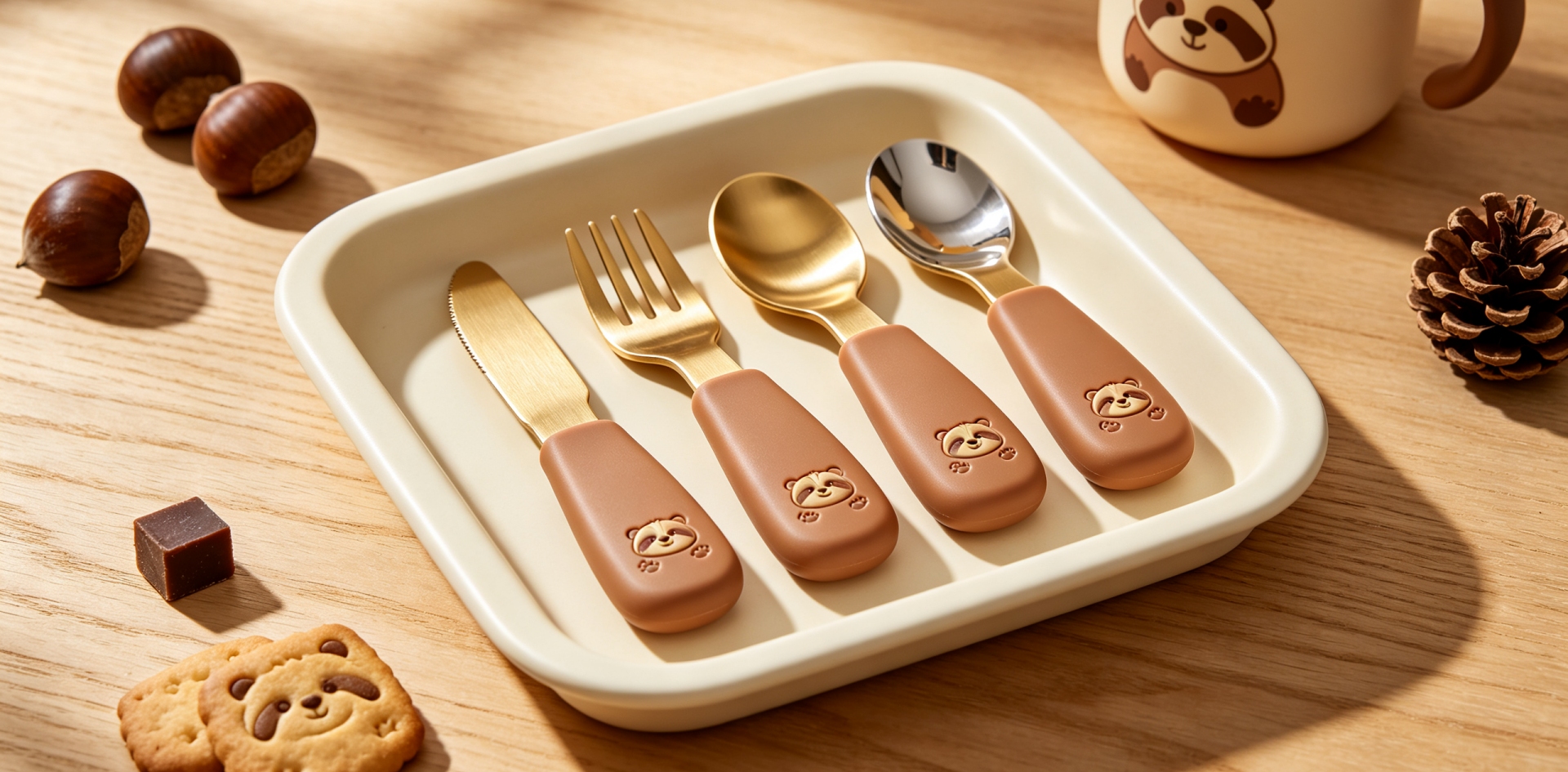
Stainless Steel Cutlery Handle Thickness Design for B2B Buyers
When developing stainless steel spoons, forks and knives for a wholesale or private label project, buyers often pay close attention to the overall appearance of the handle. However, handle thickness and cross-section are also important product specifications that can influence how the cutlery looks and feels in the hand.
Two stainless steel flatware pieces can have a similar length and surface finish but provide a different handling experience because their handle thickness, width and cross-sectional shape are different.
For B2B buyers, these details are worth confirming during product development and sample approval. A professional stainless steel cutlery manufacturer can help translate the desired handle appearance into measurable specifications suitable for mass production.
Why Handle Thickness Matters in Stainless Steel Cutlery
The handle is one of the main structural and visual areas of a spoon, fork or knife.
Its dimensions can influence:
-
Overall product proportion
-
Visual weight
-
Grip feeling
-
Handle appearance
-
Relationship between handle and working section
-
Product weight
-
Packaging arrangement
Handle thickness should therefore be considered together with handle width and overall length.
A very thin handle may create a lightweight visual appearance, while a thicker handle can produce a more substantial design impression.
The right specification depends on the customer's product positioning and intended market.
Handle Thickness and Cross-Section Are Different
Handle thickness and handle cross-section are related but not exactly the same.
Thickness refers to the material dimension at a particular point, while the cross-section describes the overall shape of the handle when viewed across its width.
A handle may have a relatively flat cross-section, a more rounded profile or a specially developed shape.
For customized stainless steel cutlery, buyers can discuss both aspects with the manufacturer.
Useful specifications may include:
-
Handle length
-
Maximum handle width
-
Handle thickness
-
Cross-sectional shape
-
Handle curvature
-
Transition dimensions
-
Material specification
-
Product weight
These measurements provide a clearer description than simply saying that a handle should be “thick” or “thin.”
Stainless Steel Spoon Handle Design
For a stainless steel spoon, the handle needs to visually connect with the bowl.
If the handle is relatively wide, the spoon may have a stronger visual presence. A narrower handle can create a lighter and more delicate appearance.
When developing a customized spoon, buyers can consider the relationship between:
-
Bowl width
-
Bowl length
-
Handle length
-
Handle width
-
Handle thickness
-
Overall product length
These dimensions can be adjusted according to the target product style.
For a new private label collection, a physical sample is particularly useful because buyers can evaluate both the appearance and the actual handling experience before approving production.
Stainless Steel Fork Handle Design
The handle of a stainless steel fork needs to work visually with the fork head and tines.
A fork with a relatively wide head may require a handle proportion that provides a suitable transition from the working section to the grip area.
Relevant specifications can include:
-
Overall fork length
-
Fork head width
-
Handle length
-
Handle width
-
Handle thickness
-
Transition shape
-
Product weight
For a matching spoon and fork collection, the handle design does not need to be identical in every dimension.
Instead, the goal is to maintain a recognizable design relationship between the products.
Stainless Steel Knife Handle Design
Knife handles can require additional consideration because the blade creates a different visual and structural relationship.
The handle dimensions need to coordinate with the blade length and overall knife proportions.
For customized stainless steel knives, buyers may confirm:
-
Overall knife length
-
Blade length
-
Handle length
-
Handle width
-
Handle thickness
-
Handle profile
-
Connection area
-
Product weight
When the knife belongs to a complete cutlery collection, its handle can follow the same design language as the spoon and fork.
This allows the collection to appear coordinated while still giving each product its appropriate structure.
How Buyers Should Compare Handle Samples
When comparing stainless steel cutlery samples, buyers should avoid judging handle design only from photographs.
A practical sample review can include several checks.
First, measure the overall length and handle dimensions.
Second, compare the handle width and thickness at the same reference points.
Third, look at the cross-sectional shape.
Fourth, hold the product and evaluate the overall grip feeling.
Finally, place the spoon, fork and knife together and compare their visual proportions.
This provides more useful information than evaluating only one product independently.
Defining Handle Parameters for OEM Projects
For an OEM stainless steel cutlery project, clear specifications can make communication between the buyer and factory more efficient.
Instead of providing only a general design description, buyers can provide a drawing, sample or reference dimensions.
A basic handle specification can include:
| Parameter | Example Requirement |
|---|---|
| Handle length | Confirmed by drawing |
| Maximum width | Confirmed by product specification |
| Thickness | Confirmed by sample or drawing |
| Cross-section | Flat, rounded or customized |
| Surface finish | Selected according to collection |
| Logo | Position and size confirmed |
| Material | Specified stainless steel grade |
The exact values should be determined according to the customer's product requirements rather than using one standard dimension for every project.
Sample Development Helps Confirm the Final Design
A drawing can define measurements, but a physical sample provides another level of evaluation.
During sample approval, the buyer can check whether the actual handle looks and feels consistent with the original concept.
If the handle appears too wide, too narrow, too thin or too heavy for the intended product positioning, adjustments can be discussed before mass production.
This is especially useful when developing a completely new spoon, fork or knife rather than selecting an existing standard design.
Once the final sample is approved, the confirmed specifications can be used as a reference for production.
Experience in Customized Cutlery Development
B2B customers do not always begin with complete technical specifications.
Some customers provide a photograph and ask the factory to develop a similar product. Others provide an existing cutlery sample and request changes to the handle.
For example, a customer may want to keep the same spoon bowl but develop a wider handle. Another customer may want a new fork handle that matches an existing knife.
In these situations, the factory needs to consider the complete product rather than changing one measurement in isolation.
Handle dimensions, working-section proportions, material thickness and overall product weight may all need to be reviewed together.
Practical project experience helps the manufacturer identify these relationships during the development stage.
Product Documentation and Factory Qualification
For international B2B buyers, product specifications are only one part of supplier evaluation.
Factory experience, audit information and certification materials can also provide useful background when selecting a manufacturing partner.
Homefelt's website identifies the company as a stainless steel cutlery manufacturer and supplier serving B2B customers worldwide, with more than 40 years of stainless steel cutlery manufacturing experience. The site also lists BSCI, SEDEX 4P, BRC and ISO9001 audits, Disney audit experience, and FAMA and FSC certifications.
For individual projects, buyers can discuss product specifications, sample approval, inspection requirements and relevant testing documentation according to their market requirements.
One-Stop Service for Customized Stainless Steel Cutlery
A customized cutlery project may require much more than adjusting the handle dimensions.
Homefelt can provide a one-stop service according to the customer's actual project, including product design, product customization, packaging and transportation.
Depending on the requirements, the service can cover:
-
Spoon, fork and knife development
-
Handle design customization
-
Material and specification confirmation
-
Sample production
-
OEM manufacturing
-
ODM development
-
Logo and private label customization
-
Packaging design
-
Customized packaging
-
Bulk production
-
Transportation coordination
Different customers can receive different service combinations.
A customer with a completed drawing may need mainly manufacturing and packaging support. Another customer may need assistance from the initial design concept through sampling, production and delivery.
The purpose is to create a dedicated service solution based on the customer's situation.
Building a Long-Term B2B Partnership
For wholesalers, distributors, retailers and private label brands, stainless steel cutlery is often a long-term product category.
After the initial spoon, fork and knife collection is approved, customers may develop additional sizes, new handle designs or matching products.
Maintaining clear product specifications can make future development more efficient and help the manufacturer understand the customer's existing collection.
Homefelt focuses on stainless steel knife, fork and spoon manufacturing for international B2B customers and supports OEM, ODM, private label, wholesale and large-volume production.
Our aim is to provide a practical one-stop service solution, support customers according to their actual requirements and grow together through long-term cooperation.
You May Be Interested In
Stainless Steel Spoon Bowl Depth Design for Wholesale Projects
Stainless Steel Cutlery Stamping and Forming for Consistent Production
Related Article



