
Stainless Steel Cutlery Orange Peel Texture for B2B
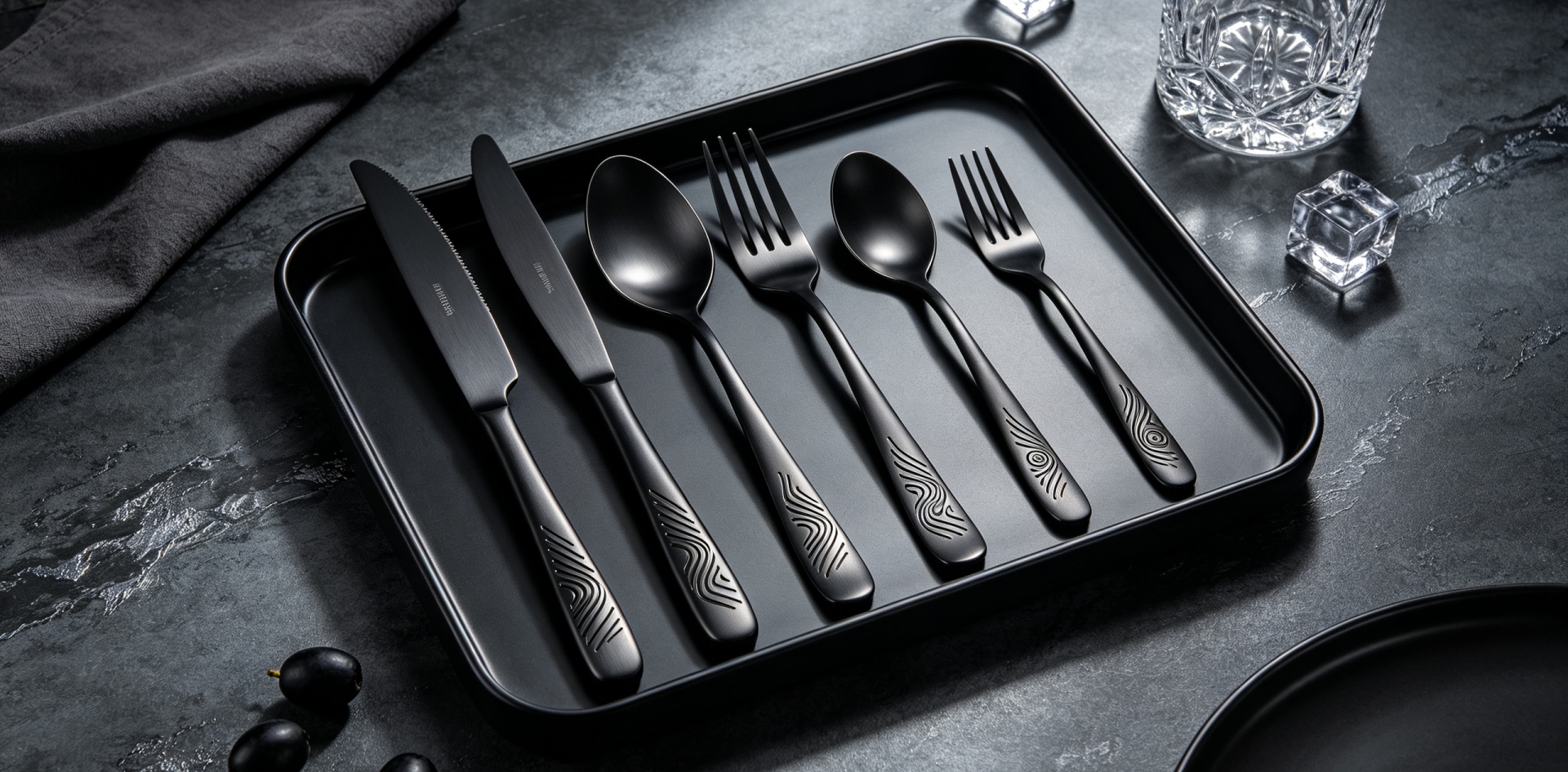
Stainless Steel Cutlery Orange Peel Texture for B2B
A stainless steel cutlery product can have the correct dimensions, shape and material while still showing differences in its visual surface quality. When polished metal is viewed under bright or directional lighting, subtle surface textures can become much more noticeable.
One example is orange peel texture.
The term describes a fine, uneven visual texture that can make a polished metal surface appear slightly dimpled or less uniform than intended. On stainless steel knives, forks and spoons, this effect may influence how light is reflected across the surface.
For B2B buyers developing polished cutlery, understanding this characteristic can help when discussing finishing requirements with a stainless steel cutlery manufacturer.
What Is Orange Peel Texture?
Orange peel texture is a surface appearance in which the metal does not reflect light as evenly as expected. Instead of producing a clean and consistent reflection, the surface may appear to have very small variations that resemble the texture of an orange peel.
It is different from a visible scratch or a deep surface defect.
The effect can be subtle, especially under ordinary indoor lighting. Under strong lighting, photography lights or showroom conditions, however, uneven reflection may become easier to notice.
The degree of visibility depends on the surface finish, product geometry, lighting conditions and the level of polishing.
For B2B production, the key point is that the desired surface appearance should be defined clearly enough for the factory to understand the customer's expectations.
Why Surface Texture Matters for B2B Cutlery
Stainless steel flatware is often sold as a coordinated collection.
When several knives, forks and spoons are placed together, differences in surface reflection can become more obvious than when a single piece is viewed independently.
This matters for retail packaging, product photography, hospitality presentation and private label collections.
A highly polished product is expected to provide a particular visual effect. If some pieces show noticeably different surface textures, the collection may appear less consistent.
For wholesale and large-volume buyers, controlling surface appearance can therefore be part of the overall product quality requirements.
The Relationship Between Polishing and Surface Texture
Polishing is not simply a process of making stainless steel brighter.
It involves preparing and refining the surface so that the finished metal produces the intended visual effect.
Different stages of surface preparation can influence the final appearance. If the underlying surface is not sufficiently uniform, later polishing may not completely eliminate all visual variation.
The condition of the material, forming process and finishing sequence can all contribute to the final result.
For custom stainless steel cutlery, this means the desired appearance should be considered throughout product development rather than only at the final inspection stage.
Orange Peel Texture and Mirror Polished Cutlery
Highly reflective stainless steel surfaces can make subtle irregularities easier to see.
A mirror-style finish reflects surrounding light strongly, so variations in the surface can appear as changes in brightness or distortion.
This does not mean that every polished cutlery product needs exactly the same surface treatment.
A buyer may prefer a bright mirror finish, a softer polished effect or a satin appearance depending on the collection.
The important point is to match the surface treatment to the intended product positioning and establish a reasonable standard before mass production.
For a private label collection positioned around a refined appearance, this discussion can be particularly useful.
How Product Shape Affects Surface Appearance
Surface texture cannot always be evaluated separately from product geometry.
A flat section, a curved handle and a shaped spoon bowl reflect light in different ways.
A small variation may be easy to see on a broad polished area but much less obvious on a strongly curved surface.
This means that quality evaluation should consider the actual shape of the product.
For OEM and ODM projects, the factory can review the surface finish together with the product design. This helps determine where visual consistency is most important.
For example, a broad knife handle may require different visual attention from a narrow fork neck or a curved spoon bowl.
Setting Practical Surface Requirements
B2B buyers do not necessarily need to define every surface characteristic using highly technical terminology.
A reference sample can often communicate the desired appearance more effectively.
The buyer and manufacturer can compare the sample under suitable lighting and identify the visual characteristics that need to be maintained during production.
For more detailed projects, the finishing requirement can be included in the product specification.
This creates a common reference before the order enters mass production.
A practical standard is important because stainless steel is a manufactured material rather than a perfectly uniform optical surface. The objective is to establish a consistent commercial result that matches the approved product.
Surface Consistency Across Large Orders
Large-volume production creates a different quality-control challenge from sample development.
A single polished sample may look excellent. The factory then needs to reproduce the same appearance across a much larger quantity.
This requires stable production and finishing conditions.
The production team can use the approved sample as a visual reference, while inspection procedures can identify noticeable differences during manufacturing.
For private label and wholesale buyers, this approach helps make the relationship between the development sample and bulk production clearer.
It also provides a more useful basis for discussing any surface variation that appears during inspection.
Why Lighting Matters During Inspection
Surface appearance is strongly influenced by lighting.
A product that looks uniform under soft room lighting may show more variation under direct or directional light.
This is why inspection conditions can influence the evaluation of polished stainless steel cutlery.
For B2B projects with specific appearance requirements, buyers and manufacturers can agree on practical inspection conditions before production.
The goal is to create a consistent method for evaluating the product rather than relying on different lighting environments for different inspections.
This is especially useful when the cutlery will later be photographed or displayed under strong commercial lighting.
Orange Peel Texture in OEM and ODM Development
OEM and ODM customers may have very different requirements for surface appearance.
Some projects prioritize a highly reflective finish. Others may prefer a softer surface that naturally hides minor visual variations.
The factory can discuss these requirements with the customer before finalizing the product specification.
Surface preparation, polishing requirements and product geometry can then be considered together.
This helps ensure that the selected finishing approach is appropriate for the product rather than being added as an afterthought.
For custom stainless steel cutlery, this type of early communication can reduce misunderstandings between the approved sample and the finished bulk order.
Private Label Collection Consistency
Private label brands often use product photography and packaging to communicate the quality and style of their collection.
A consistent surface appearance can support that presentation.
When a knife, fork and spoon are shown together, their finishes should look compatible even though the products have different shapes.
A controlled finishing process helps create this relationship.
The surface does not need to be visually identical across every geometric area. Instead, the intended finish should remain consistent with the design of each individual product.
This is particularly important for collections that use polished stainless steel as a major visual feature.
Homefelt Factory for Custom Stainless Steel Cutlery
Homefelt factory provides stainless steel knives, forks, spoons and complete flatware sets for B2B customers.
The factory supports OEM, ODM, private label, wholesale and large-volume production according to different project requirements.
For custom cutlery, buyers can discuss material, product design, surface finish, packaging and transportation requirements with the factory team.
Homefelt can develop a customized service package according to the customer's actual project, allowing product development and manufacturing requirements to be considered together.
For buyers with specific polishing expectations, surface appearance can be discussed during the development stage rather than waiting until after mass production.
This helps establish a clearer reference for the final product.
From Surface Sample to Production Reference
An approved sample is especially useful when the product has a particular finishing requirement.
The sample can demonstrate the relationship between the stainless steel material, product geometry and surface treatment.
Once approved, it can serve as a reference for production.
If the product is reordered later, the same reference can help maintain continuity.
For a B2B brand, this is valuable because the same product may remain in the catalog for an extended period.
A clear production reference reduces the need to reinterpret the surface appearance each time a new order is placed.
Balancing Appearance and Commercial Production
The most attractive surface finish is not always the most appropriate choice for every B2B project.
A buyer also needs to consider order quantity, target market, price positioning, product design and expected repeat orders.
A highly demanding surface requirement may require additional process control, while a more practical finish may provide an appropriate appearance with efficient production.
The right choice depends on the specific project.
An experienced stainless steel cutlery manufacturer can help buyers understand how the desired surface appearance relates to the actual production process.
This allows the buyer to make the product specification more practical before confirming a large order.
Why Small Surface Details Matter
A stainless steel cutlery collection is judged as a complete product.
Material, dimensions, structure, polishing and visual consistency all contribute to the finished result.
Orange peel texture is only one possible surface characteristic, but it illustrates why finishing quality should be considered together with the rest of the manufacturing process.
For B2B buyers, the useful approach is to identify the surface characteristics that matter to the product and establish them clearly with the factory.
This creates a shared reference for development, inspection and future production.
Homefelt Factory for B2B Cutlery Programs
Homefelt factory supports customers with customized stainless steel knives, forks, spoons and complete flatware collections.
Whether the project involves OEM, ODM, private label, wholesale or bulk production, the service can be adapted to the customer's requirements.
Product design, customization, finishing, packaging and transportation can be coordinated as part of an integrated service approach.
For customers developing a polished stainless steel collection, surface appearance can be discussed together with the product design from the beginning.
Once the product has been approved, the reference sample and agreed specifications can support stable production and future replenishment.
A polished stainless steel surface can look simple, but achieving a consistent commercial appearance requires control throughout several stages of manufacturing.
By discussing surface characteristics such as orange peel texture at the appropriate stage of product development, B2B buyers can create clearer expectations and a stronger production reference.
This helps connect the original product concept with the final knives, forks and spoons delivered in bulk.
Custom Stainless Steel Cutlery for OEM & ODM Projects
Private Label Stainless Steel Flatware Manufacturing
Custom Stainless Steel Knife, Fork and Spoon Collections
Wholesale Stainless Steel Cutlery for B2B Buyers
Homefelt Factory Custom Cutlery Service
B2B Stainless Steel Cutlery Manufacturing
Stainless Steel Fork Tine Taper for B2B Cutlery
Stainless Steel Cutlery Handle Edge Radius for B2B
Related Article



