
Stainless Steel Cutlery Product Engineering for OEM and Bulk Production
Stainless Steel Cutlery Product Engineering for OEM and Bulk Production
A stainless steel spoon, fork or knife may appear simple after it has become a finished product, but developing a new cutlery item for commercial production involves many connected decisions.
For B2B buyers, the difference between a product concept and a reliable manufactured product is often the engineering work carried out between the two stages. Product engineering connects design intent with manufacturing practicality so that a stainless steel cutlery product can be produced consistently at commercial volumes.
This is especially relevant for OEM, ODM and private label projects where customers want products that are developed around their own requirements rather than selected directly from a standard catalogue.
What Stainless Steel Cutlery Product Engineering Covers
Product engineering focuses on how a product concept can become a practical manufactured item.
For stainless steel cutlery, this means looking at the complete product rather than considering one isolated feature. The spoon, fork or knife needs to work as a finished product while remaining suitable for the intended manufacturing process.
Depending on the project, engineering evaluation can consider:
-
Product construction
-
Overall design relationships
-
Material requirements
-
Manufacturing practicality
-
Production consistency
-
Product documentation
-
Relationship between related cutlery items
-
Requirements for future repeat production
The objective is not to change the customer's design unnecessarily. It is to understand the design and identify a practical route for producing it at the required commercial quantity.
From Concept to Manufacturable Cutlery
Many B2B projects begin with a concept rather than a fully developed manufacturing specification.
A customer may provide a reference product, sketch, image or initial design idea. At this stage, the factory needs to understand what the customer wants the final spoon, fork or knife to achieve.
Product engineering helps organize those requirements into a form that can be evaluated from a manufacturing perspective.
For example, if a customer wants a new stainless steel spoon for a private label collection, the factory needs to consider how the intended design can be produced repeatedly rather than treating the product as a one-off prototype.
The same principle applies to forks, table knives and complete flatware collections.
Engineering for Complete Flatware Collections
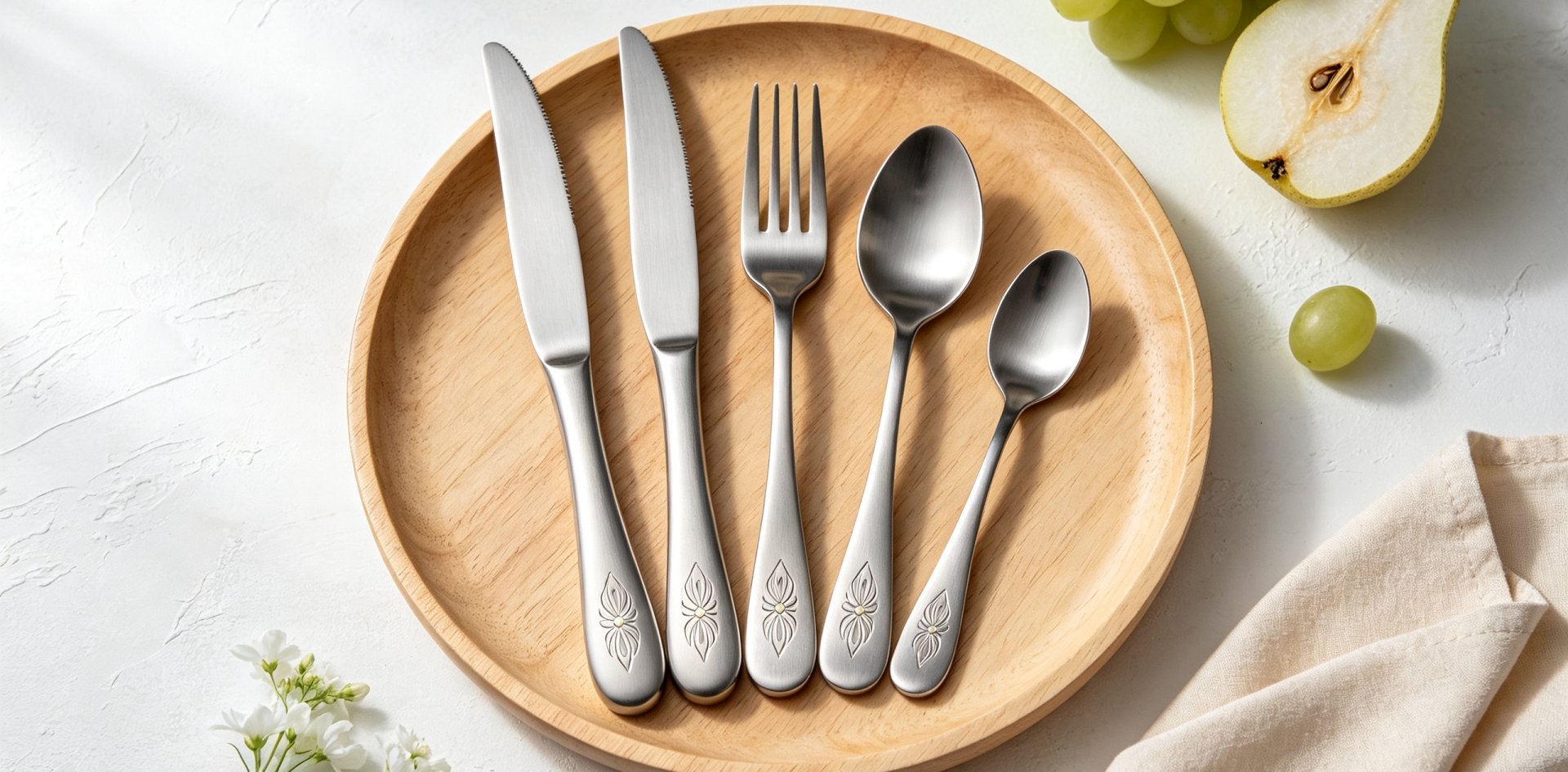
A B2B customer may not be developing just one product. A complete collection can contain several spoons, forks and knives that need to look and function as one product family.
Product engineering therefore needs to consider relationships between the different items.
The individual products should be developed according to their own requirements while maintaining an appropriate overall design direction. This is important for private label brands because the collection itself becomes part of the brand's product identity.
For wholesalers and distributors, a coordinated collection can also make the product range easier to present to commercial customers.
Engineering decisions made during the development stage can therefore influence not only manufacturing but also the consistency of the finished product range.
Balancing Design and Production Requirements
One of the most useful roles of a stainless steel cutlery manufacturer is helping customers understand the relationship between design choices and manufacturing.
A design may look excellent visually but require additional development before it can be produced efficiently in large quantities. Another design may be easier to manufacture but not fully match the customer's intended market positioning.
A professional engineering discussion allows these considerations to be evaluated before the project enters full production.
The goal is not simply to choose the easiest product to manufacture. Instead, the factory and customer can work together to find a practical balance between design requirements, product quality and commercial production.
Supporting OEM and ODM Customers
OEM and ODM projects often require closer cooperation than standard wholesale orders.
For OEM customers, the factory may need to work from customer-defined product requirements and develop the manufacturing details around them.
For ODM customers, the manufacturer may contribute more directly to the development process, helping transform an initial concept into a practical stainless steel cutlery product.
In both cases, engineering communication should remain closely connected with the customer's intended market and product positioning.
This approach allows the factory to provide more than simple production capacity. It becomes a technical partner during product development.
Homefelt Factory Experience
Homefelt factory specializes in stainless steel spoons, forks, knives and complete flatware sets for international B2B customers.
With 40 years of experience in the stainless steel cutlery business, Homefelt has worked with international buyers and well-known brands on customized products, wholesale supply and large-volume manufacturing.
This experience gives the factory practical knowledge of how stainless steel cutlery designs move from development into commercial production.
Homefelt has passed BSCI, SEDEX 4P, BRC and ISO9001-related audits and has relevant certification and testing documentation according to applicable project requirements.
For customers, the value of this experience is not limited to production. It also supports communication during the development stage, when product requirements need to be understood before manufacturing begins.
Product Engineering for Private Label Brands
Private label customers often need products that are distinctive enough to represent their own brand while remaining practical for their target market.
Product engineering can help connect these two requirements.
The customer can communicate the desired product style, collection direction and commercial requirements. The factory can then evaluate how the product can be developed into a manufacturable stainless steel spoon, fork or knife.
If several products are planned, the same engineering approach can be applied across the collection.
This creates a stronger foundation for brands that intend to expand their flatware range over time rather than purchasing unrelated products one by one.
From Engineering to Bulk Manufacturing
Once the product requirements have been confirmed, the engineering work becomes part of the foundation for production.
The final product information can be used by the manufacturing team as a reference for the bulk order. This is particularly important for large-volume production because the approved product needs to remain consistent throughout the manufacturing process.
For repeat orders, the established product information can also help the factory reproduce the same product more efficiently.
This creates a connection between initial product development and long-term supply.
One-Stop Service for B2B Cutlery Projects
Product engineering is only one stage of a complete stainless steel cutlery project.
Homefelt provides a one-stop service according to the customer's actual situation, covering product design, stainless steel cutlery manufacturing, packaging and transportation.
For an OEM or ODM customer, this allows product development and manufacturing to be coordinated through one factory.
For private label brands, wholesalers and distributors, the same service can support customized products and large-volume orders through to finished delivery.
Instead of providing a standard solution to every customer, Homefelt can discuss the project according to its product requirements, target market and purchasing plan.
Building a Long-Term Product Partnership
For B2B customers, a successful stainless steel cutlery project can become the starting point for a much longer relationship.
A product that performs well in the market may lead to repeat orders, additional SKUs and new collection development. Having an experienced factory involved from the product engineering stage can make these future projects easier to coordinate.
Homefelt aims to be a long-term China service partner for stainless steel cutlery customers, combining product development, manufacturing and one-stop support.
The goal is to help customers create practical products, maintain reliable production and grow together through long-term cooperation.
For product details, customization questions or a quotation, contact ingrid@homefelt.net.
Stainless Steel Cutlery Collection Development for OEM and Bulk Orders
Stainless Steel Cutlery Specification Sheet for OEM and Bulk Production
Related Article



