
Stainless Steel Cutlery Set Size Coordination for OEM B2B Projects
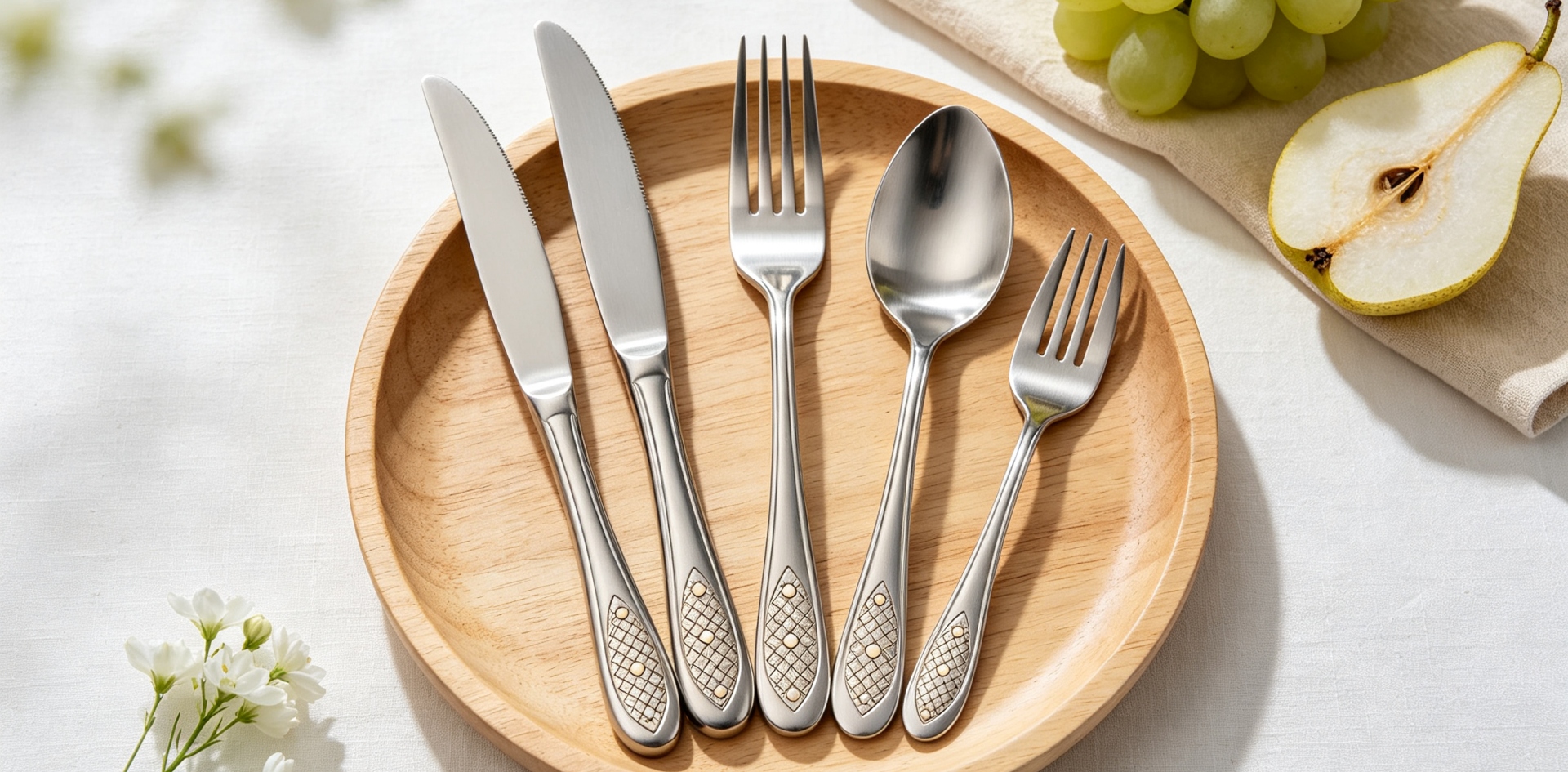
Stainless Steel Cutlery Set Size Coordination for OEM B2B Projects
For a professional stainless steel cutlery project, a knife, fork and spoon should not only look similar. Their overall dimensions need to work together as a coordinated product series. For wholesalers, distributors, hospitality suppliers and private label brands, size coordination can directly influence how a cutlery set looks on the table, how it fits packaging and how consistently the finished products can be presented across different markets.
A stainless steel cutlery set normally includes knives, forks and spoons with different functions. Because each piece has a different working end, simply making all pieces the same proportion is not enough. A successful set requires a practical relationship between overall length, handle proportion, working area and visual scale.
This is one area where an experienced stainless steel cutlery factory can provide useful support before a bulk production order is confirmed.
Why Cutlery Set Dimensions Need to Work Together
When buyers develop a new flatware series, they often begin with individual product drawings. A spoon may look suitable by itself, and a fork may also meet its requirements, but the two products may appear unbalanced when placed next to each other.
For example, if the spoon has a long visual handle while the fork has a shorter working section and a relatively large head, the complete set may look inconsistent. The same problem can occur when a table knife has a substantially different overall length from the spoon and fork.
For retail packaging, hospitality projects and commercial table settings, buyers usually want the complete set to communicate one product identity.
The main dimensions that should be reviewed together include:
-
Overall product length
-
Handle length
-
Working-end length
-
Working-end width
-
Handle-to-head proportion
-
Relative scale between knife, fork and spoon
-
Packaging arrangement and available internal space
These dimensions do not need to be identical. Instead, they should form a logical visual and functional relationship.
Coordinating Knife, Fork and Spoon Dimensions
A practical stainless steel cutlery series usually begins by establishing the intended role of each piece.
The spoon requires enough bowl area for its intended use. The fork needs sufficient tine length and head width for comfortable use. The knife needs a blade structure suitable for its application. Their functional differences naturally create different proportions.
The factory therefore evaluates the three pieces as a group rather than treating them as completely independent products.
For an OEM or ODM project, buyers can provide reference samples, drawings or target dimensions. The manufacturer can then review whether the proposed dimensions are suitable for production and whether the pieces can maintain a consistent appearance.
This is especially useful when a customer wants to extend an existing cutlery collection. New products should look like part of the same family instead of appearing to come from unrelated designs.
Overall Length and Visual Balance
Overall length is one of the easiest dimensions for buyers to compare, but it should not be considered alone.
A knife may be longer than a fork because of its blade structure. A spoon may require a different balance between bowl and handle. Therefore, the important question is not simply whether all three products have similar lengths, but whether their proportions look intentional when displayed together.
For B2B buyers, this can be checked during the sample stage.
A useful development process is to place the knife, fork and spoon side by side and evaluate:
-
Whether their handles appear visually related
-
Whether the working ends have a compatible scale
-
Whether the set looks balanced when placed on a table
-
Whether the pieces fit together naturally in packaging
-
Whether the complete collection matches the customer's target positioning
Small dimensional adjustments at this stage can prevent larger problems after mass production begins.
Handle and Working-End Proportion
A stainless steel cutlery product can have the correct overall length but still look unbalanced if the handle and working end are not properly coordinated.
For a spoon, the bowl occupies a significant part of the functional area. For a fork, the tines and head determine the working-end proportion. For a knife, the blade creates a different visual structure.
This means that B2B product development should consider both total length and the distribution of that length.
For example, extending the handle while keeping the working end unchanged can create a more elongated appearance. Increasing the working-end dimensions can produce a stronger visual presence. Neither direction is automatically better; the appropriate choice depends on the intended market, usage scenario and overall design language.
This is why dimensional development is often more effective when handled as a complete cutlery series.
Packaging Compatibility Matters
For private label and wholesale projects, product dimensions also influence packaging.
A cutlery set may be packed in a paper box, color box, gift box, sleeve, pouch or other customized packaging format. If the knife, fork and spoon dimensions change, the internal arrangement may also need to change.
Before confirming mass production, the factory can review:
-
Product length
-
Product stacking arrangement
-
Internal packaging dimensions
-
Separation between individual pieces
-
Presentation of the complete set
-
Space required for customized inserts or branding elements
This becomes particularly important for private label products because packaging is normally developed together with the cutlery.
A coordinated product-and-packaging approach can reduce unnecessary adjustments later in the project.
Selecting Dimensions for Different B2B Applications
Different customers may need different dimensional priorities.
A hospitality supplier may focus on practical proportions and comfortable table presentation. A retail brand may pay more attention to the visual relationship between products inside a package. A distributor may require a standardized series that can be offered across several markets.
Commercial buyers may also require several pieces within one collection, such as table spoon, teaspoon, dinner fork, salad fork and table knife.
In this situation, each item should be developed according to its specific function while maintaining a recognizable relationship with the rest of the collection.
The goal is not to make every product look identical. The goal is to create a unified stainless steel cutlery family.
Parameters to Confirm Before Bulk Production
A professional B2B cutlery project should confirm important specifications before production begins.
Depending on the project, the specification sheet may include:
-
Product name
-
Overall length
-
Working-end dimensions
-
Material specification
-
Thickness
-
Surface finish
-
Handle design
-
Logo or branding position
-
Individual product weight
-
Set composition
-
Packaging requirements
-
Tolerance requirements
-
Inspection requirements
Not every project requires the same level of specification. However, having clear product parameters gives both the buyer and factory a common reference.
For repeat orders, these specifications also become useful for maintaining consistency between production batches.
Experience from Customer Projects
In real B2B projects, customers may begin with a reference product, a photograph or a general dimensional requirement rather than a complete technical drawing.
An experienced factory can help transform that initial requirement into a more complete product specification.
For example, a customer may know the desired overall length and visual style but still need assistance coordinating the spoon, fork and knife proportions. The development process can then include sample preparation, dimensional review, packaging confirmation and final approval before bulk manufacturing.
This type of project experience is particularly valuable for customers developing their own private label collection because the factory is not simply producing an existing item. It is helping establish a repeatable product specification.
Quality and Certification Support
Product dimensions are only one part of a professional stainless steel cutlery project. Buyers also need confidence in the factory's manufacturing and quality systems.
Homefelt factory has extensive experience in the stainless steel cutlery business and has worked with well-known brands. The company has passed BSCI, SEDEX 4P, BRC, ISO9001 and Disney audits, and has FAMA and FSC certifications.
For B2B customers, these credentials can support supplier evaluation and project development. Depending on the product and customer requirements, relevant product specifications, inspection information and testing documentation can also be discussed during the order process.
The purpose is to connect product design with a reliable manufacturing process rather than treating the specification sheet as an isolated document.
OEM, ODM and Private Label Development
For customers with their own brand, size coordination can be included in a broader OEM or ODM development project.
Homefelt factory can work with customers on stainless steel knife, fork and spoon products according to their requirements, including product design, customization, packaging and transportation.
Customers can provide an existing sample, drawing, reference image or target dimensions. The factory can then discuss the appropriate product structure and prepare samples for confirmation before bulk production.
For private label buyers, this approach makes it possible to develop a complete collection instead of purchasing unrelated standard products.
Large-volume production also benefits from having an agreed specification before manufacturing begins. Once the product dimensions, materials, finish, packaging and other requirements are confirmed, the same specification can be used as a reference for future orders.
One-Stop Service for B2B Cutlery Buyers
A cutlery project often involves more than manufacturing the knife, fork and spoon.
A buyer may need product development, sample confirmation, packaging design, production scheduling, inspection and transportation. Managing each stage separately can increase communication time and create unnecessary coordination work.
Homefelt factory provides a one-stop service designed around the customer's actual situation. Product design, stainless steel cutlery customization, packaging and transportation can be coordinated as part of one project.
For different customers, the service process can also be adjusted according to order quantity, product complexity, packaging requirements and delivery expectations.
The objective is to provide an exclusive service package rather than forcing every customer into the same purchasing process.
Building a Consistent Cutlery Collection for Long-Term Orders
A successful B2B cutlery project should consider future orders as well as the first shipment.
When the dimensions and specifications of a collection are clearly established, buyers can more easily expand the range later. New spoons, forks or knives can be developed according to the same design language and dimensional logic.
This is particularly valuable for brands and distributors that want to build a long-term flatware category.
A reliable stainless steel cutlery manufacturer should therefore contribute not only production capacity, but also practical experience in product development, specification control and project coordination.
Homefelt factory focuses on stainless steel cutlery and provides OEM, ODM, private label, wholesale and bulk manufacturing support for B2B customers. With long-term experience in the industry, the factory works with customers to develop practical products and stable supply solutions.
For buyers looking for a China stainless steel cutlery factory, the most effective starting point is usually a clear product requirement. Even if the initial information is only a reference sample, target dimensions or product image, the project can be discussed and developed into a complete specification.
Stainless Steel Spoon Bowl Design: Size, Depth & Capacity for B2B Orders
Custom Logo Stainless Steel Cutlery for Private Label B2B Brands
Related Article



