
Stainless Steel Knife Handle Curvature: A Practical Detail for B2B Custom Designs
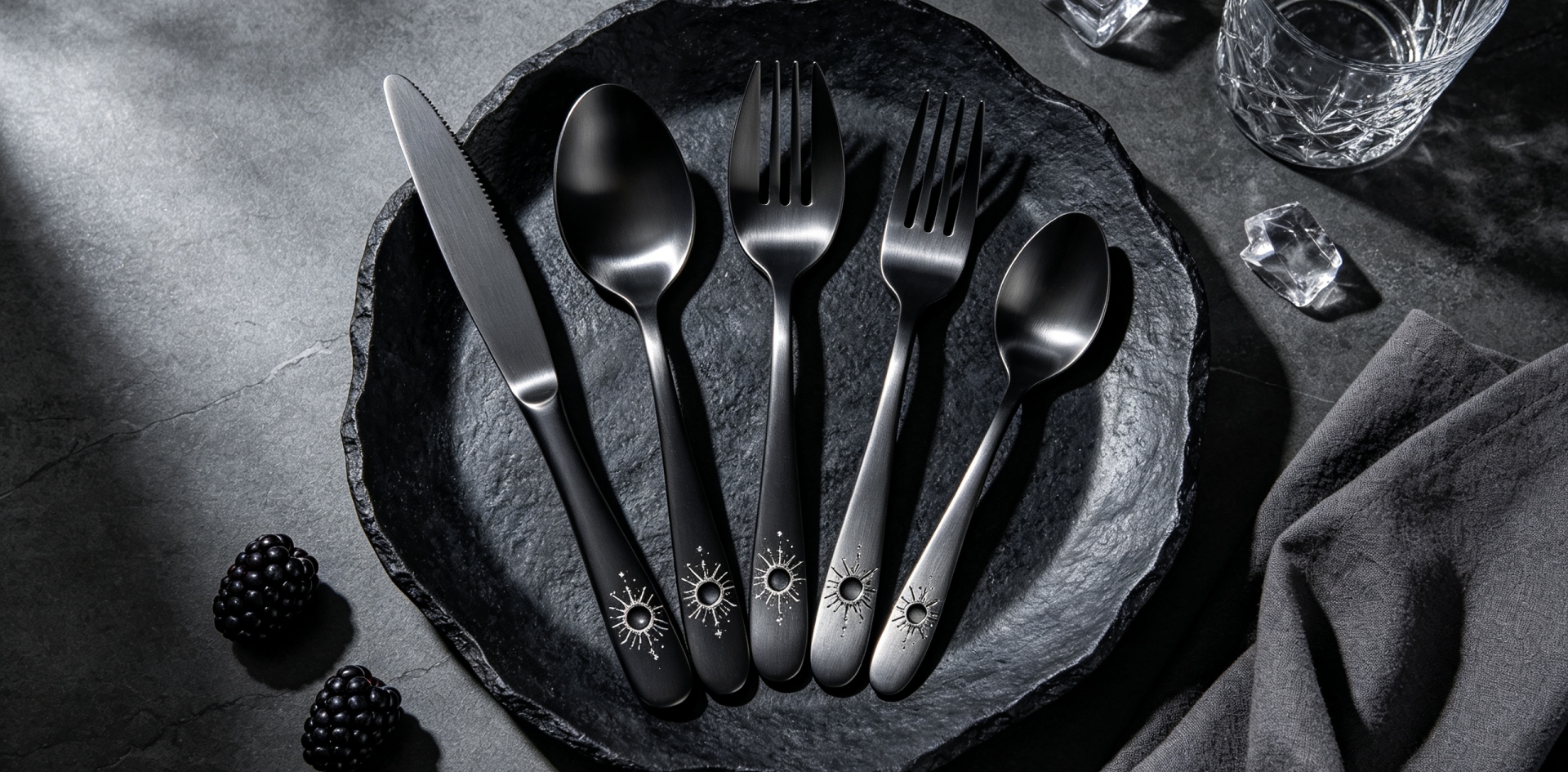
Stainless Steel Knife Handle Curvature: A Practical Detail for B2B Custom Designs
When developing a custom stainless steel table knife, buyers usually discuss the blade, handle length, handle width, material, finish, and overall dimensions. Another design detail that can significantly influence the appearance of the finished product is the curvature of the handle.
The handle does not always need to be completely straight. Depending on the design, it may have a subtle curve, a stronger contour, or a combination of straight and curved sections.
For B2B customers developing OEM, ODM, private label, or wholesale stainless steel cutlery, handle curvature can become an important part of the product specification.
What Is Knife Handle Curvature?
Handle curvature describes the way the knife handle changes direction along its length.
A handle may follow a relatively straight line, or it may gradually curve toward one direction. The curvature can also change along different sections of the handle.
In a custom stainless steel knife, this characteristic contributes to the overall silhouette of the product.
Even when two knives have the same overall length and similar blade dimensions, different handle curvature can give them very different visual identities.
For a private label collection, this can be an effective way to create a distinctive appearance without changing the basic function of the knife.
Why Handle Curvature Matters in Custom Cutlery
The handle is one of the first parts buyers notice when comparing similar cutlery designs.
A straight handle can create a clean and restrained appearance, while a curved handle may give the product a softer or more dynamic visual direction.
The appropriate curvature depends on the design concept and the relationship between the knife and the rest of the collection.
For B2B buyers, the key is not simply choosing a curved or straight handle. It is defining a shape that can be reproduced accurately and consistently in production.
Curvature and Overall Knife Proportion
The handle should be considered together with the blade.
The blade and handle form one complete product, so a change in the handle curvature can affect the visual balance of the entire knife.
For example, a strongly curved handle may require a different relationship with the blade than a straight handle.
Likewise, a subtle curve may need to be coordinated with the blade profile to maintain a clean overall silhouette.
When developing an OEM product, these elements can be reviewed together during the technical drawing and sample stages.
The objective is to establish a complete design rather than optimize the handle independently.
Handle Curvature and Brand Design
Private label brands often want their flatware to have recognizable design characteristics.
This does not necessarily require complicated decoration.
A distinctive handle contour can become part of the brand's visual language.
When the curvature is combined with the handle proportions, surface finish, and blade design, the knife can develop a recognizable appearance.
For a complete collection, similar design principles can then be applied to the matching fork and spoon.
This creates a relationship between the different products without requiring their shapes to be identical.
Defining Curvature for OEM Manufacturing
A buyer can communicate handle curvature in several ways.
A technical drawing can show the intended profile and dimensions.
A physical reference sample can communicate the actual three-dimensional appearance.
A product photograph can also provide a useful starting point, although additional measurements may be needed before production.
For more precise OEM projects, the manufacturer may need to understand the exact curve, transition points, and relationship between the handle and blade.
Once these details are confirmed, they can become part of the approved product specification.
Using a Sample to Evaluate the Handle
Handle curvature is one of the design characteristics that can be difficult to judge from dimensions alone.
A physical sample gives the buyer a clearer understanding of the finished silhouette.
The knife can be viewed from different angles and placed beside the matching fork and spoon.
This allows the buyer to evaluate whether the curvature fits the overall collection.
If the handle appears too straight, too curved, or visually unbalanced with the blade, the design can be adjusted before mass production.
For private label projects, sample approval provides an important opportunity to confirm that the finished product matches the intended brand direction.
Curvature and Matching Flatware
A knife is rarely developed completely independently in a full flatware collection.
The customer may also require a matching dinner fork and table spoon.
These products have different structures, but they can share a common visual language.
For example, the knife handle may have a controlled curve, while the fork and spoon handles use related contours.
The exact geometry does not have to be identical.
Instead, the design characteristics can be coordinated so that the three products appear to belong to the same collection.
This approach is useful for brands that want to create a cohesive private label flatware range.
Curvature and Production Repeatability
A custom design must work not only as a sample but also as a repeatable production product.
This is particularly important for B2B buyers placing large quantities.
Once the handle curvature has been approved, it should be incorporated into the manufacturing reference used for the production order.
The factory then has a defined target for reproducing the design across the required quantity.
For future repeat orders, the same approved specification can be used again.
This makes the curvature a documented product characteristic rather than a subjective visual description.
Supporting Wholesale Cutlery Programs
Wholesale customers often need products that can remain in their assortment for an extended period.
A customized table knife may be sold individually or as part of a complete flatware set.
If the product is successful, the buyer may reorder it repeatedly.
A clearly defined handle profile makes it easier to maintain consistency across these orders.
It can also help distinguish the buyer's customized product from generic stainless steel knives supplied by different manufacturers.
For B2B purchasing, this can be particularly useful when the product forms part of a private label range.
ODM Product Development
ODM manufacturing can be useful when a customer wants to develop a distinctive product without creating every manufacturing detail independently.
The manufacturer can start from an existing production concept and adapt the design according to the customer's commercial requirements.
Handle curvature can be modified as part of this process.
The customer may want a more contemporary appearance, a softer silhouette, or a shape that visually connects with an existing collection.
The final curvature can then be evaluated through sampling before the product is released for bulk production.
From Design Detail to Production Specification
A successful custom knife project requires the design to be translated into clear manufacturing information.
Handle curvature should therefore be considered together with overall length, blade dimensions, handle dimensions, material, thickness, finish, and other agreed specifications.
When the complete product is documented clearly, the factory has a stronger reference for production.
The buyer also has a more reliable basis for quotation confirmation, sample approval, quality discussion, and future purchasing.
This becomes increasingly important as the number of SKUs in a private label collection grows.
Homefelt for Custom Stainless Steel Knife Manufacturing
Homefelt specializes in stainless steel knives, forks, spoons, cutlery sets, and flatware for B2B customers.
With more than 40 years of experience in the stainless steel cutlery business, the factory supports OEM, ODM, private label, wholesale, and bulk manufacturing projects.
Customers can provide their own drawings, reference samples, product photographs, or initial design requirements.
For a custom table knife, details such as handle curvature can be reviewed together with the blade, handle proportions, overall dimensions, surface finish, and matching cutlery.
When a complete collection is being developed, the design relationship between the knife, fork, and spoon can also be considered from the beginning.
This gives wholesalers, distributors, and private label brands a practical way to move from an initial design concept to a production-ready stainless steel flatware collection.
Once the sample has been approved, the agreed specifications can serve as the basis for bulk production and future repeat orders.
Build Your Custom Stainless Steel Knife
Handle curvature may appear to be a small design detail, but it can influence the visual character of a stainless steel table knife and its relationship with the rest of a flatware collection.
For B2B buyers, defining this detail clearly can make communication with the manufacturer more efficient and help ensure that the approved design can be reproduced consistently.
If you are developing a custom stainless steel knife, private label flatware collection, or OEM cutlery program, you can provide your reference sample, drawing, or product requirements to begin the development and quotation process.
Request a Custom Stainless Steel Table Knife Quotation
Develop an OEM Stainless Steel Knife
Start a Private Label Flatware Manufacturing Project
Request Wholesale Stainless Steel Table Knife Pricing
Develop a Matching Knife, Fork and Spoon Collection
Stainless Steel Table Knife Shoulder Width: A Practical Detail for B2B Custom Designs
Stainless Steel Spoon Handle Centerline: A Practical Detail for B2B Custom Designs
Related Article



