
Stainless Steel Spoon Bowl Lift Height for OEM and Private Label Production
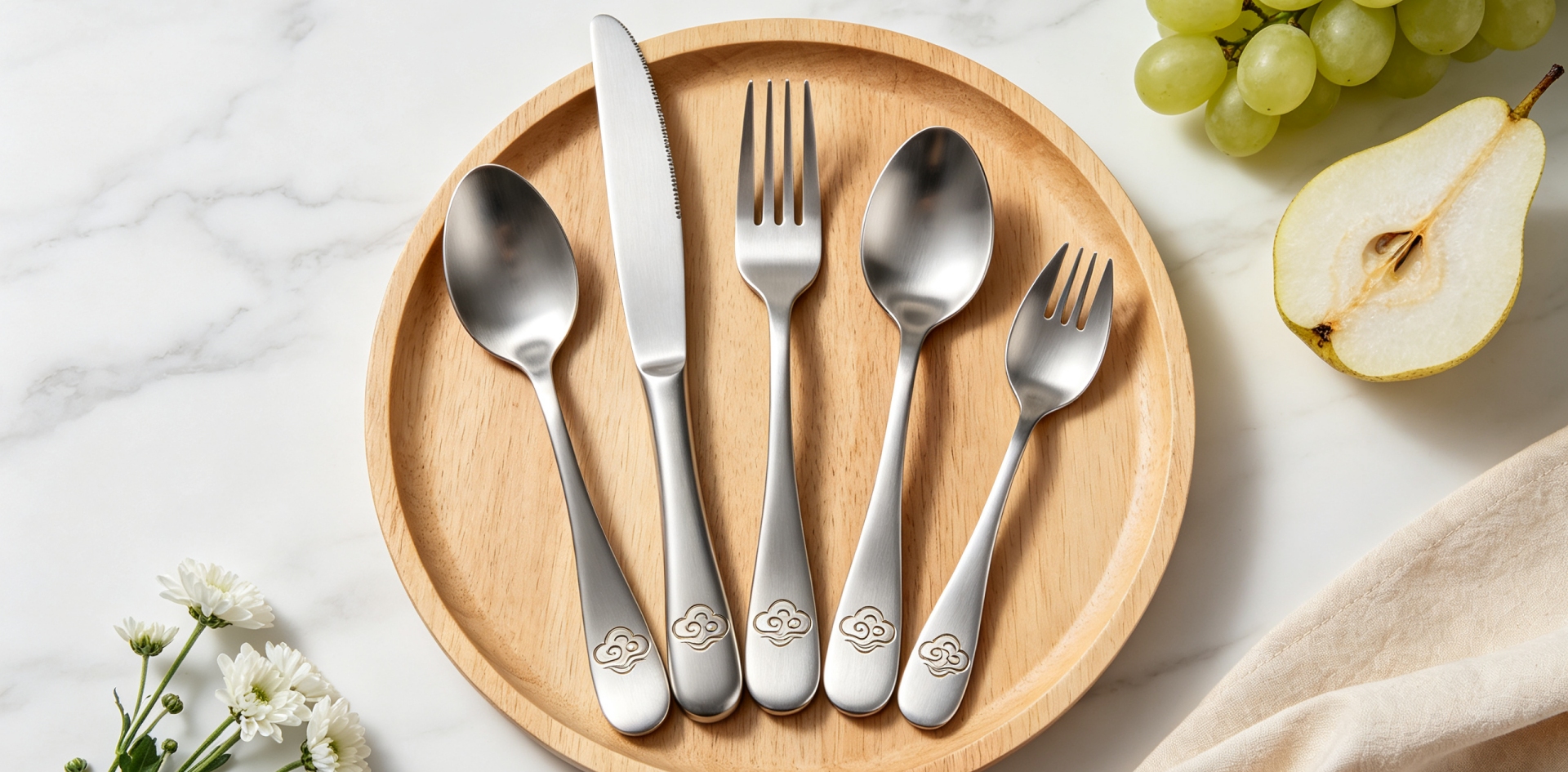
Stainless Steel Spoon Bowl Lift Height for OEM and Private Label Production
In stainless steel spoon manufacturing, the bowl is usually evaluated through dimensions such as length, width and capacity. However, another three-dimensional parameter can have a significant influence on the finished product: bowl lift height.
Bowl lift height describes the vertical elevation of the spoon bowl relative to an established reference plane, normally considered together with the handle and longitudinal centerline. It is not simply the same as bowl depth. A spoon can have similar depth but a different overall elevation or transition from the handle into the bowl.
For OEM and private label projects, controlling this relationship helps manufacturers reproduce the intended spoon profile across large production quantities.
What Is Spoon Bowl Lift Height?
A stainless steel spoon is a three-dimensional formed product. The bowl curves across its width and length while the handle generally follows a defined longitudinal direction.
Bowl lift height can be understood as the vertical position of the bowl's functional surface or reference point relative to the selected handle plane.
Depending on the spoon design, manufacturers may define reference points around:
-
Bowl center
-
Bowl opening
-
Longitudinal centerline
-
Handle reference plane
-
Bowl-to-handle transition
-
Lowest bowl point
-
Upper bowl profile
The exact measurement method should be established according to the product drawing because different spoon constructions may use different reference surfaces.
This is particularly useful for custom spoons where the visual profile has been carefully developed for a particular brand or collection.
Why Bowl Lift Height Matters
The vertical position of the bowl contributes to the overall silhouette of the spoon. If it changes during production, the spoon may appear flatter or more elevated than the approved sample.
This can influence several practical characteristics.
First, it affects the relationship between the bowl and handle. A spoon with a relatively elevated bowl may have a more pronounced three-dimensional profile, while a lower configuration may create a flatter appearance.
Second, it can influence how the spoon sits when placed on a table or inside packaging. For retail and hospitality collections, visual consistency between pieces is important.
Third, bowl lift height can influence the perceived transition from handle to bowl. Even when the handle length and bowl dimensions remain unchanged, a different vertical relationship can make the entire spoon feel different.
For private label buyers, these details can be part of the visual identity of the product.
Bowl Lift Height Is Not the Same as Bowl Depth
These two parameters are related but should not be treated as identical.
Bowl depth describes the vertical distance within the bowl between a reference opening plane and the lowest internal point. Bowl lift height describes the position of the bowl within the overall three-dimensional profile.
A production specification may therefore require both.
For example, two spoons could have similar bowl depth but different bowl lift heights because their transition geometry and handle reference planes are different.
This distinction becomes especially useful when reproducing an existing sample. Instead of describing the spoon as simply “deep” or “shallow,” the manufacturer can establish measurable reference relationships.
How Bowl Lift Height Is Developed
During OEM product development, bowl lift height is normally considered together with the complete spoon geometry.
The engineering team may review:
-
Overall spoon length
-
Bowl length
-
Bowl width
-
Bowl depth
-
Handle length
-
Handle cross-section
-
Bowl-to-handle transition
-
Material thickness
-
Forming requirements
-
Finished surface requirements
The objective is to create a balanced product rather than optimizing one dimension independently.
Material thickness also matters. Stainless steel sheet with a particular thickness behaves differently during forming compared with a thinner or thicker specification. Tooling geometry and forming pressure need to work together to achieve the required final shape.
For a custom spoon, the approved sample and technical drawing can therefore serve as the primary references for subsequent production.
Maintaining Consistency During Mass Production
The challenge becomes greater when the same spoon is manufactured in large quantities.
During forming, stainless steel passes through controlled deformation processes. Tool condition, material characteristics, forming pressure and production sequence can influence the final three-dimensional profile.
If bowl lift height is not controlled, differences may gradually appear between production batches.
A professional production system should establish suitable inspection references before mass production begins. Depending on the spoon design, checks may include dimensional fixtures, profile gauges, sample comparison and controlled visual inspection.
The purpose is to identify deviations before they become widespread across a production batch.
Bowl Lift Height in OEM and Private Label Collections
For private label collections, a spoon rarely exists as an isolated product. It normally needs to coordinate visually with forks and knives.
The spoon's overall profile should therefore be considered alongside the collection's design language.
A modern flatware collection may use relatively simple surfaces and controlled geometric transitions. A classic collection may use more decorative shapes. A premium collection may combine sculpted handles with carefully formed bowls.
In each case, the spoon bowl lift height can contribute to the visual relationship between the working end and handle.
For branded collections, small dimensional differences can become more noticeable when products are placed side by side in retail packaging or arranged together on a table.
Homefelt Factory's Approach to Custom Spoon Production
Homefelt factory specializes in stainless steel knives, forks, spoons and complete flatware collections for B2B customers. The factory supports OEM, ODM, private label, wholesale and large-volume production.
For a custom spoon project, customers can provide an existing sample, technical drawing, product image or initial concept. The manufacturing team can review the required dimensions and structure and then develop a practical production specification.
The service can cover product design, sample development, manufacturing, packaging and transportation as a one-stop solution. This allows the production plan to be adjusted according to the customer's market, order quantity, packaging requirements and product positioning.
For customers developing their own branded flatware, this approach can also reduce the gap between a design concept and a repeatable production product.
Quality References and Manufacturing Experience
Homefelt has 40 years of experience in the stainless steel cutlery business and has worked with well-known brands and international customers.
The factory has passed BSCI, SEDEX 4P, BRC, ISO9001 and Disney audit requirements, with FAMA and FSC certificates available for applicable projects.
These qualifications provide supporting information when buyers evaluate a manufacturing partner. For an individual spoon project, however, the most important production references remain the approved sample, agreed specifications, material requirements and inspection criteria.
This combination of manufacturing experience and documented product requirements helps create a clearer path from prototype to bulk production.
From Spoon Concept to Bulk Order
A successful custom spoon is not determined by one measurement alone. Bowl dimensions, lift height, wall thickness, handle geometry, material specification, surface treatment and packaging all need to work together.
This is especially important for buyers ordering thousands of pieces under one private label program. Consistency between the first approved sample and subsequent production should be considered from the beginning of the project.
Homefelt can work with buyers on stainless steel spoon development for restaurant supply, hospitality collections, retail programs, distributors and private label brands. OEM and ODM projects can be developed according to specific product drawings, target specifications and order requirements.
If you already have a spoon sample or design idea, the factory can review the structure and help convert the concept into a production-ready specification.
Related Article



