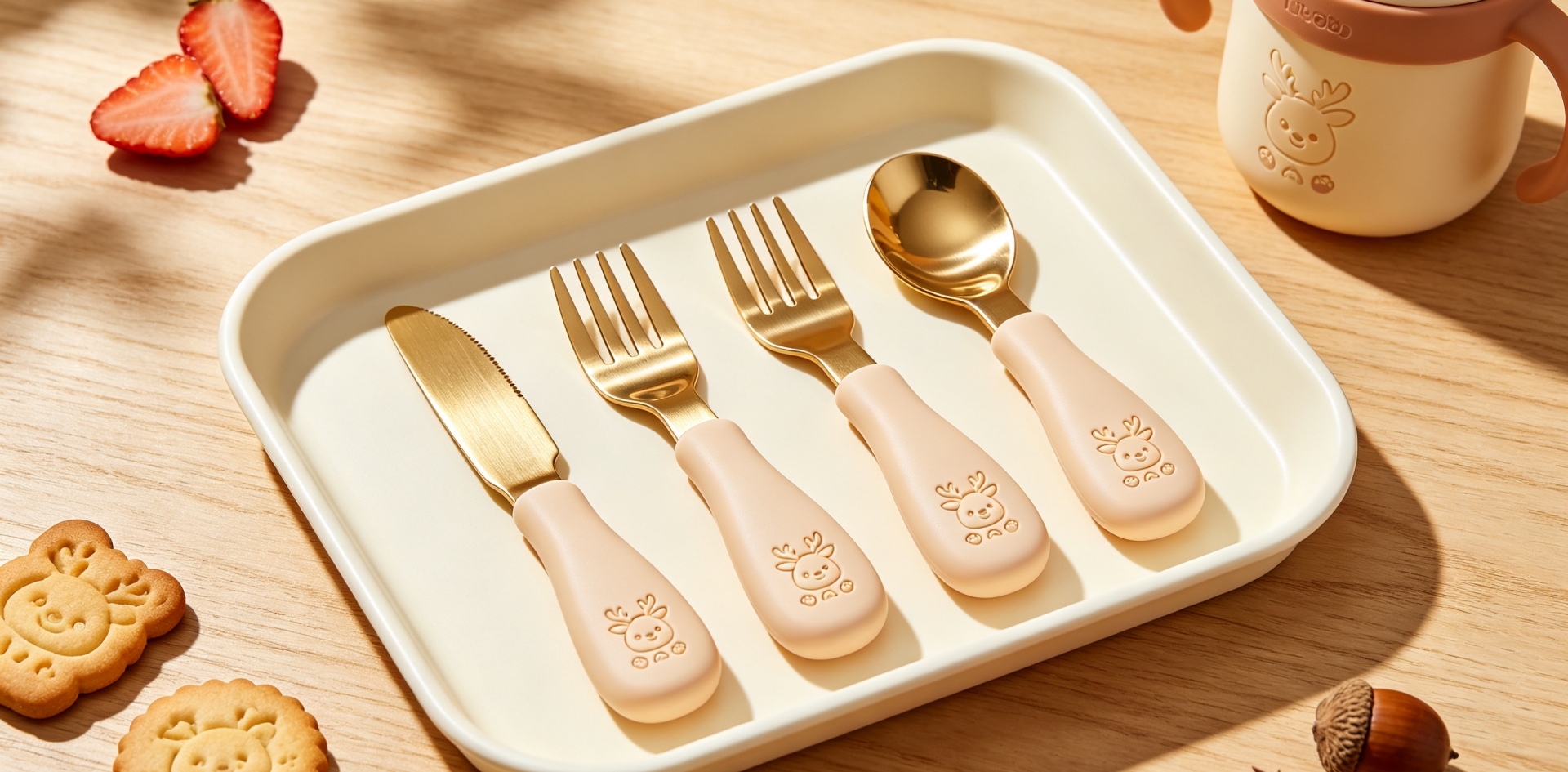
Stainless Steel Spoon Decorative Pattern Alignment

Stainless Steel Spoon Decorative Pattern Alignment
Decorative patterns can give a stainless steel spoon a distinctive appearance and help a cutlery collection stand out in the market. Whether the handle features engraved lines, embossed details, geometric motifs, or a repeated decorative border, the position of the pattern matters as much as the design itself.
For importers, distributors, retailers, and private label brands, inconsistent pattern placement can make products from the same order look noticeably different. A motif that sits too close to one edge, shifts away from the centerline, or appears at different distances from the handle end may affect the overall presentation of a coordinated collection.
For this reason, decorative pattern alignment should be considered during product development rather than left entirely to final visual inspection. Homefelt factory supports stainless steel spoon customization, OEM/ODM development, private label projects, and bulk cutlery production for B2B customers.
Why Decorative Pattern Position Matters
A decorative handle is usually designed around the proportions of the complete spoon. Its pattern may follow the centerline, align with the handle edges, or occupy a defined area between the neck and the handle end.
Even when the motif itself is correct, inconsistent positioning can change the appearance of the finished product. A pattern placed too close to one side may look asymmetrical. A repeated border that stops at different distances from the tip can make otherwise identical spoons appear inconsistent.
Pattern alignment is particularly important for collections with several spoon sizes. A teaspoon and a dinner spoon may have different handle lengths, but their decorative elements should follow the intended design logic.
Buyers should distinguish between two requirements:
-
Pattern accuracy: Whether the intended design details have been reproduced correctly.
-
Pattern positioning: Whether those details appear in the correct location and orientation on the handle.
Both may need separate acceptance criteria for a custom product.
Common Types of Decorative Handle Patterns
Different decorative methods create different alignment requirements. The inspection approach should reflect how the pattern is produced and how it appears on the finished spoon.
Engraved lines and motifs may require consistent spacing, direction, and placement. If a design includes several parallel lines, uneven spacing can become visible when spoons are arranged side by side.
Embossed or raised patterns require attention to the location and definition of the raised features. Their position should remain consistent relative to the handle outline, and the details should not appear unintentionally distorted.
Repeated geometric patterns need consistent spacing and orientation. A sequence of diamonds, circles, or other motifs may look unbalanced if the spacing changes noticeably along the handle.
Border patterns often follow the perimeter of a handle. Their appearance depends on the relationship between the border and the handle edges, particularly around curves and tapered sections.
Decorative logo areas may combine a brand mark with other visual elements. Buyers should confirm the relative positions of the logo, pattern, and handle end before approving the final sample.
How to Define Pattern Position in a Technical Drawing
A written instruction such as “place the pattern in the center” may not provide enough information for accurate production. The center could refer to the handle's length, width, decorative panel, or a specific reference point.
A technical drawing can remove this ambiguity by identifying the pattern's position in relation to defined datums.
Depending on the design, useful information may include:
-
Overall handle length and width.
-
Pattern start and end positions.
-
Distance from the handle end to the first decorative feature.
-
Horizontal or longitudinal centerline.
-
Pattern width and overall length.
-
Spacing between repeated elements.
-
Rotation or orientation of the motif.
-
Permitted positional variation for critical features.
For a simple pattern, a dimensioned drawing and approved sample may be sufficient. More complex designs may benefit from a detailed enlargement showing the decorative area separately.
If a pattern follows a curved handle, the drawing should make clear how its position is measured. A straight-line distance and a distance measured along a curved surface are not necessarily equivalent. The buyer and factory should agree on the reference method before production.
Sample Approval: What Buyers Should Check
A physical sample provides an opportunity to confirm both the pattern's appearance and its location on the finished spoon. This is especially important when photographs or digital artwork were used during the early design stage.
During sample review, buyers can check the following points:
-
Compare the motif with the approved artwork or drawing.
-
Confirm the pattern's position relative to the handle centerline and end.
-
Check the spacing and orientation of repeated features.
-
Review whether the pattern remains visually balanced on the handle.
-
Inspect the relationship between decorative details and the handle edges.
-
Confirm that the pattern remains clear after the specified surface finishing.
The pattern should be evaluated on the finished product, not only on an unfinished sample. Polishing and other finishing operations may affect how clearly a decorative feature appears.
If a sample requires revision, the feedback should identify the location and nature of the discrepancy. For example, stating that the pattern must move a defined distance toward the handle end is more useful than describing it simply as “slightly misplaced.”
Manufacturing Factors That Can Affect Alignment
Decorative pattern consistency depends on the design, tooling, positioning method, product geometry, and finishing requirements. The relevant controls vary according to the pattern type.
For patterns produced using dedicated tooling, the tooling layout and its relationship to the spoon blank influence the final position. For processes that require separate positioning or registration, the locating method must consistently reference the same part of the handle.
The shape of the handle also matters. A wide, flat decorative panel may provide a clear reference area, while a narrow or tapered handle leaves less room for positioning variation. Curved surfaces and decorative contours can make alignment more challenging than a simple flat layout.
Finishing must also be considered. Excessive polishing may soften small engraved or embossed details, while inconsistent material removal may make repeated patterns appear different from one another.
These factors should be reviewed during sample development so that the proposed design is suitable for repeat manufacturing at the expected order volume.
Maintaining Pattern Consistency Across Bulk Orders
Once the design has been approved, the factory should use a controlled reference for production. This may include the technical drawing, approved sample, decorative artwork, tooling reference, and agreed inspection criteria.
A practical inspection plan can include:
-
Verifying the first production samples against the approved design.
-
Checking pattern position on selected items during production.
-
Comparing repeated motifs for spacing and orientation.
-
Inspecting the finished surface for incomplete or distorted details.
-
Recording deviations and confirming corrective action where necessary.
The inspection frequency should reflect the complexity of the pattern, order quantity, production method, and buyer's quality requirements. A simple decorative line may need fewer checks than a detailed repeating motif covering most of the handle.
For repeat orders, the approved pattern version should be recorded alongside the product code and drawing revision. This reduces the risk of outdated artwork or an earlier sample being used for a new production run.
Coordinating Patterns Across Different Spoon Sizes
A cutlery collection may include teaspoons, dessert spoons, table spoons, and serving spoons. Their handle dimensions can differ substantially, so applying the same decorative layout without adjustment may not produce a consistent appearance.
Instead, buyers should identify which pattern characteristics must remain common and which can change with the handle size.
For example, the motif style, line spacing, and general relationship to the handle outline may remain consistent, while the overall pattern length changes to suit each product. The exact approach depends on the collection's approved design.
Homefelt can discuss pattern positioning for custom stainless steel spoon ranges and related flatware products. Providing drawings for the complete collection helps establish a consistent visual direction before individual samples are finalized.
Documentation and Quality Records
Clear records help maintain the approved decorative design throughout development, production, and repeat purchasing.
A project specification may include the product code, artwork revision, dimensioned drawing, approved sample identification, finish requirements, and pattern-position inspection results. If a buyer requests a specific measurement method or formal acceptance tolerance, those requirements should be documented before production begins.
Relevant material records, inspection reports, and factory certification documents can also support supplier evaluation where applicable. However, general factory certification does not establish that a decorative pattern is correctly positioned. That requirement needs to be checked against the approved product specification.
For buyers managing multiple SKUs, keeping each pattern version linked to the correct product code is especially useful. It helps purchasing, product development, and quality teams refer to the same approved design.
Preparing a Custom Pattern Inquiry
When requesting a quotation for a decorative stainless steel spoon, provide the expected quantity, material preference, handle dimensions, surface finish, and packaging requirements. Include the original artwork or a clear reference image, along with any drawing that defines the pattern's position.
If the artwork is not yet finalized, describe the intended style and ask the factory to review its manufacturing feasibility. Agree on the sample approval process and critical inspection points before moving to bulk production.
Homefelt factory offers stainless steel cutlery customization, OEM/ODM manufacturing, private label development, wholesale supply, and large-volume production. One-stop support can include product design coordination, packaging, and transportation planning tailored to each customer's needs.
To discuss a decorative spoon design or request a quotation, contact ingrid@homefelt.net with your reference artwork, target specifications, and expected order quantity.
You May Be Interested In
Stainless Steel Spoon Bowl Wall Thickness Distribution
Stainless Steel Spoon Bowl Curvature and Contour Control
Related Article