
Stainless Steel Cutlery Center Offset Control for OEM and Private Label Manufacturing
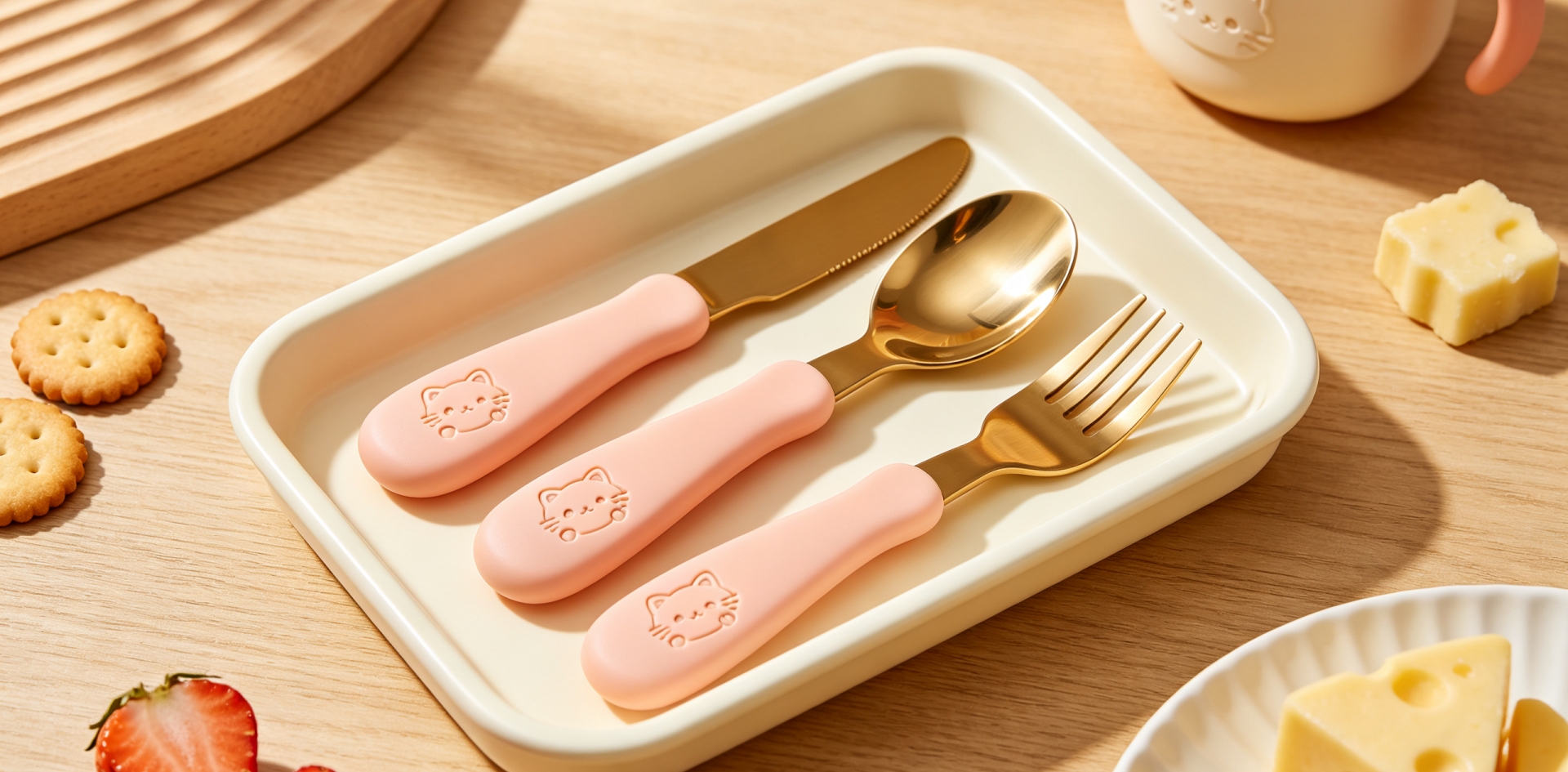
Stainless Steel Cutlery Center Offset Control for OEM and Private Label Manufacturing
When a stainless steel spoon, fork or table knife is designed for commercial production, its important dimensions are not limited to length, width and thickness. The position of key product features relative to the intended center reference can also affect the appearance and consistency of the finished cutlery.
Center offset describes the positional difference between a specified product feature and its intended reference center. It can involve the relationship between a handle and working end, a decorative feature and the product reference, or another defined section of the cutlery.
For OEM and private label manufacturing, controlling this offset helps ensure that the finished products remain consistent with the approved design.
What Does Center Offset Mean?
A stainless steel cutlery piece normally has one or more reference axes established during product development. These references allow the production team to determine whether important features remain in their intended position.
Depending on the product, the inspection reference may involve:
-
Product longitudinal reference
-
Handle reference
-
Working-end reference
-
Decorative feature position
-
Logo location
-
Functional center
-
Tooling reference
-
Packaging orientation
Center offset is then evaluated as the distance or positional difference between the actual feature and the specified reference.
The exact definition should be established in the product drawing because a spoon, fork and knife may have different functional reference structures.
Why Center Offset Matters in Cutlery Production
Small positional differences can become more noticeable when a product contains a clearly defined geometric design.
For example, a spoon with a decorative line running through its handle may require that line to remain properly positioned relative to the bowl.
A fork with a special handle detail may require the feature to remain aligned with the fork head.
A table knife with a branded element may need the feature to maintain a consistent relationship with the blade and handle.
When hundreds or thousands of pieces are produced, even small deviations can create visible differences within the same SKU.
This is particularly important for private label buyers who have invested in a distinctive product identity.
Center Offset Is More Than Visual Alignment
Center offset can also have a practical role in production.
A product may need to fit into a packaging insert, presentation box or molded tray. If a feature or section is consistently displaced from the intended position, it can affect how the product sits within the packaging.
For cutlery sets, the relationship between individual pieces can also influence the overall presentation.
This is why a good specification should describe important positional relationships rather than relying only on phrases such as “centered” or “straight.”
How Center References Are Established
During OEM development, the factory can establish reference points based on the product drawing and approved sample.
For a spoon, the bowl and handle may provide the main longitudinal reference.
For a fork, the fork head and tine arrangement can provide important reference information.
For a table knife, the blade and handle relationship can establish the required product direction.
Once the reference is defined, specific features can be checked against it.
The measurement method should be simple enough for production inspection while accurately representing the customer's design requirement.
Factors That Can Influence Center Offset
Several manufacturing stages can affect the final position of a feature.
Blank dimensions determine the initial distribution of material. Forming operations then transform the blank into the final three-dimensional product.
Tooling geometry also plays an important role. If the tool reference is not properly matched with the intended product center, repeated offset may appear throughout production.
Decoration and logo application can introduce another layer of positional control. Surface treatment and finishing should therefore be considered together with the original product reference.
For assembled products, component joining may also influence final positioning.
This is why center offset should ideally be considered during product engineering rather than being treated only as a final inspection issue.
Controlling Center Offset in Mass Production
For bulk orders, the objective is to establish a repeatable production method.
A typical control process may include:
-
Review of technical drawings
-
Confirmation of product references
-
Sample development
-
Tooling verification
-
First-piece inspection
-
In-process dimensional checks
-
Finished-product inspection
-
Packing verification
The actual inspection frequency depends on the project requirements and order volume.
For selected products, a dedicated fixture can make positional inspection faster and more consistent. For other designs, dimensional gauges or visual reference templates may be more practical.
The important point is that the inspection method should be connected directly to the approved specification.
Center Offset in Custom and Private Label Flatware
Custom flatware often contains more distinctive details than standard catalog products.
A private label collection may include:
-
Custom logos
-
Decorative grooves
-
Embossed patterns
-
Special handle shapes
-
Geometric surfaces
-
Two-tone designs
-
Custom packaging
These features make positional consistency more important.
When a product is photographed, displayed in retail packaging or arranged on a restaurant table, inconsistent positioning can make the collection appear less refined.
A controlled center reference gives the factory a practical way to reproduce the design across production batches.
Homefelt Factory for Custom Stainless Steel Cutlery
Homefelt factory specializes in stainless steel knives, forks, spoons and complete flatware collections for B2B customers.
The factory supports OEM, ODM, private label, wholesale and large-volume manufacturing. Customers can provide existing samples, drawings, reference products or initial design concepts for evaluation.
During development, the production team can review the relationship between material specification, blank design, tooling, forming, decoration and final inspection.
Homefelt also provides one-stop support covering product design, manufacturing, packaging and transportation. This allows customers to develop an exclusive service solution according to their product requirements, market positioning and order volume.
For distributors, retailers, hospitality suppliers and private label brands, this integrated approach can make custom product development easier to manage.
Manufacturing Experience and Quality References
Homefelt has 40 years of experience in the stainless steel cutlery business and has worked with well-known brands and international B2B customers.
The factory has passed BSCI, SEDEX 4P, BRC and ISO9001 requirements and has experience with Disney audits. FAMA and FSC certificates are also available for applicable projects.
For buyers evaluating a supplier, these documents provide supporting information about the manufacturer's production and management capabilities.
For a specific cutlery project, however, product drawings, approved samples, material specifications and inspection requirements remain the key technical references.
This combination of practical manufacturing experience and clearly defined specifications helps reduce uncertainty during bulk production.
From Product Reference to Repeatable Manufacturing
Center offset may seem like a small dimensional detail, but it becomes valuable when a custom cutlery design depends on precise relationships between its different sections.
For OEM and private label projects, defining the reference before production can help the factory understand exactly where important features should be positioned.
Homefelt can support custom stainless steel spoons, forks, knives and complete flatware sets from product development through bulk manufacturing. The team can work with customer drawings, physical samples and target specifications to develop a suitable production approach.
If you are preparing a new stainless steel cutlery project, send your product drawings, reference samples, required materials and target quantity to ingrid@homefelt.net.
Related Article



