
Stainless Steel Cutlery Collection Structure for B2B Brands
Stainless Steel Cutlery Collection Structure for B2B Brands
A stainless steel cutlery collection is more than a group of individual knives, forks and spoons. For B2B brands, the way products are grouped can influence purchasing decisions, inventory management, packaging and future collection development.
A buyer may start with a few popular pieces, but as the business grows, the range can quickly become more complex. Different handles, finishes, lengths, set configurations and packaging options can create many SKUs.
Building a clear collection structure from the beginning helps keep the range easier to manage while giving customers enough choice.
Start With a Clear Collection Direction
Before selecting individual products, it is useful to define what the collection is intended to achieve.
A brand may want to develop a complete everyday flatware range, a premium stainless steel collection, a private label retail series or a practical range for wholesale distribution.
The collection direction influences many later decisions.
For example, a premium range may require more attention to handle details and surface finishing, while a wholesale program may place greater importance on consistent specifications, efficient packaging and suitable price positioning.
A stainless steel cutlery factory can review these requirements before discussing individual models, helping the buyer connect the product concept with realistic manufacturing conditions.
Create a Logical Product Structure
A well-organized collection normally has a clear relationship between its products.
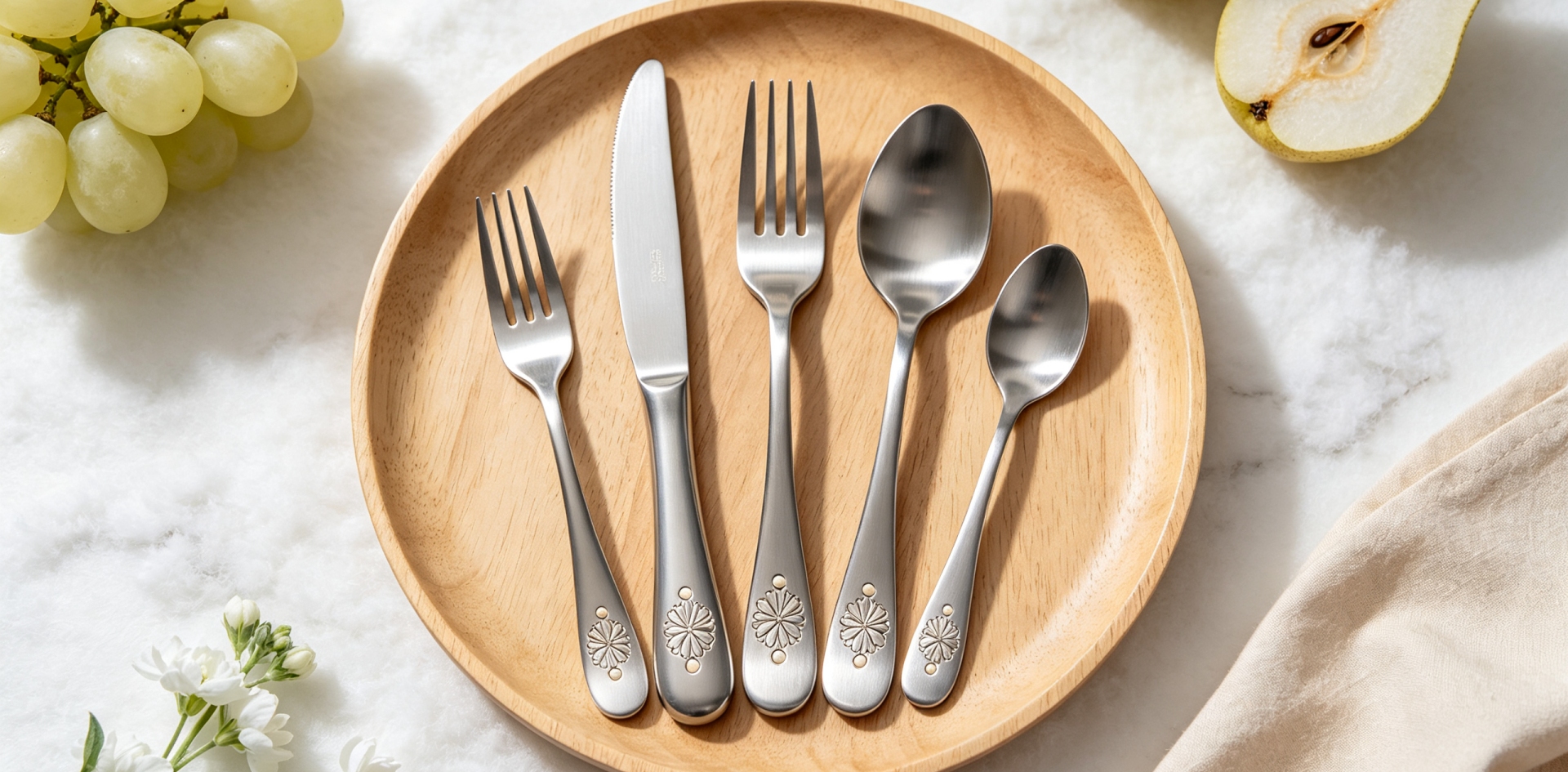
Dinner knives, dinner forks and dinner spoons can form the core group. Smaller spoons or additional forks can then be added according to the target market and sales channel.
The objective is not necessarily to offer the largest possible number of products.
Instead, the collection should contain pieces that make sense together and serve clear commercial purposes.
For B2B buyers, this approach can make purchasing and inventory decisions easier because every SKU has a defined role within the range.
Coordinating Knives, Forks and Spoons
Visual coordination is particularly important when several cutlery pieces are sold as a collection.
The handle shape, surface finish, proportions and decorative details should create a consistent overall appearance.
This does not mean every piece must be completely identical. A spoon, fork and knife have different functional requirements, so their dimensions and working ends naturally differ.
The important point is that the pieces should feel like members of the same collection.
For custom projects, Homefelt factory can discuss the relationship between different knife, fork and spoon designs so that the final range maintains a consistent direction.
Managing Different Product Levels
Some B2B brands need more than one product level within the same collection.
For example, a business may offer a standard stainless steel range alongside a more customized or premium range. Another company may use different specifications for different customer groups.
These products can be organized as separate levels while maintaining the overall brand identity.
This structure can give distributors and retailers more options without requiring the brand to create an unrelated product family for every price segment.
The factory can then discuss the appropriate specifications and production requirements for each group.
Avoiding Unnecessary SKU Growth
One of the challenges of expanding a cutlery range is controlling the number of SKUs.
A small design difference can create a completely new product reference. If several handle variations, finishes and packaging configurations are combined, the number of possible products can increase rapidly.
For B2B buyers, every additional SKU can affect purchasing, inventory, product photography, packaging and order management.
A practical collection therefore focuses on meaningful product differences rather than creating variations simply for the sake of variety.
A factory with experience in stainless steel cutlery can help buyers consider which variations are realistic for production and which may add complexity without enough commercial value.
Planning Individual Pieces and Sets
A cutlery collection may be sold as individual pieces, complete sets or both.
Selling individual knives, forks and spoons can be useful for wholesalers and distributors that need flexible replenishment. Complete sets can provide a more convenient option for retail or private label programs.
The two approaches can also work together.
For example, a brand may develop a core four-piece set while keeping the individual pieces available for replacement or additional purchases.
This creates more flexibility without requiring an entirely separate product collection.
Packaging should be considered alongside the selected sales format because individual products and complete sets may require different packaging configurations.
Building a Collection Around the Target Customer
The same stainless steel cutlery range can be structured differently depending on who will purchase it.
A distributor may need a compact selection of commercially proven products. A retail brand may require several coordinated designs and packaging options. A private label customer may want a collection that is distinctive enough to support its own brand identity.
Understanding the customer's sales channel before finalizing the collection can prevent unnecessary development work.
For this reason, B2B buyers should explain their target market, expected order quantity and preferred sales format when discussing a new project with a factory.
The information gives the supplier a better understanding of what the collection needs to accomplish.
Supporting Private Label Collections
Private label brands often need a collection that looks consistent across packaging, product listings and physical retail displays.
The stainless steel cutlery itself is only one part of this process.
Product names, model numbers, set configurations, logo requirements and packaging information should be organized consistently across the range.
Homefelt can support private label cutlery projects by combining product customization with OEM and ODM manufacturing, branded packaging coordination and bulk production.
This integrated approach allows customers to develop several related products under one collection direction.
Preparing for Future Expansion
A good collection structure should leave room for future development.
A brand may initially launch with three or four core products and later add additional spoons, forks, knives or complete sets based on customer demand.
If the original collection has a clear design direction, new pieces can be developed as natural additions instead of appearing disconnected.
This is one reason why it can be useful to think about the complete collection before placing the first large production order.
The goal is not to manufacture every possible item immediately. It is to understand where the product range can go next.
How a Factory Can Support Collection Development
For a B2B buyer, working with a factory can provide more than manufacturing capacity.
An experienced stainless steel cutlery supplier can help review product references, discuss customization requirements, evaluate production considerations and organize related products into a practical collection.
At Homefelt factory, customers can discuss stainless steel knives, forks, spoons and flatware sets according to their own business requirements.
The service can include OEM, ODM, private label manufacturing, product customization, packaging coordination and large-volume production.
Customers do not necessarily need to follow one fixed service package. Requirements can be discussed according to the actual project, whether the customer needs a few customized products or a broader collection with packaging and export support.
From Collection Planning to Commercial Production
Once the collection structure is confirmed, the next stage is turning the selected products into production-ready items.
Specifications, samples, branding, packaging and quantities can then be reviewed before the order is released.
Clear communication at this stage helps ensure that each SKU is connected to the correct product information and packaging configuration.
For larger B2B orders, this becomes especially important because several models may be produced and packed at the same time.
A structured collection makes the entire process easier to follow, from the initial product discussion to bulk manufacturing and future reorders.
Build a Collection That Can Grow With Your Business
The purpose of a stainless steel cutlery collection is not simply to contain many products.
A strong collection should have a clear relationship between its pieces, match the needs of the target market and remain practical for manufacturing and future expansion.
For wholesalers, distributors and private label brands, this approach can create a more manageable product range while still providing room for new opportunities.
Homefelt factory can work with customers from the early product discussion through customization, OEM/ODM manufacturing, packaging and large-volume production.
If you already have product references, samples or a collection idea, you can send the information directly to the factory for discussion.
Custom Stainless Steel Cutlery Collection
OEM & ODM Flatware Manufacturing
Private Label Stainless Steel Cutlery Factory
Wholesale Stainless Steel Knife Fork Spoon
Textured Handle Stainless Steel Cutlery for B2B Brands
Stainless Steel Cutlery Development for B2B Brands
Related Article



