
Stainless Steel Cutlery Local Height Difference for OEM and Bulk Manufacturing
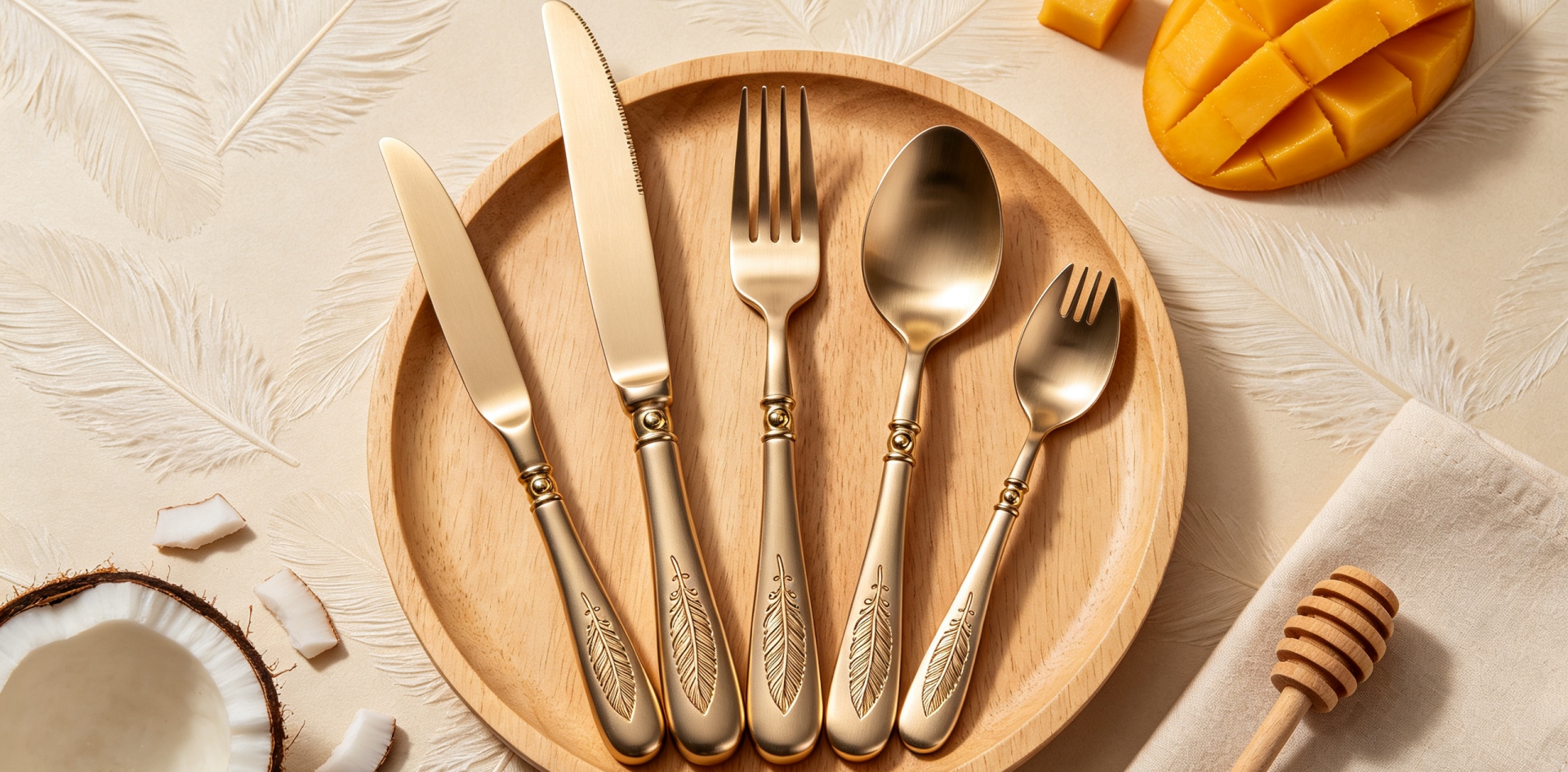
Stainless Steel Cutlery Local Height Difference for OEM and Bulk Manufacturing
A stainless steel cutlery product is a three-dimensional object rather than a simple flat piece of metal. Spoon bowls, fork heads, knife blades and handles can contain several different formed areas, and the height relationship between these areas can influence the final product profile.
Local height difference refers to the vertical relationship between two defined points or surfaces on the same cutlery piece. It can be used to describe how one section sits relative to another section without treating the entire product as either flat or curved.
For OEM and private label projects, defining these local relationships can help manufacturers reproduce a specific product shape more accurately during bulk production.
What Is Local Height Difference?
In cutlery manufacturing, a reference plane or reference point can be established according to the product drawing. Other selected areas can then be measured relative to that reference.
Depending on the design, the reference may involve:
-
Handle surface
-
Bowl reference area
-
Fork head surface
-
Knife blade surface
-
Decorative section
-
Transition area
-
Product center reference
-
Fixture reference plane
The purpose is to describe the relative position of specific areas rather than relying only on an overall visual description.
This can be especially useful for custom products where the design contains multiple formed levels.
Why This Parameter Matters
Two stainless steel spoons can have identical overall length, width and material thickness while still having different three-dimensional profiles.
The same applies to forks and table knives.
A spoon may have a raised transition between its bowl and handle. A fork may contain a shaped head that sits at a controlled height relative to the handle. A table knife may have different height relationships between the blade, bolster and handle.
When these relationships change, the product can look noticeably different even though its main dimensions remain within specification.
For private label collections, these subtle details can contribute to the visual identity of the finished product.
Local Height Difference and Three-Dimensional Design
Modern stainless steel flatware frequently uses formed surfaces instead of completely flat profiles.
A handle may contain a central raised section. A spoon may transition from a deeper functional area toward a higher neck. A knife can have a controlled relationship between blade and handle.
These features should be considered as connected geometry.
When a buyer provides an existing sample, simply measuring the overall thickness may not capture the complete design. Local height measurements can provide additional information about how the product was formed.
For OEM development, this can help the factory understand the intended three-dimensional structure before tooling is finalized.
Material and Tooling Considerations
The final height relationship is influenced by both material and tooling.
Stainless steel sheet thickness affects how the blank responds during forming. Material grade can also influence forming behavior.
Tool geometry determines the shape transferred to the product. If two adjacent sections require different elevations, the tool needs to create a controlled transition between them.
The forming sequence also matters. A product that requires several operations may need the different areas to be established in a defined order.
For this reason, local height difference should be considered during product engineering rather than treated only as a final inspection measurement.
Controlling Local Height During Production
A practical production specification should identify the areas that need to be compared.
For example, a customer drawing may define a reference surface and then specify the acceptable height range of a particular section.
The factory can then use an appropriate inspection method based on the product design.
Possible methods include:
-
Dimensional fixtures
-
Profile gauges
-
Height measurement tools
-
Reference templates
-
Approved master samples
-
First-piece inspection
-
Periodic production checks
The method does not need to be complicated. It needs to provide a repeatable way of determining whether the finished product remains consistent with the approved specification.
Application to Stainless Steel Spoons
For spoons, local height relationships can be important around the bowl, shoulder, neck and handle.
A custom spoon may require the bowl to sit at a particular elevation relative to the handle plane. Another design may use a more pronounced transition between the working area and gripping area.
The important point is that the intended relationship should be defined according to the actual design.
This allows the manufacturer to distinguish between an intentional three-dimensional feature and an unwanted production deviation.
Application to Forks and Table Knives
Forks can also contain multiple formed areas. The fork head, shoulder and handle may each have a defined position within the overall profile.
For table knives, the blade and handle can be evaluated through their relative height and transition relationships.
This becomes particularly useful for custom designs with sculpted handles or decorative elements.
Instead of inspecting only the overall product outline, the factory can establish selected reference points that correspond to the customer's design intent.
Consistency in Bulk Manufacturing
The main challenge for a B2B order is maintaining the same result throughout production.
A sample may look correct when it is developed, but the same geometry needs to remain stable when the order moves into mass production.
This is why production references should be established before the bulk run.
The approved sample can be supported by technical drawings, dimensional requirements and suitable inspection references. These materials give the production and quality teams a common standard.
For repeat orders, retaining the same product specification can also make it easier to reproduce the original design.
Homefelt Factory for OEM and ODM Flatware
Homefelt factory specializes in stainless steel spoons, forks, knives and complete flatware collections for B2B customers.
The factory supports OEM, ODM, private label, wholesale and large-volume manufacturing. Customers can provide physical samples, drawings, product images or initial design concepts for evaluation.
For a custom product, the production team can review material, geometry, forming requirements, surface treatment and inspection references together.
Homefelt also offers one-stop service covering product design, manufacturing, packaging and transportation. This allows customers to develop an exclusive service solution according to their market positioning, product requirements and order volume.
For distributors, retailers, hospitality suppliers and private label brands, this integrated approach can simplify the transition from product concept to repeat production.
Manufacturing Experience and Quality References
Homefelt has 40 years of experience in the stainless steel cutlery business and has worked with well-known brands and international B2B customers.
The factory has passed BSCI, SEDEX 4P, BRC and ISO9001 requirements and has experience with Disney audits. FAMA and FSC certificates are also available for applicable projects.
These documents provide useful supporting information when buyers evaluate a manufacturing partner. For individual products, however, the most important technical references remain the approved sample, material specification, product drawing and agreed inspection requirements.
Combining documented requirements with practical manufacturing experience helps reduce uncertainty during bulk production.
From Product Geometry to Repeatable Supply
Local height difference is a relatively small product parameter, but it can help describe three-dimensional relationships that are difficult to communicate through overall dimensions alone.
For OEM and private label projects, clearly defining these relationships can make custom stainless steel cutlery easier to reproduce and inspect.
Homefelt can support the development and bulk production of stainless steel spoons, forks, knives and complete flatware collections according to customer drawings, samples and specifications.
If you are developing a new cutlery design, send your reference sample, drawings, material requirements and target quantity to ingrid@homefelt.net. The Homefelt team can review the project and discuss a suitable manufacturing solution.
Related Article



