
Stainless Steel Cutlery Set Assembly for B2B Orders
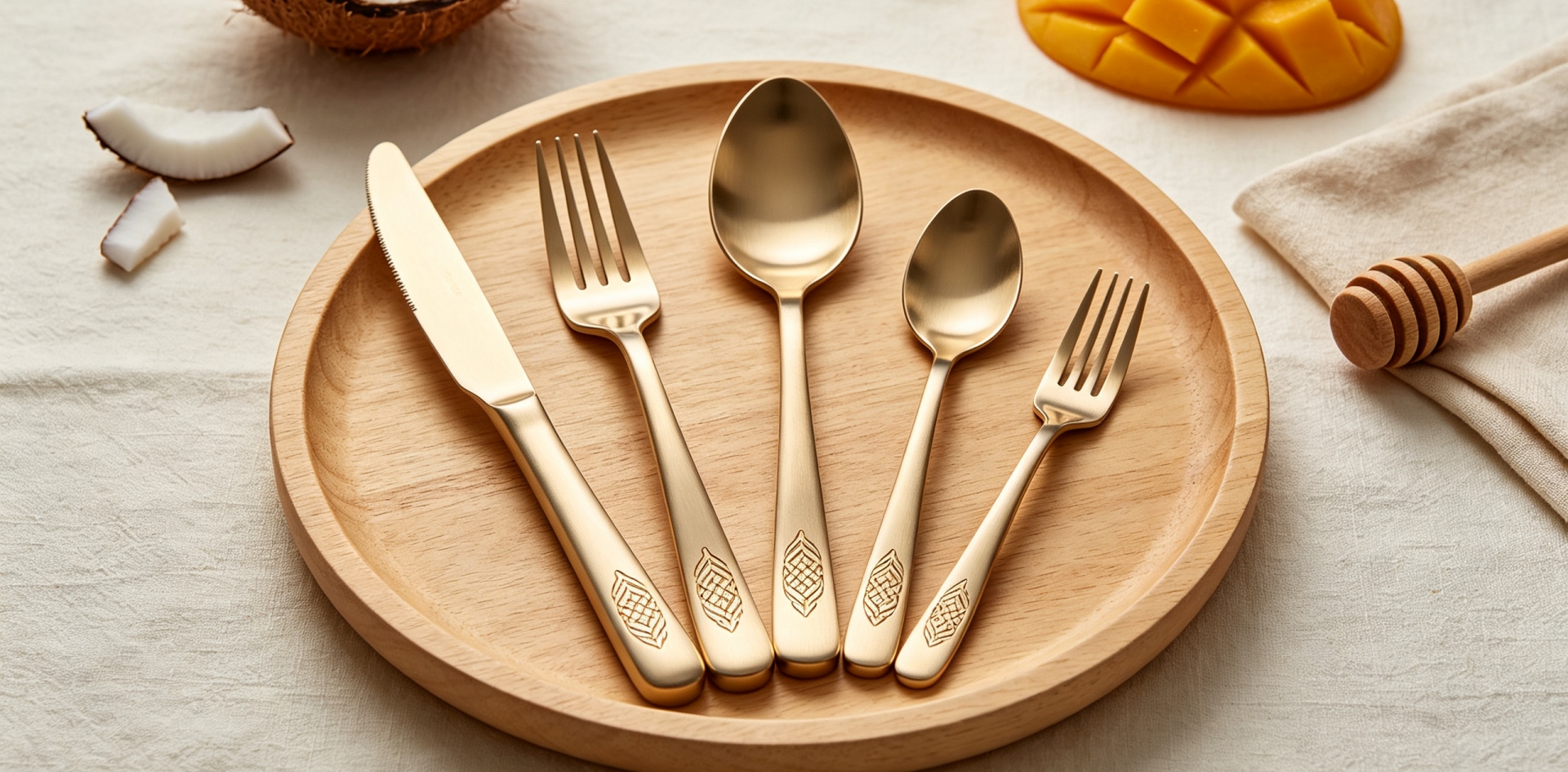
Stainless Steel Cutlery Set Assembly for B2B Orders
A stainless steel cutlery set may contain only a few pieces, but producing a complete set for a large B2B order requires more than manufacturing each knife, fork and spoon separately.
The individual pieces need to come together as one consistent commercial product.
This is where set assembly becomes important.
For wholesalers, distributors, private label brands and retailers, the final set needs to contain the correct pieces, in the correct quantity, with the intended appearance and packaging configuration.
A reliable stainless steel cutlery manufacturer therefore needs to manage both individual product production and the final assembly process.
What Is Cutlery Set Assembly?
Cutlery set assembly is the process of bringing the required knives, forks, spoons and other approved pieces together according to the customer's confirmed set configuration.
The process may include piece counting, matching, visual checking, set preparation, packaging and final verification.
The exact procedure depends on the customer's product and packaging requirements.
A simple four-piece set may contain one table knife, one dinner fork, one tablespoon and one teaspoon.
A larger set may include additional pieces or multiple quantities of the same item.
For B2B production, the assembly process needs to follow the approved product specification rather than relying on assumptions.
Why Assembly Matters for B2B Buyers
When a customer orders individual cutlery pieces, each product can be inspected separately.
A cutlery set creates another level of responsibility.
The individual products need to be combined correctly.
If one piece is missing, duplicated or replaced by the wrong version, the complete set no longer matches the customer's specification.
For a large order, even a small assembly error can affect many finished sets.
This is why set assembly should be treated as part of the manufacturing process rather than simply a final packing activity.
Matching Knives, Forks and Spoons
A coordinated set should contain pieces that belong to the same approved collection.
This involves more than checking the product name.
The factory may need to confirm dimensions, handle design, surface finish, material and product version.
For example, two forks may look similar but belong to different product versions.
If the wrong fork is placed into a private label set, the finished package may not match the approved sample.
A clear assembly reference helps reduce this type of mistake.
The relationship between individual pieces is especially important for custom OEM and ODM collections.
Following the Confirmed Set Structure
Before production begins, the customer normally confirms the required set configuration.
This information becomes the basis for assembly.
The factory needs to know how many pieces belong in each set and which specific products are included.
For example, a customer may require:
-
One table knife
-
One dinner fork
-
One tablespoon
-
One teaspoon
Another customer may require a different combination.
The assembly team should follow the customer's confirmed configuration rather than using a standard set format.
This flexibility is important for private label and wholesale projects.
Assembly and Product Version Control
B2B cutlery collections can contain several similar-looking products.
A customer may have different handle styles, finishes, lengths or product versions within the same range.
During assembly, these differences need to remain clear.
A defined product reference helps the factory identify which knife, fork and spoon belong together.
This is particularly useful when a customer orders multiple sets within the same production program.
Clear identification can reduce the risk of mixing different versions during the assembly stage.
The Role of Pre-Assembly Checking
Before individual pieces are assembled into sets, the products can be checked against the confirmed production requirements.
The purpose is to make sure the correct items are available for assembly.
Visual characteristics can also be reviewed.
For example, the team may check whether the surface finish is consistent with the approved sample and whether the handles belong to the correct design.
This creates a useful checkpoint between individual production and final set preparation.
For large-volume orders, such checkpoints can make the overall process easier to control.
Keeping Set Contents Consistent
Consistency is particularly important when a buyer receives thousands of identical sets.
Each finished package should contain the same approved combination.
If one package contains four pieces and another contains only three, the difference creates an immediate commercial problem.
A structured assembly process helps maintain the same configuration throughout the order.
The factory can organize the required pieces according to the confirmed set structure and use counting or checking procedures before final packaging.
The exact method can vary according to the product and order quantity.
Assembly for Private Label Products
Private label cutlery sets often involve customized packaging.
The packaging may include the customer's brand, product information, collection name and specific piece configuration.
This makes correct assembly especially important.
The physical contents of the package need to correspond with what the packaging communicates.
If the customer markets a four-piece set, the finished package should contain the four approved pieces.
For private label programs, assembly therefore connects product manufacturing with the customer's final sales presentation.
Assembly and Retail Presentation
The arrangement of cutlery inside a retail package can influence how the product is presented.
A well-organized set allows the customer to see the intended collection clearly.
The knife, fork and spoon may be positioned according to a specific packaging layout.
Depending on the customer's requirements, pieces may be separated by protective materials or arranged in an insert.
The assembly process needs to follow the agreed packaging structure.
This is particularly important when the product is intended for retail shelves or e-commerce fulfillment.
Custom Set Assembly for Different B2B Buyers
Different B2B customers may require different set structures.
A retailer may want a basic four-piece set.
A hospitality supplier may need larger configurations.
A distributor may purchase several set variations for different markets.
A private label brand may create a distinctive combination for its own collection.
A flexible stainless steel cutlery factory can adapt the assembly process to these different requirements.
The key is to establish the confirmed configuration before the final assembly stage.
Reducing Assembly Errors in Large Orders
Large-volume orders require a systematic approach.
When thousands of sets need to be assembled, relying only on memory or informal communication creates unnecessary risk.
The production team can work from a confirmed product list and assembly reference.
Products can be organized before assembly so that the required pieces are easier to identify.
The final sets can then be checked against the approved configuration.
This creates a repeatable process that can be applied throughout the order.
For B2B customers, repeatability is particularly important because commercial orders often require consistent output rather than one-time assembly.
Assembly and Quality Inspection
Quality inspection does not end when individual knives, forks and spoons leave production.
The complete set is also a product.
A set-level inspection can confirm that the correct pieces have been combined and that the overall presentation matches the approved requirement.
Depending on the project, inspection may include:
-
Correct number of pieces
-
Correct product versions
-
Consistent finish
-
Correct arrangement
-
Correct protective materials
-
Correct packaging
-
Correct labeling
The inspection scope can be adjusted according to the customer's requirements.
This allows the final product to be checked as a complete commercial unit.
From Individual Pieces to Finished Sets
One advantage of an integrated cutlery factory is that the individual products and the final set can be managed within one production system.
The factory understands how the knife, fork and spoon were produced and can then prepare them according to the customer's set configuration.
This can make communication more direct.
Instead of coordinating separate suppliers for individual pieces and final assembly, a B2B customer can discuss the complete set requirement with one manufacturing partner.
For brands developing custom collections, this integrated approach can also simplify product development.
OEM and ODM Cutlery Set Assembly
OEM customers may provide a fixed set configuration and require the factory to reproduce it.
The factory follows the approved product specifications and packaging requirements.
ODM customers may begin with a general concept and work with the manufacturer to finalize the set structure.
In both cases, the assembly stage needs to reflect the final confirmed product specification.
For custom projects, the factory can coordinate the individual products, set configuration and packaging requirements as one project.
This helps connect the original product concept with the finished commercial package.
Homefelt Factory for Custom Stainless Steel Cutlery Sets
Homefelt factory produces stainless steel knives, forks, spoons and complete flatware sets for B2B customers.
The factory supports OEM, ODM, private label, wholesale and large-volume production.
Customers can discuss not only the individual cutlery pieces but also the complete set configuration, packaging and transportation requirements.
Homefelt can develop a customized service package according to the customer's project.
This allows product development, manufacturing and final set preparation to be considered together.
For a private label brand, this can be useful when the finished product needs to move from a custom design into a ready-to-sell retail set.
Custom Packaging and Set Assembly
Packaging is closely connected with assembly.
The package needs to accommodate the correct number and arrangement of pieces.
Different packaging formats may require different assembly methods.
For example, a gift-style box may require a specific internal arrangement, while a simple retail sleeve may use another configuration.
A bulk carton for wholesale supply may have different requirements again.
The assembly process should therefore be developed together with the final packaging concept.
This helps ensure that the finished cutlery set is not only complete but also properly prepared for transportation and presentation.
Supporting Future Reorders
A successful cutlery set may remain in a customer's product catalog for a long time.
When the customer places a repeat order, the original set structure needs to be reproduced accurately.
The approved sample, product specifications, packaging reference and assembly configuration can all help maintain continuity.
This is especially useful for private label brands and distributors that reorder the same set regularly.
A clear reference makes the repeat order easier to manage and reduces the need to redefine the complete product every time.
Assembly as Part of One-Stop Service
For B2B customers, the value of a factory is not limited to producing individual stainless steel pieces.
A complete service can include product development, customization, manufacturing, set assembly, packaging and transportation.
This one-stop approach can simplify project coordination.
The customer can communicate the desired finished product rather than managing every production stage independently.
For companies developing multiple cutlery sets, this can also make the supply process more organized.
The factory can coordinate the requirements across the complete product program.
Building a Reliable Cutlery Set Program
A good cutlery set begins with the right product design, but the final commercial result depends on every stage that follows.
The knife, fork and spoon need to be manufactured according to the approved specifications.
The correct pieces need to be matched.
The set needs to be assembled consistently.
The packaging needs to correspond with the product configuration.
The finished order then needs to be prepared for delivery.
Each stage supports the next.
For B2B buyers, treating the complete set as one product can help create clearer communication with the manufacturer.
Why Set Assembly Matters for Bulk Orders
When an order contains hundreds or thousands of complete sets, assembly becomes a meaningful part of production.
A small issue repeated across a large quantity can affect the entire shipment.
This is why professional B2B manufacturing requires structured processes for both individual pieces and complete sets.
The objective is simple: every finished package should represent the product that the customer approved.
For OEM, ODM and private label projects, this consistency is particularly valuable because the finished set represents the customer's own brand.
From Custom Specification to Finished Product
The strongest B2B cutlery programs connect product design with practical execution.
The customer defines the desired knives, forks and spoons.
The factory develops or manufactures the approved products.
The set configuration is confirmed.
The pieces are assembled and checked.
Packaging and transportation are then coordinated according to the project requirements.
Homefelt factory can support this process for customized stainless steel cutlery sets, OEM and ODM projects, private label programs, wholesale orders and large-volume production.
By treating set assembly as an important part of the finished product, buyers can create a clearer connection between their product specifications and the sets ultimately delivered to their customers.
A stainless steel cutlery set may look simple when it reaches the retail shelf or dining table.
Behind that finished package, however, each piece needs to be correctly manufactured, matched and prepared.
For B2B buyers, a clear assembly process helps turn individual stainless steel knives, forks and spoons into a consistent, ready-to-sell product.
Custom Stainless Steel Cutlery Sets for OEM & ODM Projects
Private Label Stainless Steel Flatware Set Manufacturing
Custom Knife, Fork and Spoon Sets
Wholesale Stainless Steel Cutlery Sets for B2B Buyers
Homefelt Factory Custom Cutlery Service
OEM Stainless Steel Cutlery Manufacturing
Stainless Steel Cutlery Set Assembly for B2B Orders
Stainless Steel Fork Tine Tip Radius for B2B Cutlery
Related Article



