
How Cutlery Size and Weight Affect Stainless Steel Flatware Selection
How Cutlery Size and Weight Affect Stainless Steel Flatware Selection
When buyers compare stainless steel cutlery for a new product range, appearance is usually one of the first considerations. However, for professional B2B projects, size and weight can be equally important.
A stainless steel spoon that is slightly longer, a fork with a different handle proportion, or a knife with a heavier construction can create a noticeably different user experience.
For wholesalers, distributors, retailers, restaurant suppliers and private label brands, understanding these details can make product selection more precise and help manufacturers develop the right cutlery collection.
Homefelt factory specializes in stainless steel knives, forks, spoons and flatware sets for international B2B customers. With more than 40 years of experience in stainless steel cutlery manufacturing, the factory provides standard products as well as OEM, ODM and private label customization.
Why Cutlery Dimensions Matter
Cutlery is handled directly by the user, so dimensions are closely connected with comfort and functionality.
The overall length of a spoon affects how it sits in the hand and how it is used with different tableware. Fork length influences the balance between the handle and the working end. A knife may require a different proportion depending on its intended application.
For B2B buyers, these details should therefore be considered together with the target market and intended use.
A product designed for everyday household dining may have different requirements from a collection developed for hospitality, foodservice or premium retail.
Important Dimensions for Stainless Steel Spoons
For spoons, several dimensions can be reviewed during product development.
These may include:
-
Overall spoon length
-
Handle length
-
Bowl length
-
Bowl width
-
Bowl depth
-
Material thickness
-
Individual piece weight
The bowl shape is especially relevant because it influences both appearance and practical use.
A deeper bowl may create a different eating experience from a shallow bowl, while a wider bowl can give the product a different visual proportion.
When developing a custom spoon, buyers can provide a reference product or explain the intended market position. The manufacturer can then discuss suitable dimensions and production requirements.
Fork Dimensions and Proportion
A stainless steel fork also contains several measurable elements.
Overall length, handle proportion, tine length, tine spacing and material thickness can all influence the final product.
For a complete cutlery collection, the fork should normally have a visual relationship with the matching spoon and knife.
For example, if the handle of the spoon is relatively slim and elegant, the matching fork and knife may need to follow the same design language.
This is one reason why B2B buyers often prefer to develop a complete collection rather than selecting unrelated products individually.
Knife Dimensions and Balance
Knife design can require additional consideration because the blade and handle need to work together.
Depending on the product concept, buyers may discuss overall length, blade dimensions, thickness, handle proportions and weight.
A heavier knife can create a more substantial impression, while a lighter construction may suit another product positioning.
The appropriate specification depends on the customer's market and intended application.
For customized projects, the buyer can provide a drawing, sample or visual reference so the factory can understand the expected proportions before sample development.
How Weight Changes the Product Experience
Two stainless steel cutlery products can have similar dimensions but different weights.
Weight can be affected by material thickness, handle construction, product dimensions and manufacturing design.
For B2B customers, weight is not simply a production number. It can also be part of the product positioning.
For example, a premium-looking flatware collection may require a more substantial hand feel, while a large-volume everyday collection may have different cost and weight targets.
Therefore, weight should be confirmed as part of the product specification instead of being treated as an incidental result of production.
Matching Cutlery Dimensions Across a Set
When a customer orders a complete cutlery set, consistency becomes particularly important.
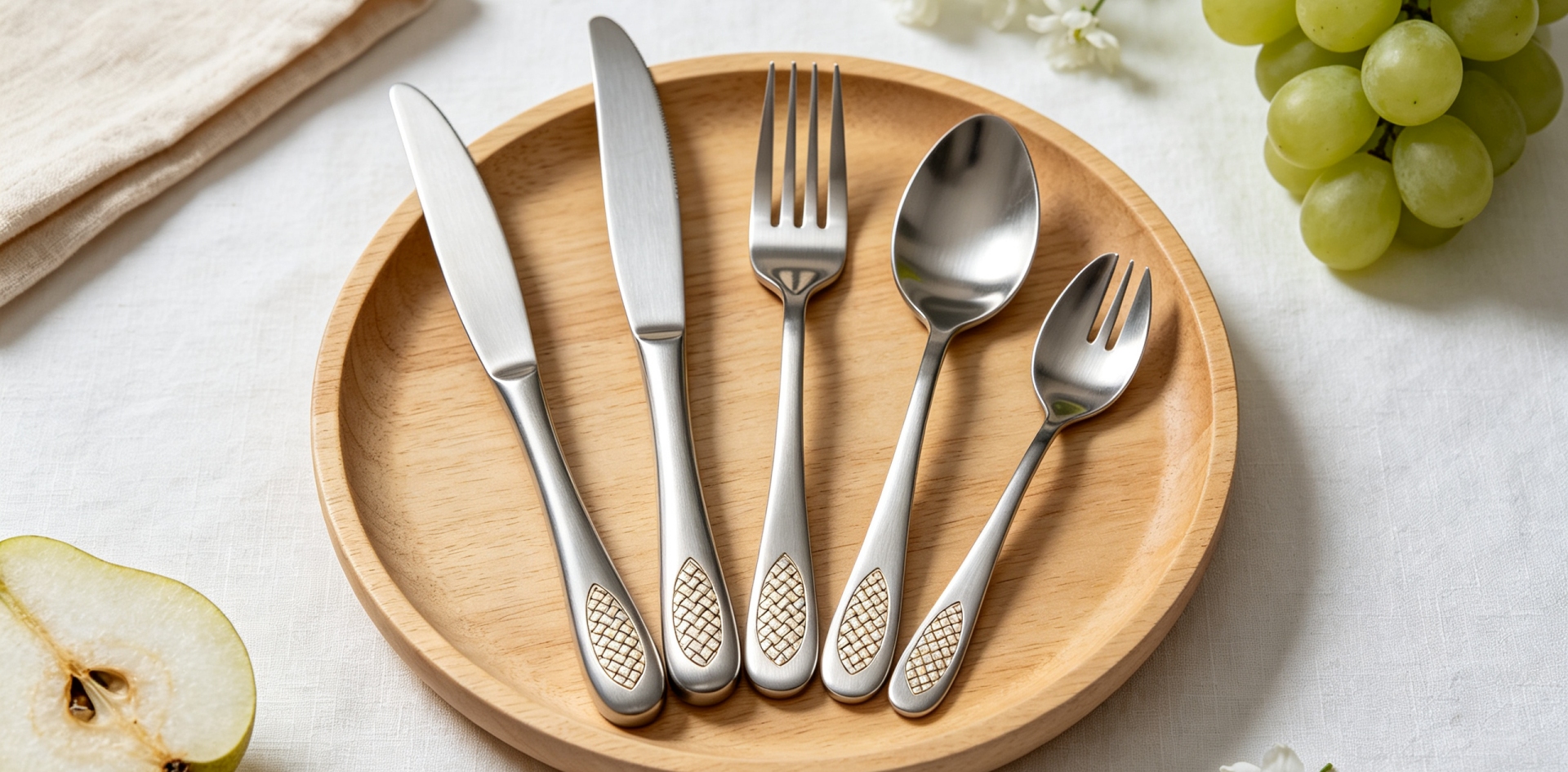
A typical set may include:
-
Table knife
-
Table fork
-
Table spoon
-
Dessert spoon
-
Teaspoon
The exact combination can be customized according to the customer's market.
Although each piece has its own function, the collection should look coordinated when placed together.
Handle width, overall length, thickness and visual proportion can be reviewed across the complete set.
This approach is especially useful for private label brands that want to establish a recognizable product collection.
Designing for Different B2B Markets
There is no single dimension that is suitable for every stainless steel cutlery project.
Different buyers can have very different requirements.
A restaurant supplier may require a practical and durable collection for frequent use.
A supermarket or retailer may be more focused on the visual appearance of the set and packaging.
A private label brand may have its own existing design language and require customized proportions.
A distributor may need several sizes or product combinations for different customers.
Understanding the market before confirming the final dimensions can help avoid unnecessary product adjustments later.
From Reference Sample to Production Specification
Many international buyers do not begin a project with a complete technical drawing.
Instead, they may have a photograph, an existing cutlery sample, a competitor reference or a general design idea.
This is a common starting point for OEM and ODM projects.
The manufacturer can review the reference and discuss the important product parameters with the customer.
Once the key dimensions, material, finish and design details are confirmed, the product can move toward sample development.
This process allows the customer to evaluate the actual product before committing to larger production quantities.
Customization Beyond Product Dimensions
Product customization does not have to stop at size and weight.
B2B customers can also discuss:
-
Handle design
-
Logo placement
-
Surface finish
-
Cutlery set combinations
-
Retail packaging
-
Private label requirements
-
Carton specifications
-
Shipping arrangements
By combining these elements, a standard stainless steel cutlery concept can be developed into a product range specifically designed for the customer's market.
One-Stop Support from Product Design to Shipment
Managing product development through several suppliers can create additional communication and coordination work.
Homefelt provides integrated support for stainless steel cutlery projects, including product customization, OEM and ODM manufacturing, private label development, packaging coordination and bulk production.
Customers can discuss their requirements according to their own project situation.
If the buyer already has a finished drawing, the factory can work from the existing specifications.
If the buyer only has a product concept or reference sample, the team can discuss the dimensions, design and production requirements before confirming the final solution.
This flexible approach allows the service to be adapted to different B2B purchasing models.
Supporting Long-Term Product Development
For a professional buyer, a successful cutlery project can develop into a long-term product program.
Once a spoon, fork or knife has been approved, future production needs to follow the agreed specifications consistently.
As the customer's business grows, additional products may also be added to the same collection.
This is where manufacturing experience becomes valuable.
Homefelt has more than 40 years of experience in stainless steel cutlery and supports customers with product development, customized manufacturing and bulk supply.
The goal is to provide more than an individual product. The factory can work with customers to develop a complete cutlery solution that can grow with their business.
Custom Stainless Steel Cutlery Handle Design for B2B Collections
Stainless Steel Cutlery Specifications for Custom B2B Projects
Related Article



