
Stainless Steel Flatware Logo Position Control for OEM and Private Label Orders
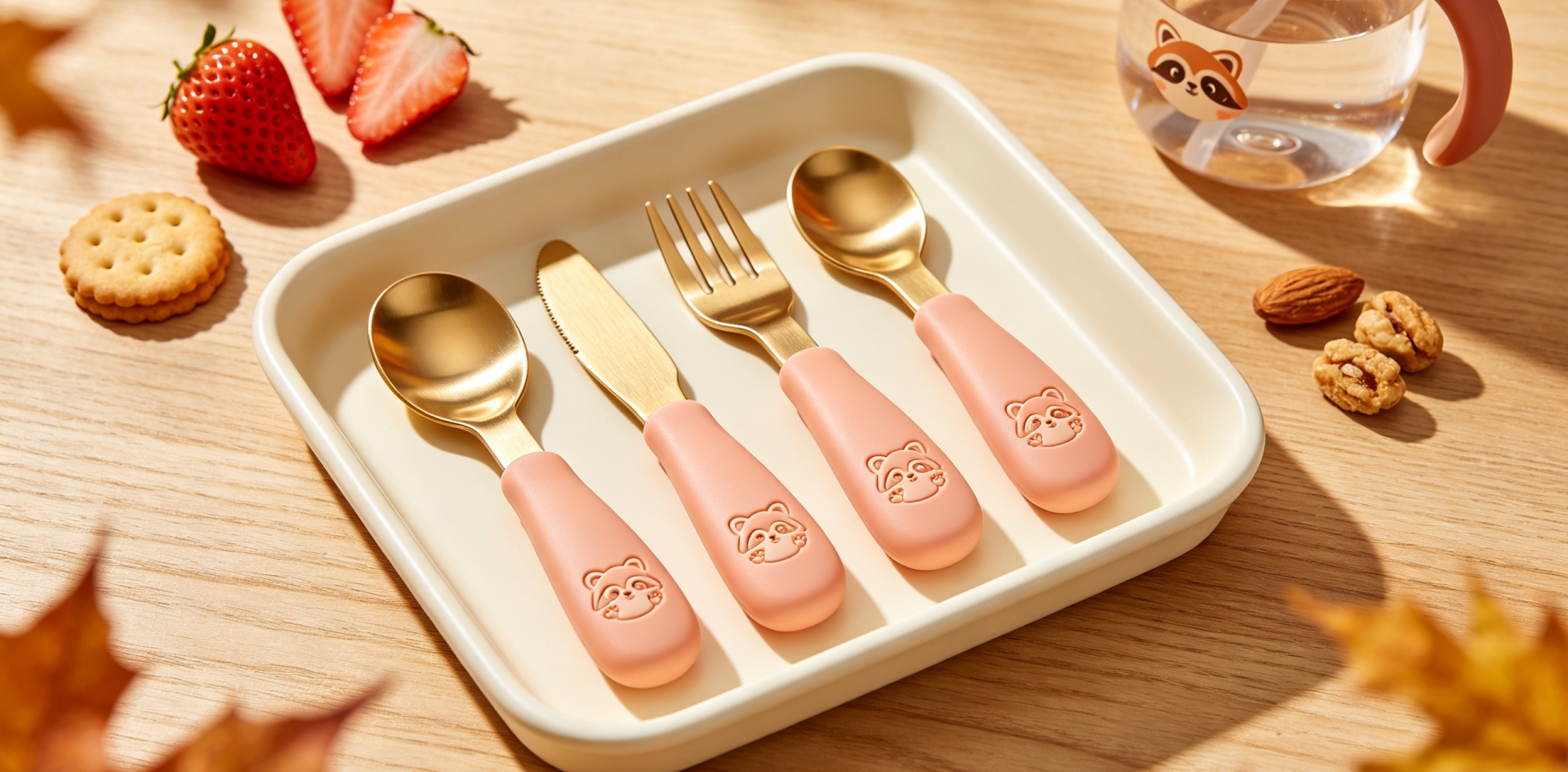
Stainless Steel Flatware Logo Position Control for OEM and Private Label Orders
For a private label flatware collection, a brand logo is often one of the most recognizable details on the finished product. Buyers may carefully approve the logo artwork, size and marking method, but another specification deserves equal attention during production: logo position.
A logo that is technically correct but positioned differently from piece to piece can make a collection look inconsistent. This becomes particularly noticeable when knives, forks and spoons are displayed together or when the products are packaged as a branded flatware set.
For OEM and bulk orders, defining the logo position clearly before mass production helps the factory maintain a consistent visual standard across the entire order.
Why Logo Position Matters on Flatware
Stainless steel cutlery has relatively narrow and elongated surfaces. Because of this, even a small change in logo location can be visually noticeable.
The position may be measured from the handle end, handle transition, centerline or another defined reference point. The correct reference depends on the design of the specific product.
A logo placed too close to the end can look crowded, while one positioned too far toward the functional area may interfere with the intended visual balance.
For a custom branded flatware manufacturer, logo placement therefore needs to be treated as a measurable production parameter rather than an approximate visual instruction.
Common Logo Position References
Different cutlery designs require different positioning methods.
For a spoon, the logo may be placed along the handle centerline at a defined distance from the handle end.
For a fork, the position may need to account for the relationship between the fork head and the handle.
For a table knife, the available branding area may be affected by the blade, bolster or handle profile.
Typical specifications can include:
-
Logo location
-
Distance from a reference edge
-
Distance from the handle end
-
Centerline position
-
Logo width and height
-
Orientation
-
Marking depth where applicable
-
Permitted positional tolerance
The exact specification should be established from the approved drawing or sample.
Logo Position and Product Geometry
One reason logo positioning can become complicated is that stainless steel flatware is not always completely uniform in shape.
Handles may taper, curve or include decorative transitions. Some designs have embossed areas, grooves or surface textures that affect the available branding space.
A logo that looks centered on a flat drawing may not appear centered on a three-dimensional handle.
For OEM private label cutlery production, the factory should therefore evaluate the branding position on the actual product geometry.
Homefelt can review customer artwork together with product drawings or physical samples to determine a practical reference position before production begins.
This is especially useful for newly developed flatware collections where the handle design has not yet entered mass production.
Choosing a Suitable Branding Area
The branding area should provide enough visual space for the logo while maintaining the overall design of the cutlery.
Several factors can be considered:
-
Handle width
-
Handle taper
-
Surface curvature
-
Decorative patterns
-
Finish type
-
Logo dimensions
-
Distance from functional areas
-
Relationship between different pieces
For a complete collection, the logo does not necessarily need to be located at exactly the same absolute distance on every piece. What matters is that the position follows a consistent design logic.
For example, a spoon, fork and knife may have different handle lengths. A proportional position may create a more balanced appearance than applying one identical measurement to all three products.
This is an important consideration for ODM and private label projects.
Maintaining Position Accuracy in Bulk Production
A logo placement approved on a sample is only useful if the same specification can be maintained during mass production.
Bulk stainless steel cutlery orders can contain thousands or significantly more individual pieces. Production therefore needs a clear reference for operators and inspectors.
The approved sample, technical drawing and production specification can work together as the basis for positioning control.
During production, inspection may check whether the logo:
-
Remains within the specified position
-
Follows the correct orientation
-
Maintains the approved size
-
Stays aligned with the handle geometry
-
Matches the approved visual standard
The inspection method should be appropriate to the logo type and product design.
For large-volume orders, defining these requirements before production is much more efficient than trying to correct inconsistent branding after the goods have been completed.
Logo Position Across a Complete Flatware Collection
Private label buyers often order several SKUs under the same brand.
A collection may include a dinner spoon, teaspoon, dinner fork, table knife and additional specialty pieces. If each SKU uses a completely different logo position without a design reason, the collection may look less coordinated.
A better approach is to establish a branding principle for the collection.
The principle can consider:
-
Common logo orientation
-
Visual distance from the handle end
-
Relative position within the available handle area
-
Logo scale
-
Relationship between different handle shapes
-
Finish and color consistency
Homefelt can help customers translate a general branding concept into practical production specifications for individual knife, fork and spoon designs.
This is particularly useful when the collection contains different handle shapes but needs to maintain a unified brand identity.
Branding Method and Position Requirements
Logo position should also be considered together with the selected marking method.
Depending on the product and customer requirements, branding may involve laser marking, engraving, embossing or another suitable process.
Different methods may require different surface conditions and available space.
For example, a fine logo may require a sufficiently clear surface area, while an embossed mark needs suitable forming conditions. Colored or coated flatware may also require the branding process to be evaluated together with the surface treatment.
For this reason, a professional OEM flatware supplier should review the logo method and position together rather than confirming them separately.
From Artwork to Production Sample
A practical private label project normally begins with customer artwork and product information.
The buyer can provide the logo file, desired size, preferred location and product drawing or sample. The factory can then evaluate the available branding area and propose a suitable production position.
A sample can be produced for confirmation before bulk manufacturing.
At this stage, buyers should review the actual product rather than relying only on a digital rendering. The physical sample provides a better indication of how the logo interacts with the handle shape, surface finish and overall product proportions.
Once approved, the sample and specifications can become the production reference for the bulk order.
Project Experience at Homefelt
Homefelt has extensive experience supporting branded stainless steel cutlery projects for B2B customers.
A typical project may start with an existing cutlery design and a customer logo, or with a completely new private label collection. The factory can review the product structure, material, surface finish and branding requirements before confirming the production method.
For multiple SKUs, the branding position can be coordinated across the collection so that the final products share a consistent visual identity while still respecting the geometry of each individual piece.
This practical experience is valuable for buyers who need more than standard catalog products and require a manufacturer capable of turning branding guidelines into repeatable production specifications.
Quality Documentation for B2B Projects
Professional buyers may also need supplier and quality information when developing branded flatware.
Homefelt has passed BSCI, SEDEX 4P, BRC and ISO9001-related requirements and has experience with Disney audits. The factory also holds FAMA and FSC certificates for applicable business requirements.
For individual projects, the relevant quality documents and inspection materials can be discussed according to the customer's product and market requirements.
The focus remains on providing useful documentation that supports the actual procurement project rather than adding unnecessary compliance information.
One-Stop Service for Branded Flatware
Logo placement is only one part of a private label flatware project.
A successful branded collection may also require product design, material selection, surface treatment, packaging, carton configuration and transportation planning.
Homefelt provides OEM and ODM manufacturing for stainless steel knives, forks, spoons and flatware sets, allowing these requirements to be coordinated through one service.
Customers can develop an exclusive service package according to their market and project requirements, from product design through packaging and transportation.
This one-stop model can reduce communication between multiple suppliers and make it easier to keep branding requirements consistent throughout the order.
Why Experienced Manufacturing Matters
For standard products, logo placement may appear to be a simple detail. For large-volume private label orders, however, small inconsistencies can affect the appearance of the entire collection.
An experienced stainless steel flatware factory understands that branding specifications need to be measurable, repeatable and connected to the geometry of the actual product.
Homefelt has 40 years of experience in the stainless steel cutlery business and has worked with customers requiring customized designs, branded products and large-volume production.
The goal is to provide more than manufacturing capacity. By combining product development, production experience and one-stop service, Homefelt aims to become a long-term China service partner for customers developing and expanding their cutlery collections.
Planning a Private Label Flatware Order
If you are preparing a branded knife, fork or spoon project, it is helpful to provide the logo artwork together with the product drawing, reference sample, desired logo size and preferred position.
Homefelt can review the available branding area and help establish practical positioning specifications before sample approval.
After confirmation, the same production team can coordinate manufacturing, packaging and transportation according to the final order requirements.
Related Article



