
Stainless Steel Flatware Pattern Alignment for OEM and Private Label Manufacturing
Stainless Steel Flatware Pattern Alignment for OEM and Private Label Manufacturing
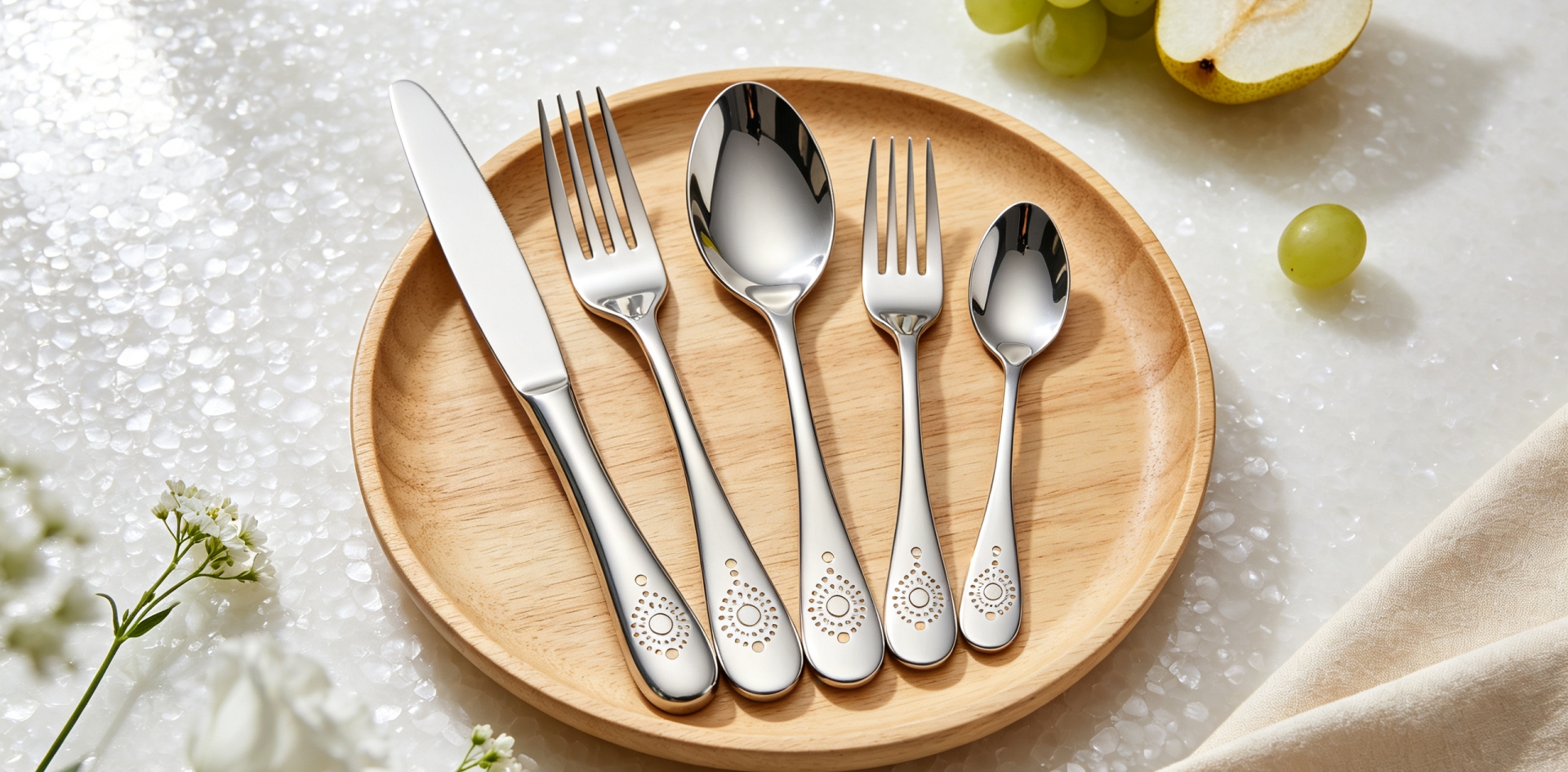
For stainless steel flatware, decorative details are often what make a collection recognizable. A raised motif, recessed pattern, engraved element, geometric mark or repeated decorative structure may appear simple on a drawing, but keeping that pattern in the correct position across thousands of spoons, forks and knives requires controlled production.
For OEM and private label buyers, pattern alignment is not only a visual consideration. It can affect the relationship between the decoration and the handle centerline, edges, end section, transitions and other design features. A small positional difference can become noticeable when several pieces are displayed together.
At Homefelt factory, custom stainless steel cutlery projects can be developed around the customer's drawings, samples, brand requirements and target market. The factory supports OEM, ODM, private label, wholesale and bulk production, with product design, manufacturing, packaging and transportation coordinated as a one-stop service.
Why Pattern Alignment Matters in Custom Flatware
A decorative pattern normally has a defined reference position. This may be measured from the handle end, side edge, centerline, neck, transition area or another specified feature.
For example, a customer may request a geometric decoration positioned in the central section of a spoon handle. If the pattern moves too close to one side, its relationship with the handle shape changes. The same issue can become more obvious when the spoon, fork and knife are arranged as one flatware collection.
Pattern alignment therefore needs to be considered together with the overall product geometry.
Important parameters may include:
-
Pattern center position
-
Distance from the handle end
-
Distance from the side edges
-
Pattern length and width
-
Pattern orientation
-
Repeated element spacing
-
Relationship with the handle centerline
-
Position relative to decorative borders
-
Alignment between different pieces in one collection
These details can be included in a product specification or technical drawing before mass production begins.
How the Pattern Is Controlled During Product Development
The first step is to define the reference points clearly.
A drawing that only shows the decoration visually may not provide enough information for consistent manufacturing. For commercial production, the factory may need dimensions or reference relationships showing where the pattern begins, ends and sits relative to the product geometry.
For a spoon, the pattern may be positioned according to the handle centerline and handle end. For a fork, the same design may need to account for the fork head and neck transition. A knife may require a different reference because its handle and blade have different proportions.
This is where engineering experience becomes important.
The decoration should be designed together with the actual cutlery shape instead of being treated as an independent graphic. During sample development, the factory can review whether the pattern remains visually balanced after forming, polishing and finishing.
Pattern Alignment and Tooling Accuracy
Many stainless steel cutlery decorations are produced through processes such as embossing, stamping, engraving or other controlled surface treatments. The tooling and positioning method influence the final location of the pattern.
A production tool may have a defined reference point that corresponds with the blank or formed product. If the positioning reference is not properly established, the same decorative feature can gradually appear inconsistent between pieces.
For OEM projects, Homefelt can review the relationship between the customer's artwork, product drawing and manufacturing method before bulk production.
This is particularly useful when the decoration contains several connected elements. Instead of checking only the overall appearance, production control can consider the position of each important feature.
Material and Forming Considerations
Stainless steel sheet thickness, material grade and forming conditions can influence the final appearance of decorative details.
A pattern that looks sharp on a flat sample may appear different after forming. Spoon handles, fork handles and knife handles can have different surface geometries, so the same decorative concept may require different tooling treatment.
Material thickness is also relevant. A decorative feature should be developed according to the actual product structure rather than relying only on artwork dimensions.
During development, the factory can evaluate:
-
Stainless steel material specification
-
Product thickness
-
Decoration depth or relief
-
Surface curvature
-
Forming direction
-
Tooling position
-
Finishing process
-
Final visual appearance
This approach helps connect the design specification with manufacturability.
Maintaining Consistency in Bulk Production
For a small sample quantity, a slight difference may be difficult to notice. In a large production order, however, repeated variation can become much more visible.
A commercial buyer may receive thousands of pieces that will be displayed together in retail packaging, hospitality environments or foodservice settings. If the decoration is positioned differently from piece to piece, the collection can lose its visual uniformity.
Production inspection can therefore compare finished products against an approved reference sample and defined specifications.
Typical checks may include:
-
Pattern position
-
Pattern orientation
-
Pattern dimensions
-
Distance from reference edges
-
Center relationship
-
Surface finish around the decoration
-
Consistency between spoon, fork and knife designs
The purpose is not simply to make every piece look identical at first glance. It is to ensure that the agreed design remains stable throughout the production batch.
Project Experience for OEM Buyers
In practical OEM projects, decorative alignment becomes especially important when a customer has developed a distinctive private-label collection.
For example, a brand may request a repeating geometric pattern across a spoon, fork and table knife. The three pieces may have different handle lengths and shapes, so placing the decoration at the same numerical distance from the handle end may not necessarily create the same visual effect.
An experienced factory can evaluate the design as a collection and determine appropriate reference positions for each SKU.
This combination of product engineering and manufacturing experience helps reduce unnecessary sample revisions and gives buyers a clearer basis for confirming the final design.
Inspection and Supporting Documentation
For B2B buyers, product appearance should be supported by measurable specifications rather than relying entirely on subjective visual judgment.
Depending on the project, documentation can include product drawings, specifications, approved samples, inspection records and relevant certification or testing materials.
Homefelt has experience serving customers with structured supplier requirements and has passed audits and certifications including BSCI, SEDEX 4P, BRC and ISO9001, as well as Disney audit requirements. FAMA and FSC certificates are also available for applicable business needs.
The exact documentation depends on the customer, product and market requirements. For a private-label project, the most important point is to establish the correct product specification before production and keep the finished goods aligned with the approved standard.
OEM, ODM and Private Label Production
Pattern alignment is particularly valuable for customers developing branded flatware collections.
Homefelt factory can work from customer drawings, reference samples or new product concepts. The service can cover product development, decorative details, stainless steel cutlery manufacturing, packaging design and shipment coordination.
For wholesale and bulk buyers, this allows the same design standard to be carried through multiple production quantities. For private-label brands, it provides greater control over the visual identity of the finished collection.
If the customer does not yet have a complete technical drawing, the factory can also discuss practical dimensions, material specifications, decorative methods and production considerations before the sample stage.
A One-Stop Approach for Custom Cutlery
A successful flatware project is not only about producing a spoon, fork or knife. The finished product needs to match the customer's commercial positioning, packaging requirements, target price and delivery plan.
Homefelt's one-stop service can coordinate:
-
Product design and development
-
Stainless steel material and specification selection
-
Decorative pattern development
-
OEM and ODM manufacturing
-
Private label production
-
Quality inspection
-
Customized packaging
-
Bulk order production
-
Transportation coordination
This gives customers one manufacturing partner rather than managing each stage separately.
For distributors, importers, restaurant suppliers, hospitality buyers and private-label brands, this approach can make custom flatware development easier to manage from initial concept to large-volume delivery.
Related Article



