
Stainless Steel Fork Handle Length: A Practical Detail for B2B Custom Flatware
Stainless Steel Fork Handle Length: A Practical Detail for B2B Custom Flatware
When developing a custom stainless steel fork, buyers often pay attention to the number of tines, head shape, overall length, surface finish, and handle design. The length of the handle is another important specification that can influence the appearance and proportions of the finished product.
For B2B customers developing OEM, ODM, wholesale, or private label flatware, handle length should be considered as part of the complete fork design rather than as an isolated measurement.
A small dimensional change can alter the relationship between the fork head and handle, as well as the visual balance between the fork and the other pieces in a stainless steel cutlery collection.
Understanding Fork Handle Length
The handle occupies a significant part of a table fork's total length.
When the handle becomes longer, the fork can have a more elongated appearance. A shorter handle places relatively more visual emphasis on the fork head.
Neither approach is automatically suitable for every project. The appropriate dimension depends on the product concept, target market, collection style, and the relationship between the fork and the matching knife and spoon.
For a standard wholesale product, the design may follow an established proportion. For a private label collection, however, a brand may want a more specific visual identity.
This is where handle length becomes a useful customization detail.
Handle Length and Overall Fork Proportion
A fork is usually evaluated as a complete product rather than as separate components.
The handle length needs to work with the fork head length, head width, tine design, neck transition, and overall fork length.
For example, changing the handle length while keeping the overall fork length unchanged will naturally change the proportion of the remaining functional area.
For an OEM project, this means that a requested handle dimension should be reviewed together with the complete technical drawing.
The goal is to create a balanced product specification that can also be reproduced consistently during mass production.
Creating a Consistent Cutlery Collection
Many B2B buyers do not purchase forks as standalone products.
They may be developing a complete collection that includes table knives, dinner forks, table spoons, teaspoons, or other related pieces.
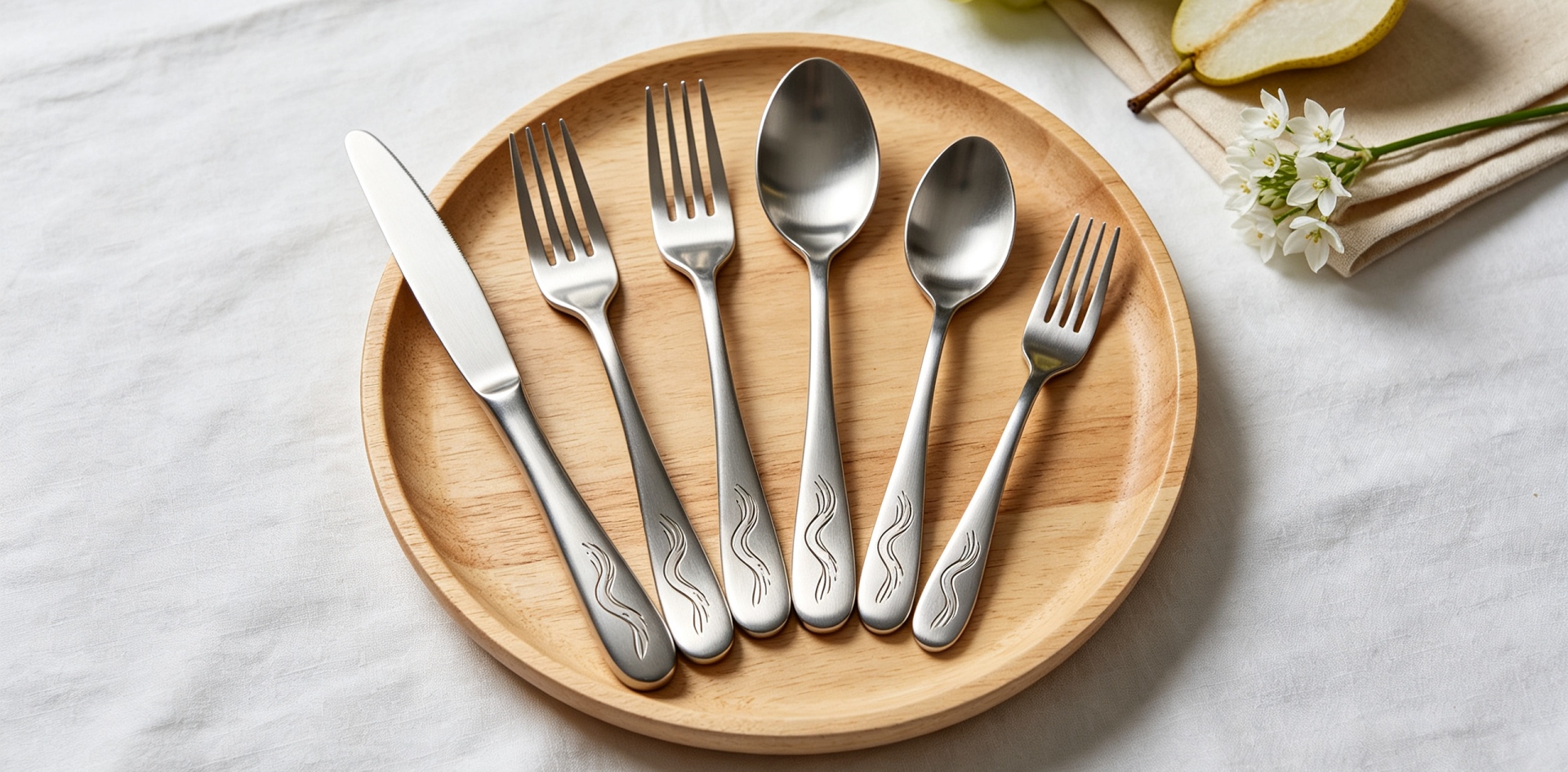
In such a collection, the handle design often creates the strongest visual connection between the different products.
The handle length of the fork therefore needs to work with the corresponding handle proportions of the knife and spoon.
The dimensions do not necessarily have to be identical because each utensil has a different functional structure.
Instead, the collection should have a coherent visual relationship.
This is especially important for private label brands that want customers to recognize different products as part of the same flatware range.
Why Handle Length Matters in OEM Development
OEM manufacturing often starts with a customer's existing design or product concept.
The buyer may have a reference sample but want to modify certain details for a new collection.
The handle length can be one of these details.
A buyer might want to retain the general shape of an existing fork while changing its proportions to match a new brand collection.
Alternatively, the customer may have a drawing showing the required dimensions from the beginning.
In both cases, the manufacturer needs to understand how the requested handle length relates to the other dimensions.
A practical OEM process therefore looks at the fork as a complete manufactured product rather than simply following one isolated measurement.
Handle Length and ODM Product Development
ODM projects provide another route for B2B buyers who want a distinctive product without developing every detail from zero.
A manufacturer can work with the customer to develop a fork based on an existing manufacturing concept while adapting dimensions and design characteristics for the target market.
Handle length can be adjusted as part of this development.
The buyer may want a more traditional proportion, a contemporary appearance, or a design that visually matches an existing flatware range.
The final specification should reflect the commercial purpose of the product as well as its manufacturing requirements.
Evaluating Handle Length With a Physical Sample
Dimensions on a technical drawing are important, but a physical sample can provide a better understanding of how the handle length affects the finished fork.
Once the sample is produced, buyers can place it next to the matching knife and spoon.
This makes it easier to evaluate the complete collection.
The buyer can also check whether the handle appears visually balanced with the fork head and whether the product fits the intended design direction.
If adjustments are required, the handle length can be reviewed before the specification is released for bulk production.
This can be particularly useful for custom private label projects where the visual appearance of the collection is an important part of the product identity.
Handle Length and Manufacturing Specifications
Once a fork design has been approved, its dimensions need to be clearly defined for production.
The handle length can be recorded together with the overall length, fork head dimensions, material, thickness, surface finish, and other relevant specifications.
A clear specification helps reduce ambiguity between product development and mass production.
It is also useful when the same product is reordered.
For a long-term B2B customer, the approved fork may be manufactured repeatedly over several seasons or purchasing cycles.
Keeping the original specifications clear helps the supplier reproduce the same product more efficiently.
Fork Handle Length for Wholesale Programs
Wholesale buyers often manage several cutlery SKUs at the same time.
A fork may be sold individually, included in a cutlery set, or supplied as part of a broader stainless steel flatware collection.
In each case, the handle dimension contributes to the appearance of the finished product.
For a wholesaler developing its own product range, a customized fork can also help create a more distinctive assortment compared with standard catalog products.
The manufacturer can work from the buyer's requirements and develop the fork according to the agreed specifications.
Private Label Flatware and Brand Identity
Private label customers often want their products to have a recognizable design language.
This does not always require an unusual shape.
Sometimes the combination of several carefully controlled details creates the identity of the collection.
The handle length, handle profile, surface finish, transition between the handle and fork head, and relationship between different utensils can work together to create a consistent appearance.
For this reason, handle length can be considered part of the broader product design rather than simply a production measurement.
Homefelt for Custom Stainless Steel Fork Manufacturing
Homefelt specializes in stainless steel knives, forks, spoons, cutlery sets, and flatware for B2B customers.
With more than 40 years of experience in the stainless steel cutlery business, the factory supports OEM, ODM, private label, wholesale, and bulk production projects.
For a custom stainless steel fork, customers can provide drawings, reference samples, product specifications, or simply a design concept.
Details such as handle length can then be evaluated together with the fork head, overall dimensions, finish, material, and matching cutlery pieces.
When a fork is being developed as part of a complete collection, the factory can also consider the relationship between the fork, knife, and spoon so that the finished range has a consistent commercial appearance.
This is useful for wholesalers, distributors, retailers, and private label brands that need a customized stainless steel flatware program rather than a standard off-the-shelf product.
For larger orders, establishing the fork dimensions clearly before mass production also provides a useful reference for quality control and future repeat orders.
Start Your Custom Fork Project
If you are sourcing stainless steel forks for wholesale, private label, OEM, or bulk purchasing, providing clear dimensional requirements can make the product development process more efficient.
If the exact handle length has not yet been finalized, a reference sample or design drawing can also help the manufacturer understand the desired direction.
From the initial concept to sample approval and bulk production, a clear communication process allows the final fork to be developed around your commercial requirements.
Request a Custom Stainless Steel Fork Quotation
Develop an OEM Stainless Steel Fork
Start a Private Label Flatware Collection
Request Wholesale Stainless Steel Fork Pricing
Develop a Matching Fork, Knife and Spoon Set
Stainless Steel Fork Neck Length: A Practical Detail for B2B Custom Designs
Stainless Steel Cutlery Carton Packing: A Practical B2B Guide for Bulk Orders
Related Article



