
Stainless Steel Knife Cutting Edge Geometry for Custom B2B Designs
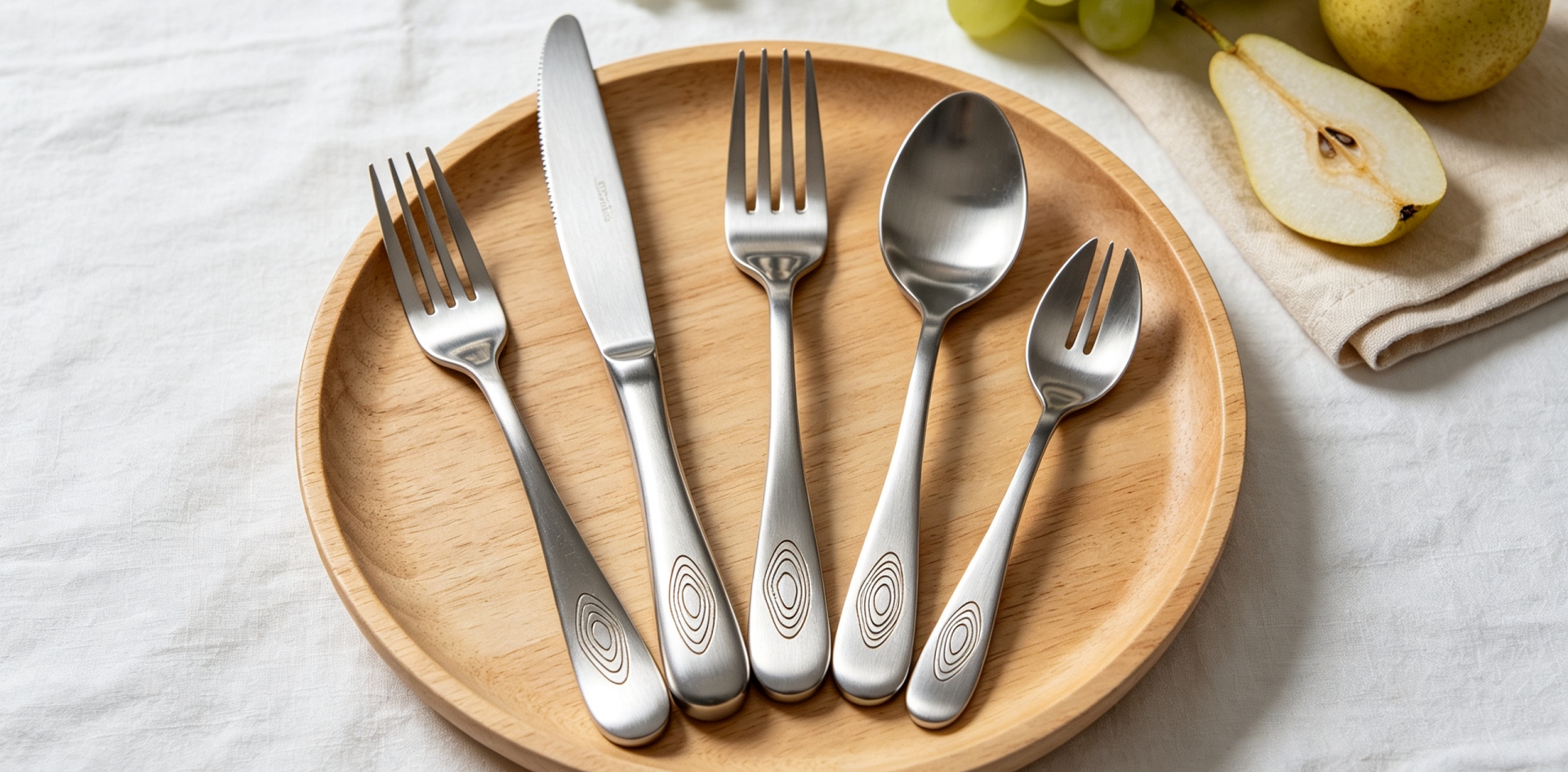
Stainless Steel Knife Cutting Edge Geometry: A Practical Detail for B2B Custom Designs
When developing stainless steel table knives for a commercial product range, the blade is often discussed mainly in terms of appearance, material and overall shape. However, the geometry of the cutting edge also deserves careful attention. Small differences in the way the edge is formed can affect the knife’s cutting behavior, visual appearance, production consistency and final product positioning.
For B2B buyers developing custom flatware, this is not simply a technical detail. The cutting edge is part of the relationship between design and function. A well-planned blade can support the intended use of the knife while also fitting naturally into the visual language of the complete cutlery collection.
What Is Cutting Edge Geometry?
Cutting edge geometry refers to the shape and structure of the working edge of a knife blade. It can involve factors such as the transition toward the edge, the bevel area, the angle of the cutting edge and the way the blade thickness changes as it approaches the tip.
These details do not need to be identical for every stainless steel table knife. A knife intended for general dining use may require a different edge structure from a product designed for more demanding foodservice applications.
For a B2B project, the important point is to define the intended performance before finalizing the technical drawing. The manufacturer can then evaluate how the requested geometry can be translated into a stable production process.
Why the Bevel Matters
The bevel is the transition between the main blade surface and the cutting edge. Its width, angle and visual treatment can influence how the blade looks as well as how the edge performs.
A narrow, carefully controlled bevel can create a refined appearance, while a more pronounced bevel may be suitable when a stronger visual definition is required. The appropriate solution depends on the overall blade design, thickness, intended use and manufacturing method.
For a custom flatware project, the bevel should not be considered separately from the rest of the knife. The blade profile, thickness, handle proportions and transition areas all work together. Changing one element may require adjustments to another.
This is especially relevant when a buyer has a reference sample but wants to develop a proprietary version. The manufacturer needs to understand which characteristics are essential and which can be adapted during development.
Balancing Cutting Performance and Production Stability
In B2B manufacturing, a cutting edge cannot be evaluated only from the perspective of an individual sample. The same design must remain practical when produced repeatedly in commercial quantities.
A highly specific edge geometry may look excellent on a prototype but become more difficult to control during large-scale production if the specifications are unnecessarily complicated. For this reason, experienced stainless steel knife manufacturers normally consider both the desired result and the repeatability of the process.
The objective is not simply to make the sharpest possible edge. Instead, the knife should achieve the intended cutting performance while maintaining a stable manufacturing standard.
For wholesalers, retailers and private label brands, this balance is particularly important. A product range may require thousands of pieces across multiple orders, so the production method needs to support consistent results rather than relying on excessive manual adjustment.
How Blade Thickness Influences the Edge
Cutting edge geometry is closely connected to blade thickness. If the main blade is relatively thick, the transition toward the edge needs to be designed appropriately. If the blade is thinner, the geometry can be approached differently.
This relationship is one reason why changing the thickness specification after development can affect the original edge design.
When requesting a quotation for custom stainless steel table knives, buyers can provide the preferred blade thickness together with drawings, reference samples or intended application information. This gives the manufacturer a clearer basis for evaluating the complete blade structure rather than quoting from an isolated dimension.
The Role of Edge Angle
The angle of the cutting edge is another important design consideration. A smaller angle can create a different cutting feel from a larger angle, but the practical result also depends on material, blade thickness, heat treatment, grinding and finishing.
For B2B projects, it is therefore better to treat the edge angle as part of the complete manufacturing specification rather than assuming that one number automatically determines knife performance.
An experienced factory can review the requested specification together with the rest of the design and advise whether the proposed geometry is suitable for production.
Designing the Edge for the Intended Market
Different B2B customers may have different expectations for the same basic table knife.
A retail brand may place greater emphasis on the refined appearance of the blade. A restaurant supply distributor may focus more heavily on practical everyday performance and production durability. A private label brand may want a recognizable blade design that complements its own collection.
These requirements can lead to different approaches to edge geometry.
For an OEM or ODM project, this flexibility is useful. The knife does not have to follow a generic catalogue specification. The blade can be developed around the product positioning, target market and relationship with the other pieces in the collection.
Keeping the Blade Design Consistent Across SKUs
When a brand develops several knives within the same collection, the cutting edge should also be considered as part of the broader design system.
For example, different knife sizes or functions may require different blade dimensions, but their edge treatment can still follow a consistent design language. Similar bevel proportions, transitions and finishing details can help the collection look intentional rather than assembled from unrelated products.
This matters for B2B buyers because a successful flatware program is often sold as a collection rather than as isolated pieces. Consistency across SKUs can make product presentation clearer and simplify future product development.
What to Include in a Custom Knife Request
When contacting a stainless steel cutlery manufacturer about a custom knife, useful information may include the overall blade length, maximum width, blade thickness, handle dimensions, material specification, surface finish and intended application.
If the cutting edge has particular requirements, buyers can also provide a technical drawing or physical reference sample. Photos alone can communicate the general appearance, but drawings and samples normally provide more useful information for detailed production evaluation.
It is also helpful to explain whether the project is intended for wholesale distribution, foodservice supply, retail, private label or another commercial channel. This gives the manufacturer context when reviewing the design.
From Prototype to Bulk Production
A custom knife design normally becomes much easier to evaluate when the cutting edge is considered from the beginning of the development process.
During sample development, the manufacturer can review the relationship between blade thickness, bevel structure, edge geometry and finishing. If adjustments are required, they can be incorporated before the specification is finalized for larger production.
Once the design is confirmed, the same technical requirements can be carried forward into the manufacturing process. This creates a clearer connection between the original product concept and the finished bulk order.
For B2B buyers, that connection is valuable. The goal is not simply to receive a sample that looks good. The goal is to establish a knife specification that can be manufactured repeatedly and supplied as part of a dependable commercial product program.
Custom Stainless Steel Knives for OEM and Private Label Projects
A custom stainless steel table knife can be developed around much more than a logo or handle shape. Blade geometry, cutting edge treatment and the relationship between functional and visual details can all contribute to the final product.
For brands, distributors and wholesalers, discussing these details directly with the manufacturer can make the development process more efficient. A clear specification allows both sides to understand the intended result before quotation, sampling and bulk production move forward.
With experience in stainless steel cutlery manufacturing, Homefelt supports B2B customers developing knives, forks, spoons and complete flatware collections for wholesale, OEM, ODM and private label projects. Buyers can provide their design requirements, reference samples or initial ideas for evaluation and quotation.
If you are planning a new stainless steel knife or a complete custom cutlery range, the cutting edge is one of the details worth defining early. A well-considered specification can help connect product design, practical use and repeatable manufacturing in one solution.
Request a Custom Stainless Steel Knife Quotation
Discuss Your OEM Flatware Project
Send Your Custom Cutlery Requirements
Edelstahlgabel Querkrümmung: Ein wichtiges Detail für individuelle B2B-Besteckdesigns
Proportions des Couverts Inox : Harmoniser les Largeurs dans une Collection B2B
Related Article



