
Stainless Steel Spoon Handle Angle: A Practical Detail for Custom B2B Designs
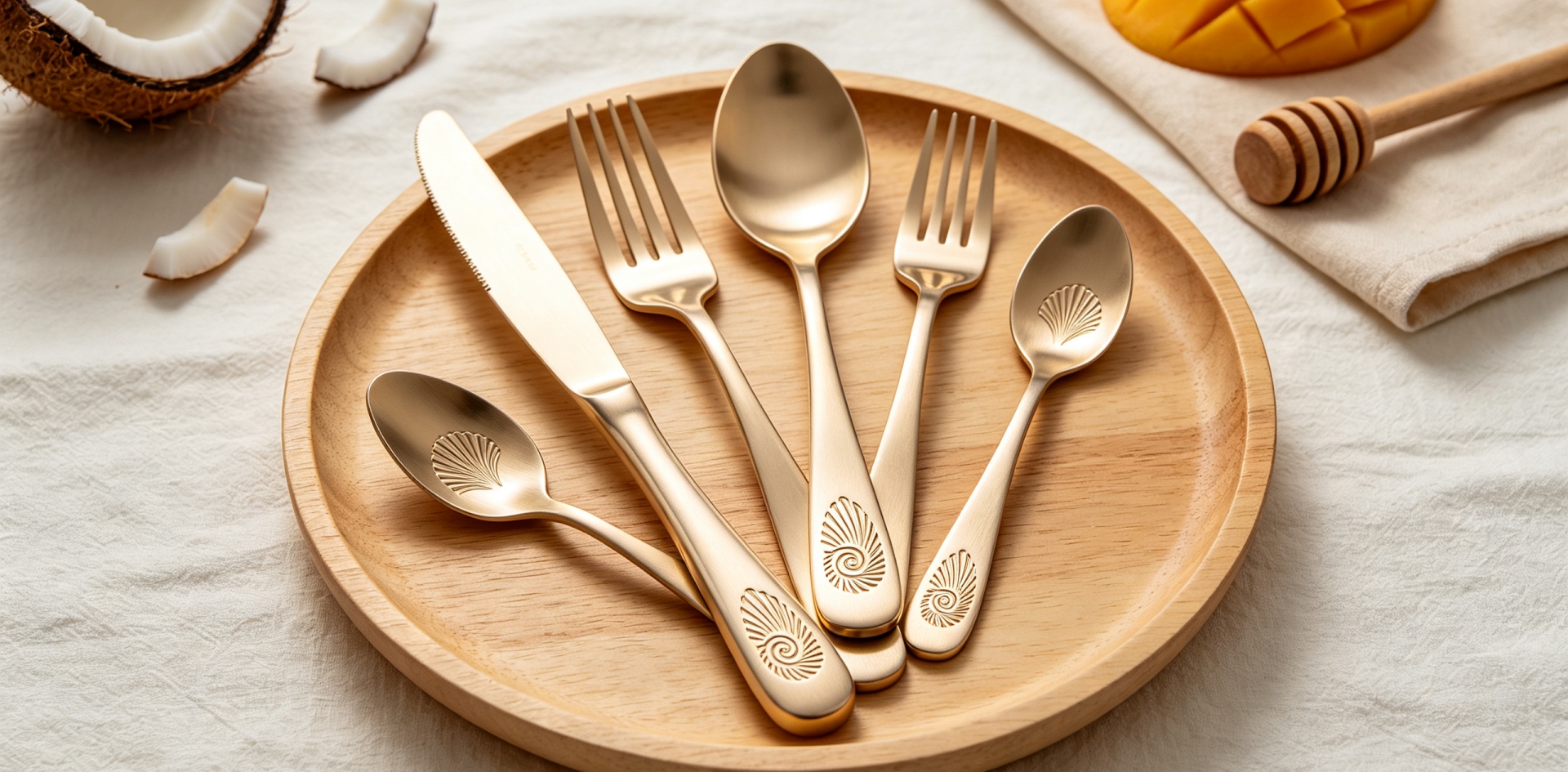
Stainless Steel Spoon Handle Angle: A Practical Detail for Custom B2B Designs
When developing a stainless steel spoon for a B2B project, buyers usually focus on the material, dimensions, finish, bowl shape, and handle design. These are important specifications, but there is another detail that can significantly influence the character of the finished product: the angle between the spoon handle and the functional part.
The handle angle is easy to overlook because it may appear to be a natural result of the overall spoon shape. In a custom product, however, this angle can be intentionally developed and adjusted to create a particular appearance and product experience.
For brands, distributors, and importers working on OEM or private label stainless steel spoons, understanding this detail can make communication with a manufacturer much more effective.
What Is the Handle Angle of a Stainless Steel Spoon?
The handle angle describes the relationship between the handle and the bowl of the spoon when viewed from the side.
Some spoons have a relatively open and gentle transition, while others have a more noticeable change in direction. A spoon can also be designed with a nearly continuous profile, depending on the intended style.
The angle does not exist independently from the rest of the product. It is connected to the bowl depth, handle length, overall curvature, and proportions of the spoon.
Changing one of these elements may affect the visual relationship between the handle and bowl.
For a standard spoon, these characteristics are already defined. For a custom stainless steel spoon, they become part of the product development discussion.
Why Handle Angle Matters in B2B Spoon Development
A small change in the side profile can make a spoon look noticeably different.
A flatter profile may create a more understated appearance, while a stronger angle can give the spoon a more structured or distinctive silhouette.
For a B2B collection, this can influence several aspects of the finished product:
-
overall visual character
-
relationship between bowl and handle
-
appearance when the spoon is placed on a table
-
consistency with matching forks and knives
-
compatibility with the brand's design language
-
repeatability during production
The purpose is not simply to make the spoon look different. The angle should work together with the complete design.
For an OEM project, the manufacturer therefore needs to understand the intended profile rather than relying only on the overall length and width.
Handle Angle and Spoon Proportions
The same angle can produce different results depending on the dimensions of the spoon.
A short handle combined with a particular angle may create a more compact appearance. A longer handle may make the same transition appear more gradual.
The bowl also changes the visual balance.
A wider or deeper bowl can make the transition between the functional section and handle more noticeable. A narrower bowl may create a different overall impression.
This is why custom spoon development should consider several dimensions together.
Useful specifications may include:
-
total spoon length
-
bowl length
-
bowl width
-
bowl depth
-
handle length
-
handle proportions
-
side profile
-
handle angle
-
surface finish
Looking at these details as a complete system makes it easier to achieve the intended design.
The Side View Is Particularly Important
For many spoon designs, the top view provides information about the outline, but the side view reveals something different.
It shows how the bowl and handle relate to each other in three dimensions.
For a custom stainless steel spoon, a side-view drawing can therefore be extremely useful.
It allows the buyer and manufacturer to discuss the intended angle and profile more clearly.
A photograph of an existing spoon can also provide valuable information, especially when the buyer wants to develop a similar product with different dimensions or branding.
When the profile is important to the design, providing a reference from more than one viewing angle can reduce misunderstandings during sample development.
How Handle Angle Influences the Product Appearance
The handle angle contributes to the visual flow of the entire spoon.
If the transition is gentle, the product may appear smooth and continuous. If the change in direction is stronger, the spoon may have a more defined profile.
Neither approach is universally better.
The appropriate solution depends on the product concept.
A classic collection may use a restrained profile. A contemporary private label range may intentionally use a more distinctive shape.
For B2B buyers, the key question is whether the selected angle supports the intended collection and can be reproduced consistently.
This is particularly important when a brand wants its spoon to look different from standard wholesale models.
Developing a Consistent Collection
A spoon rarely exists alone in a complete flatware program.
If a brand is developing a matching knife, fork, and spoon, the relationship between the different products becomes important.
The pieces do not need to have identical side profiles because their functional sections are different. However, the overall design language can still be coordinated.
For example, the spoon may use a particular degree of curvature that visually relates to the handle profiles of the fork and knife.
This type of coordination can make a collection feel intentional rather than assembled from unrelated products.
For a private label brand, that consistency can be especially valuable when several SKUs are displayed together.
Custom Spoon Angle and Manufacturing
The handle angle is not only a design decision. It also needs to work with the manufacturing process.
Stainless steel flatware is shaped through controlled forming operations, and the final profile depends on the product design and production method.
When a custom spoon requires a specific angle, the manufacturer needs to evaluate how that shape can be produced consistently.
The objective is not simply to create one successful prototype.
The same profile needs to be reproduced across a larger production quantity.
This is why design review before tooling and mass production is important. A manufacturer can examine the proposed shape and identify whether any adjustment would make the product more suitable for stable production.
The Role of Samples
For custom spoon projects, an approved sample provides an important reference.
A drawing can communicate dimensions and geometry, but the actual stainless steel product allows the buyer to see the complete relationship between the bowl and handle.
During sample evaluation, buyers can check:
-
the side profile
-
the handle angle
-
the overall silhouette
-
the relationship between bowl and handle
-
visual balance
-
consistency with the rest of the collection
-
the appearance of the selected finish
This stage is particularly useful when the spoon is a completely new design.
Small changes to the angle may be easier to identify on the physical sample than on a computer screen.
Once the desired profile has been confirmed, the approved sample can become a useful reference for subsequent production.
Why Technical Drawings Should Show the Profile Clearly
A custom spoon specification should communicate more than just overall length.
If the handle angle is an important part of the design, the side profile should be represented clearly in the technical drawing.
Depending on the design, the drawing may include:
-
side view
-
top view
-
overall dimensions
-
key reference points
-
bowl dimensions
-
handle dimensions
-
profile information
-
notes for specific design requirements
This gives the manufacturer a clearer understanding of what needs to be reproduced.
It also helps the buyer compare the production sample against the approved specification.
For long-term B2B programs, clear technical documentation becomes even more valuable because the product may be reordered months or years after the initial development.
Handle Angle and Repeat Orders
A private label spoon may become a permanent part of a brand's product range.
Once the first order has been completed, future purchases may be based on the same design.
At that point, the manufacturer needs a reliable reference for the product.
The handle angle should therefore be treated as part of the product specification rather than as an accidental result of the first sample.
Keeping the approved drawing and sample reference helps the factory reproduce the same design during later orders.
This is especially relevant for distributors and brands that expect regular replenishment.
It also provides a stronger basis for quality discussions if the product is produced repeatedly over time.
Adapting the Angle Across Different Spoon Models
A brand may eventually want to develop several spoon types using the same design language.
The exact handle angle may need to be adapted because different spoon models have different proportions.
For example, a longer spoon may require a different visual relationship between the bowl and handle than a shorter model.
The objective is not necessarily to use one identical measurement across every SKU.
Instead, the manufacturer can preserve the design principle while adjusting the details to suit each product.
This approach allows a brand to expand its range while maintaining a recognizable visual identity.
What B2B Buyers Can Provide
If you are preparing a custom stainless steel spoon project, the manufacturer does not necessarily need a complete technical specification on the first day.
A basic reference can be enough to begin.
Useful materials include:
-
an existing spoon sample
-
a hand sketch
-
a product photograph
-
a CAD drawing
-
marked-up dimensions
-
a reference product
-
a description of the intended style
If the handle angle is particularly important, indicating the desired side profile can make the discussion much clearer.
The manufacturer can then review the information and determine which additional specifications are needed for sampling and quotation.
This approach is often more practical than trying to define every technical detail before the first conversation.
From Custom Concept to Bulk Manufacturing
The purpose of OEM development is ultimately to turn a design concept into a product that can be manufactured reliably.
For stainless steel spoons, this means balancing appearance, proportions, forming requirements, finish, quantity, and cost.
The handle angle is one part of that process.
When it is considered early, the factory can incorporate it into the product design rather than trying to correct the profile after the product has already entered production.
For brands planning wholesale or private label programs, this can make the transition from prototype to bulk production more straightforward.
A clear specification also makes it easier to discuss future repeat orders.
Why Small Profile Details Can Differentiate a Product
The stainless steel spoon market includes many standard shapes.
For a brand developing its own product, differentiation does not always require an unusual or complicated design.
Sometimes a combination of relatively small decisions can create a distinctive result.
The relationship between the bowl and handle is one example.
A carefully developed handle angle can contribute to the visual character of the spoon while remaining compatible with a clean and practical overall design.
Combined with the right material, finish, proportions, and matching cutlery pieces, it can become part of a recognizable collection.
Discuss Your Custom Spoon Project
If you are developing a stainless steel spoon for a wholesale, OEM, ODM, or private label program, a drawing or sample can be a useful starting point.
You can share the desired dimensions, finish, quantity, and general design direction with the manufacturer. If the side profile or handle angle is important, that detail can be discussed during the sample development stage.
The manufacturer can then review the design, consider production requirements, prepare the sample, and make adjustments before bulk manufacturing.
This process gives B2B buyers a practical way to turn an initial product idea into a repeatable stainless steel spoon program.
Whether you are developing one new SKU or an entire flatware collection, defining the important details early can make communication clearer and the final product more consistent.
Request a Custom Stainless Steel Spoon Quote
Discuss Your OEM Spoon Project
Get a Wholesale Stainless Steel Spoon Solution
Ask About Private Label Stainless Steel Spoon Manufacturing
Send Your Spoon Design for Review
Stainless Steel Cutlery Functional Length: A Practical Detail for Custom B2B Designs
Transition Courbe des Couverts Inox : Un Détail Clé pour le Design B2B
Related Article



