
Stainless Steel Table Knife Handle Blade Alignment for OEM Manufacturing
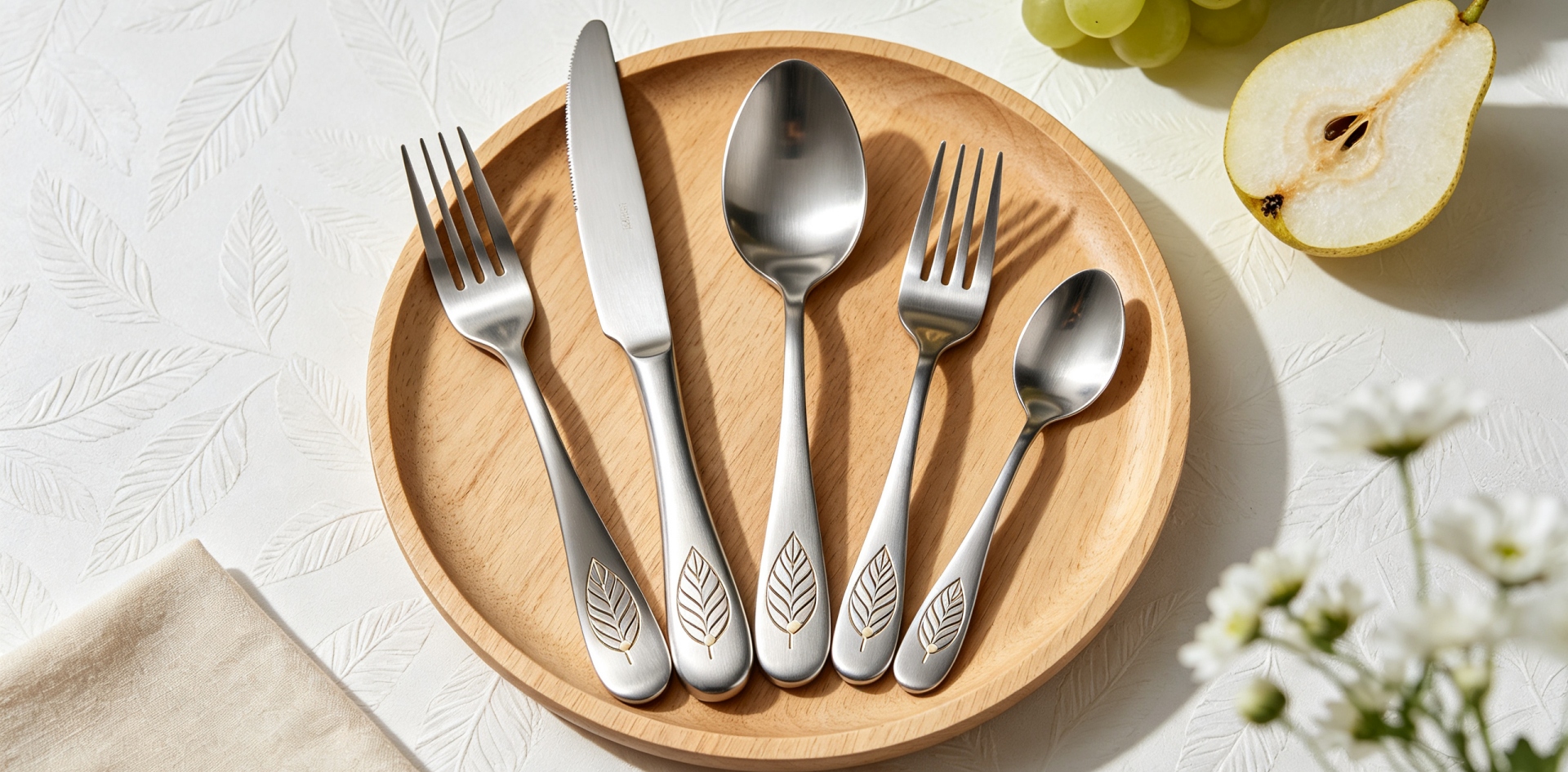
Stainless Steel Table Knife Handle Blade Alignment for OEM Manufacturing
In stainless steel table knife production, the relationship between the blade and handle is an important part of the finished product. Buyers may first notice the overall profile, surface finish or handle design, but the alignment between the blade and handle also affects how the knife looks in the hand and how consistently a collection is presented.
For OEM, ODM and private label projects, this alignment should be treated as a defined manufacturing requirement rather than something left entirely to final inspection. A small deviation can become noticeable when a large number of knives are placed together, particularly when the handle has a strong centerline or a highly recognizable decorative design.
Homefelt factory supports stainless steel knife, fork and spoon production for wholesale and bulk customers. By establishing clear alignment references during product development, the factory can help customers achieve a more consistent table knife design across samples and production batches.
What Does Handle Blade Alignment Mean?
Handle blade alignment describes the directional relationship between the main axis of a table knife handle and the blade.
A well-controlled design generally keeps the handle and blade visually coordinated along the intended center reference. The exact relationship depends on the knife design. Some models use a straight visual axis, while others intentionally introduce a slight angle or specific transition as part of the design.
The important point for OEM production is that the intended relationship should be defined before mass manufacturing begins.
Without a clear reference, different production stages may interpret the design differently. Forming, joining, grinding, polishing and finishing can all influence the final appearance.
For this reason, alignment can be included in the product drawing, sample approval criteria or manufacturing specification.
Key Parameters to Review
Several practical parameters can be used when evaluating table knife alignment.
The first is the center reference. The blade and handle should be evaluated against the intended longitudinal reference of the product rather than judged only from one viewing angle.
The second is the transition position. The point where the blade meets the handle should remain consistent with the approved design. If this position moves, the knife can appear visually unbalanced even when the overall length remains unchanged.
The third is the directional deviation. A small angular difference between blade and handle may be difficult to notice on an individual piece but become much more apparent when multiple knives are displayed together.
The fourth is the relationship between the alignment and the handle decoration. If a handle includes a logo, groove, embossed element or decorative pattern, the alignment of the blade should work with that visual reference.
These details are especially relevant to private label brands that want a recognizable and consistent collection.
Why Alignment Matters for Table Knife Appearance
Table knives are often viewed from several directions during use, storage and presentation. A deviation that is not obvious from one angle may become visible when the knife is placed beside a fork or spoon.
For hospitality projects and retail collections, visual consistency is particularly important. A set of knives with noticeably different blade directions can make the product appear less refined even if the individual pieces meet basic dimensional requirements.
Alignment also influences the perceived proportion of the knife. A correctly positioned blade can make the handle and cutting area appear balanced. If the relationship is inconsistent, the handle may look too long on one side or the blade may appear visually offset.
This is why professional flatware manufacturing considers alignment as part of the overall product specification.
Material and Construction Influence
The final alignment of a table knife is connected to its construction.
A one-piece stainless steel knife and a knife with an assembled handle may require different manufacturing controls. When separate components are joined, the position of the blade and handle needs to be established before subsequent grinding and polishing operations.
Material thickness also affects the visual transition between the components. If the blade, connecting section and handle have different dimensions, their relationship should be considered together rather than specified independently.
For custom OEM projects, Homefelt can review the intended design and identify which dimensions need to be controlled during production.
This helps convert a visual reference into measurable manufacturing requirements.
Inspection Methods for OEM Table Knives
Alignment inspection can be performed at different stages of production.
During sample development, the approved sample can establish the visual reference for the blade and handle relationship.
During production, selected dimensions and center references can be checked to identify directional deviations before large quantities move to final finishing.
At final inspection, knives can be evaluated individually and in groups. Group inspection is useful because it makes small differences easier to identify when several pieces are placed side by side.
For customers with strict requirements, the alignment criteria can be incorporated into the product specification together with material, dimensions, finish and packaging requirements.
This creates a clearer basis for repeat production and quality communication.
Homefelt Factory Experience in Custom Table Knife Production
Homefelt factory has long-term experience in stainless steel cutlery manufacturing and supports customers developing knives, forks, spoons and complete flatware collections.
For a custom table knife project, the factory can review the blade profile, handle design, connection area, material specification and finishing requirements as a complete product rather than treating each feature separately.
This engineering approach is useful when customers have their own drawings or reference samples but need assistance converting the design into a stable production specification.
Homefelt also supports wholesale and large-volume manufacturing, allowing customers to develop a product through sampling and then move toward repeat commercial orders.
Certification and factory qualification information can be provided according to project requirements. Homefelt has experience with BSCI, SEDEX 4P, BRC and ISO9001 requirements, as well as customer-specific audits and documentation.
OEM, ODM and Private Label Table Knife Programs
Different buyers may require different levels of development support.
For an OEM order, the customer may already have a complete table knife drawing and only need accurate manufacturing according to the approved specification.
For ODM development, the customer may provide a basic design direction while the factory helps refine the blade and handle relationship for production.
For private label programs, the handle and blade relationship can become part of the brand's visual identity, particularly when several cutlery pieces are designed as one coordinated collection.
Homefelt can support product development, material selection, manufacturing, packaging and transportation as a one-stop service. The service package can be adjusted according to the customer's product design, market requirements and order volume.
What Buyers Should Provide Before Quotation
To evaluate a custom stainless steel table knife project efficiently, buyers can provide:
-
Knife type and intended application
-
Stainless steel material requirement
-
Blade and handle dimensions
-
Reference drawing or sample
-
Required blade-to-handle alignment
-
Surface finish or coating
-
Logo and decoration requirements
-
Packaging specifications
-
Estimated order quantity
A simple reference drawing or existing sample can already provide useful information. If the design is still under development, Homefelt can review the concept and discuss which specifications should be confirmed before sampling.
Stainless Steel Fork Tine Side Profile for OEM and Private Label Manufacturing
Stainless Steel Cutlery Order Changes for OEM and Bulk Manufacturing
Related Article



